
Should your business rent or buy its industrial unit?
Whether to rent or buy commercial property is one of the biggest financial decisions a trading business makes, and for industrial occupiers the maths has shifte

Key takeaways
- Renting is a pure occupational cost that rises with the market at every review; buying fixes that cost at purchase and turns part of each payment into equity.
- UK multi-let rents averaged £8.40 per sq ft outside London and the South East and £16.82 within it at Q3 2024, with growth forecast at 4.6 percent a year to 2028 (Gerald Eve / Newmark).
- Owner-occupiers typically need a deposit of around 20 to 30 percent, plus stamp duty, fees and any VAT funding, and full repairing and energy compliance obligations pass to the owner.
- Buying usually wins over a long holding period in a rising rental market; renting often wins over a short one or where the deposit is working capital the trade needs.
Whether to rent or buy commercial property is one of the biggest financial decisions a trading business makes, and for industrial occupiers the maths has shifted. Industrial rents have been rising faster than most other commercial property: Gerald Eve, a Newmark company, forecasts UK multi-let industrial rental growth averaging 4.6 percent a year over 2024 to 2028 in its Multi-Let Winter bulletin 2024. A business renting its unit pays that growth every review; a business that owns its unit does not. Yet buying ties up capital, loads you with repair and compliance obligations, and reduces flexibility if the business outgrows the building.
This guide works through the decision the way we walk owner-occupiers through it: the cash flow comparison between rent and mortgage payments, the capital a purchase ties up, control and security of tenure, maintenance and energy efficiency obligations, tax treatment, and the situations where renting genuinely wins. We arrange owner-occupier mortgages on industrial units as a broker and introducer, not a lender, and nothing here is financial, legal or tax advice. Most lending of this kind to businesses is not regulated by the Financial Conduct Authority, although some agreements, for example loans secured against a borrower's home, are regulated, and we will tell you where that applies.
Should your business rent or buy its industrial unit?
The honest starting point is that there is no universal answer, only an answer for a particular business at a particular moment. Buying suits a business with stable premises requirements, predictable cash flow and a deposit it can commit without starving the trading operation of working capital. Renting suits a business that is growing or shrinking quickly, that needs its cash for stock, people or equipment, or that simply cannot find the right freehold in the right location, which in tight industrial markets is a real constraint rather than an excuse.
What has changed the calculation for industrial occupiers is the rental market itself. Industrial rents outside London and the South East averaged £8.40 per sq ft, and £16.82 per sq ft within London and the South East, on Gerald Eve (Newmark) Multi-Let Winter bulletin 2024 figures for Q3 2024, and the same bulletin forecasts growth averaging 4.6 percent a year to 2028. A tenant on a lease with regular reviews is exposed to that growth for as long as it trades; an owner has fixed its occupational cost at the point of purchase, subject only to the interest rate on its mortgage. That single difference drives much of the rest of this guide.
How do rent payments compare with mortgage payments?
The first comparison everyone makes is the monthly one: what does the lease cost against what a commercial mortgage would cost on the same building. On a typical owner-occupier mortgage the loan runs over 15 to 25 years on a repayment basis, so part of every payment is buying equity in the building rather than disappearing as an expense. Rent, by contrast, is a pure occupational cost. Even where the monthly mortgage payment is higher than the rent, the like-for-like comparison should strip out the capital repayment element, because that portion is saving, not spending.
The second comparison is what happens to each payment over time. Rent moves with the market at every review or renewal, and in industrial property the market has been moving one way; the Gerald Eve (Newmark) Winter bulletin 2024 forecast of 4.6 percent average annual multi-let rental growth to 2028 compounds to a materially higher rent within a single lease term. Mortgage payments move with interest rates, which can rise as well as fall, but a borrower can fix its rate for several years and the debt itself never grows. Our how much can I borrow calculator gives a quick first view of what a mortgage payment might look like against your current rent.
There is a third, less visible line in the comparison: rent deposits, dilapidations provisions and the professional costs of lease renewals all sit on the renting side of the ledger, while buildings insurance, mortgage arrangement fees and ongoing capital expenditure sit on the owning side. Neither column is as clean as the headline figure suggests, which is why we encourage clients to run the comparison over ten years rather than one.
| Factor | Renting | Buying (owner-occupier mortgage) |
|---|---|---|
| Monthly cost | Pure occupational expense | Part interest (expense), part capital (saving) |
| Cost over time | Rises with the market at each review | Falls in real terms as debt amortises; varies with interest rate |
| Upfront capital | Rent deposit, typically a few months | Deposit around 20 to 30 percent, plus SDLT, fees and any VAT |
| Repairs and compliance | Usually the tenant's under FRI leases | Entirely the owner's, including MEES on exit |
| Security of tenure | Lease term, with 1954 Act renewal rights and exceptions | Freehold; no landlord, reviews or expiry |
| Flexibility | High; easier to expand, contract or relocate | Lower; the building must be sold or let to exit |
| End position | Still paying rent that has compounded upwards | Owns the building outright after the term |
How much capital does buying an industrial unit tie up?
Capital is the strongest argument for renting. An owner-occupier buying an industrial unit should expect to put down a deposit of around 20 to 30 percent of the purchase price as an indicative range, with the strongest trading businesses at the lower end. On top of the deposit sit stamp duty land tax, valuation and legal fees, arrangement fees and, where the seller has opted to tax the building, VAT to fund at completion even if it is later recovered. Our deposit and LTV calculator shows how the deposit moves with price and loan to value.
The right question is not whether the business can find that money but what the money would otherwise do. For a distributor or manufacturer earning strong returns on stock and machinery, pulling six figures out of working capital to buy a building can be the wrong trade even when the mortgage payment beats the rent. For a business holding surplus cash earning very little, the same purchase can be the best return available to it. This is a conversation for your accountant as much as for us, and it deserves real numbers rather than instinct.
It is also worth knowing that the deposit does not always have to be cash. Lenders will sometimes take additional security over other property the business or its directors own, and directors' pension funds can in some circumstances buy premises through a SIPP or SSAS structure with the business as tenant, which changes the analysis entirely and needs specialist pension and tax advice before anything else.
What control and security of tenure does ownership give you?
A business that owns its industrial unit is the freeholder, which means no landlord, no rent reviews, no lease expiry and no risk of being asked to leave a site it has spent years building its operation around. For businesses with heavy fixed plant, spray booths, cranage, three phase upgrades or specialist fit-out, that permanence has a hard cash value: relocating that kind of kit is expensive and disruptive, and a landlord knows it at every rent review. Tenants under the Landlord and Tenant Act 1954 often have renewal rights, but those rights have exceptions, including redevelopment, and industrial land in strong urban locations is exactly where redevelopment pressure concentrates.
Control extends beyond tenure. An owner can extend the building, add a mezzanine, re-clad, install solar panels, sublet spare space for income or alter the use, all subject to planning rather than a landlord's consent. The building can also become a retirement asset: many of the owner-occupiers we work with eventually sell the trading business and keep the unit, leasing it back to the buyer or letting it on the open market. Workshop and small unit stock of that kind stays in demand precisely because so little of it is built; our guide to workshop finance covers that segment in more detail.
Who pays for maintenance, repairs and MEES compliance?
Ownership transfers every repairing obligation to you. The roof, the gutters, the yard, the roller doors, the electrics and the fire systems are all the owner's cost, and on older industrial stock those costs are lumpy and badly timed. Renting does not make these costs vanish, though: most industrial leases are on full repairing and insuring terms, under which the tenant maintains the property and hands it back in repair, with a dilapidations claim at lease end to settle the difference. Many tenants discover that they were already paying for the building's upkeep without owning any of it.
Energy efficiency is the obligation that deserves the most attention before a purchase. Under the Minimum Energy Efficiency Standards, a commercial building generally cannot be let with an EPC rating below E, and government policy has signalled tightening over time. An owner-occupier is not letting the building, so MEES does not bite day to day, but it bites on exit: a unit you cannot legally let without upgrade works is worth less to the investors and tenants who form your future market. Pricing the cost of bringing an older unit to a resilient EPC rating belongs in the purchase appraisal, and lenders increasingly ask the same question during underwriting.
Our practical advice is to commission a proper building survey and an EPC review before committing, then hold a maintenance reserve alongside the mortgage. Owners who budget a sensible annual figure for upkeep rarely regret buying; owners who treat the purchase price as the whole cost sometimes do.
How does tax treatment differ between renting and buying?
Rent is straightforward: it is a trading expense, deductible against profits in full as it is paid. Buying splits the cost into pieces that behave differently. Mortgage interest is generally deductible as a business expense, but capital repayments are not. The building itself is not written off against profits in the way rent is, although capital allowances, including allowances on integral features such as electrical and heating systems, can shelter part of the cost, and stamp duty land tax is payable on the purchase. If the seller has opted to tax, VAT arises on the price and usually comes back through the VAT return, but it has to be funded in the meantime.
Ownership also creates choices that renting never raises: whether the company, the directors personally, or a pension scheme should own the building, each with different income tax, corporation tax, capital gains and inheritance tax consequences. A pension purchase through a SIPP or SSAS, for example, can mean the business pays rent into its directors' own pension fund; the specialists at SIPP Property Finance cover that route in depth. All of this is squarely accountant territory. We arrange the finance to fit the structure your advisers recommend; we do not advise on which structure to choose.
When does renting an industrial unit win?
Renting wins when flexibility is worth more than equity. A business doubling headcount every two years should not anchor itself to a unit it will outgrow before the mortgage rate fixes expire, and a business in a cyclical trade may value the ability to shrink its footprint in a downturn more than any amount of capital appreciation. Renting also wins when the deposit would come out of working capital the trade actually needs, when the right buildings in the right location simply never come up for sale, and when a short commitment is needed while a longer term plan, a relocation or an acquisition, plays out.
It can also win on the numbers in the short run. In markets where capital values are high relative to rents, the total cost of buying, once stamp duty, fees, maintenance and the opportunity cost of the deposit are counted, can exceed renting for several years before the crossover arrives. The crossover usually does arrive, because rents grow and mortgage debt amortises, but a business that may not occupy the unit beyond five years should not assume it will be there to collect the benefit. The decision is a holding period question as much as a monthly cost question.
A worked rent vs buy comparison
The following comparison is illustrative only; it is not a quote, the rates and prices are assumptions, and real terms depend on the borrower, the building and the market at the time. Take a 5,000 sq ft unit in a regional market renting at £8.40 per sq ft, the Q3 2024 multi-let average outside London and the South East on the Gerald Eve (Newmark) Winter bulletin 2024. That is rent of £42,000 a year, or £3,500 a month, before service charge and insurance, and before any growth at review.
Now suppose the same unit could be bought for £550,000. A 30 percent deposit is £165,000, leaving a £385,000 loan. On an illustrative 20 year repayment mortgage at an assumed 7 percent, the payment is roughly £2,990 a month, or about £35,800 a year, of which around £27,000 is interest in the first year and the balance is capital repayment. On these assumptions the mortgage payment is lower than the rent from day one, the deductible interest element is lower still, and after 20 years the business owns the building outright while the renting business is still paying rent that has compounded upwards in the meantime.
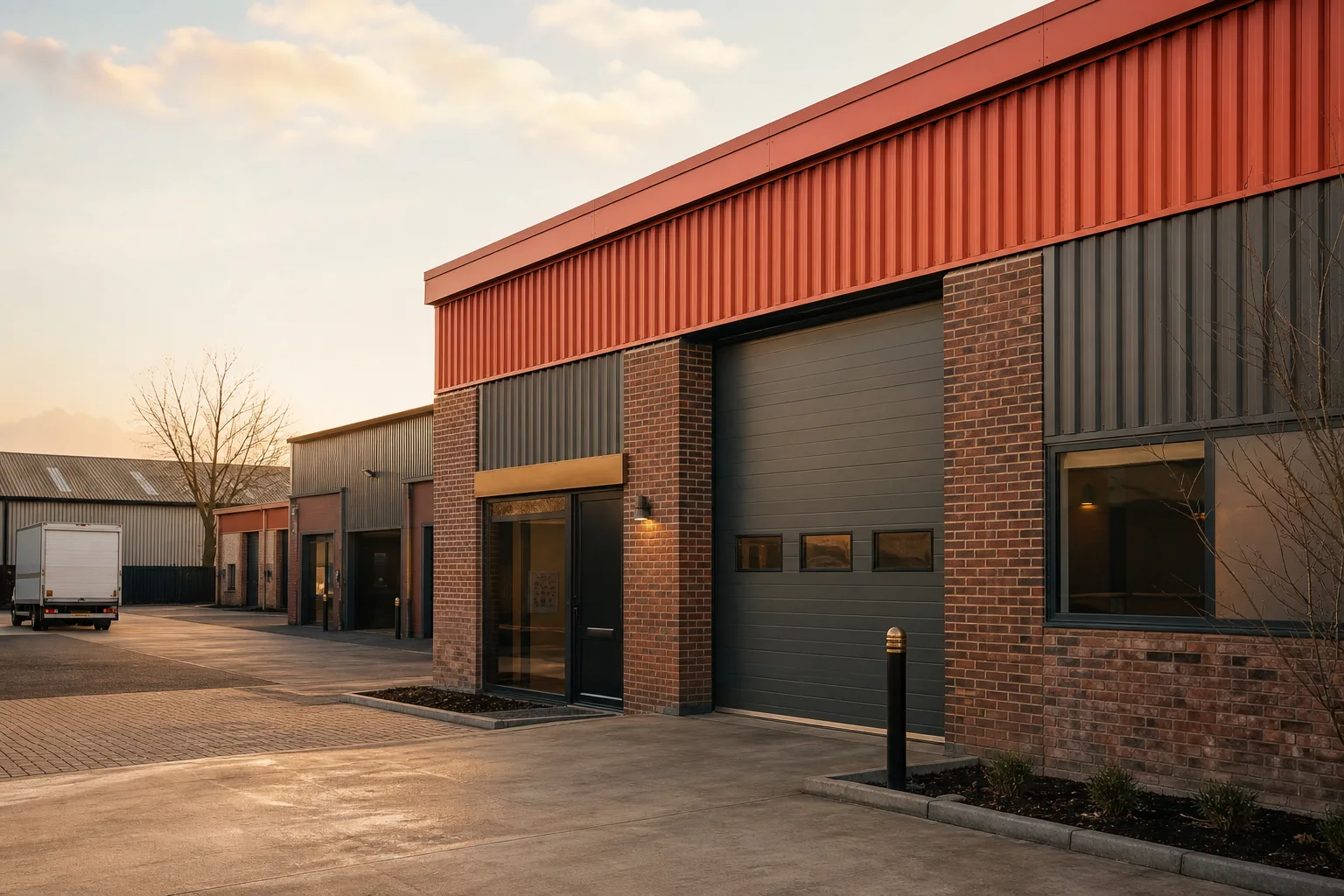
The buyer's side must also absorb stamp duty and fees at purchase, repairs and insurance every year, and the lost return on the £165,000 deposit, and a rise in interest rates would narrow or reverse the monthly gap. That is the genuine shape of the decision: buying usually wins over a long holding period in a rising rental market, renting often wins over a short one. We arrange owner-occupier mortgages across high street, challenger and specialist lenders, and we are happy to run this comparison on your actual numbers before you commit either way.
Renting vs buying an industrial unit: common questions
What is the 2 percent rule for property?
The 2 percent rule is an American residential rule of thumb suggesting monthly rent should be at least 2 percent of the purchase price. It has little relevance to UK commercial property, where pricing works off annual yield: the rent as a percentage of the price per year, not per month. UK industrial investments typically trade at single digit yields, and an owner-occupier decision is better tested with a full rent versus mortgage comparison than with imported shorthand.
Is buying commercial property a good idea for a business?
It can be, where the business has stable premises needs, a deposit it can spare from working capital, and a long enough holding period to collect the benefit of fixed occupational costs and amortising debt. It is a poor idea where flexibility matters more than equity or where the deposit would starve the trade of cash. The tax and ownership structure questions belong with your accountant, and nothing in this guide is financial advice.
What is the outlook for commercial property in 2026?
We do not make predictions, but the published data leans industrial. The MSCI UK Quarterly Property Index Q4 2025 results show UK industrial delivering a 7.2 percent total return over the 12 months to December 2025, with standard industrial outside the South East the strongest of all property segments at 9.4 percent, and Gerald Eve (Newmark) forecasts multi-let rental growth averaging 4.6 percent a year over 2024 to 2028. Past performance does not guarantee anything about 2026.
How much deposit does a business need to buy its own premises?
As an indicative range, owner-occupiers typically put down 20 to 30 percent of the purchase price, with strong trading businesses at the lower end and weaker covenants or unusual buildings at the higher end. Stamp duty, fees and any VAT funding sit on top. Some lenders will reduce the cash requirement against additional security. Our commercial mortgage deposit guide covers the detail, and terms always depend on the lender's assessment of your business.
Can my pension fund buy my industrial unit?
Sometimes. A SIPP or SSAS can purchase commercial property, including industrial units, and lease it back to your business at a market rent, which turns your occupational cost into pension contributions in economic effect. The rules on borrowing, valuation and connected party transactions are strict, and the suitability question is one for a regulated pension adviser and your accountant, not for us. We arrange the property finance side once the structure is decided.
Ready to talk about a real deal?
Send us the deal and we will come back with a view on fundability and likely terms within one working day.