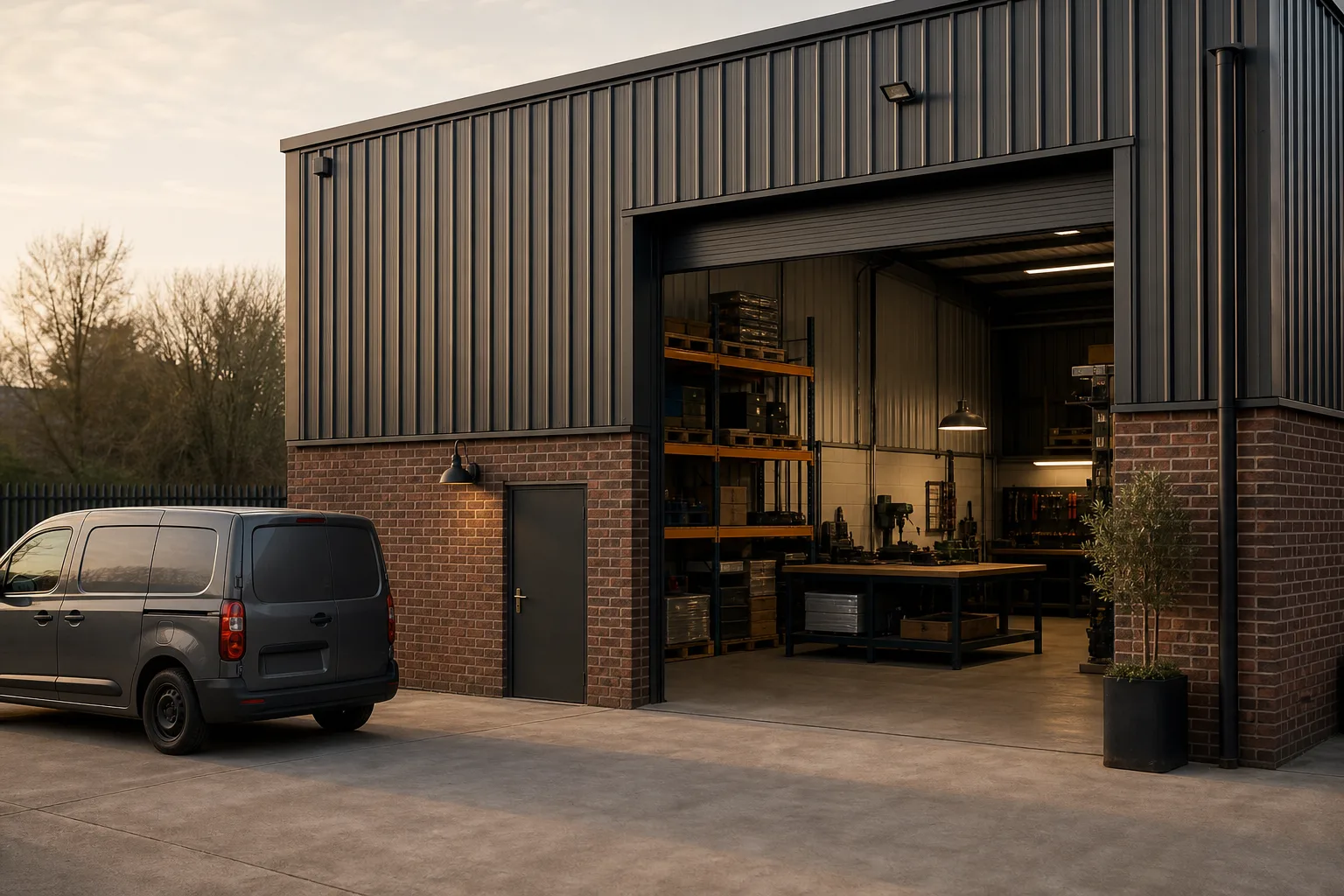
Workshop and light industrial unit finance
Funding for the classic small unit: workshops, vehicle repair premises and light industrial space, bought by the businesses that use them and the investors that let them.

Funding workshops
A light industrial unit is a small industrial building used for workshop, light manufacturing, assembly, repair or storage purposes, typically with a roller shutter door, a small office or trade area, three-phase power and a modest yard or forecourt. These are the units that house vehicle repairers and MOT stations, joiners and fabricators, makers and finishers, equipment hirers and a long tail of small businesses that need affordable workspace close to their customers. They are the most numerous building type in UK industrial property and the natural entry point into owning it.
The finance splits along a line that defines the whole market: owner-occupiers buying premises for their own business, and investors buying units to let. An owner-occupier borrows against the strength of the trading business, indicatively up to 70 to 80 percent of the property's value; an investor borrows against the rent, indicatively up to 65 to 70 percent, with interest cover tested off the net income. We arrange both, from a single £150k workshop upward, acting throughout as arranger and introducer rather than lender.
What we fund
- Single workshops and starter units from around 1,000 sq ft upward
- Vehicle repair, MOT and bodyshop premises with B2 consent
- Terraces of small units let to local SME occupiers
- Owner-occupied premises for trades, makers and fabricators
- Tired units bought for refurbishment, EPC upgrade and re-letting
Indicative terms
- Typical lot size (indicative)From around £150k for a single unit
- Owner-occupier LTV (indicative)Up to ~70 to 80%
- Investment LTV (indicative)Up to ~65 to 70% of valuation
- Term rates (indicative)From around 6%
Indicative only. Terms vary by lender, asset and borrower and are not an offer of finance.
How do you finance buying a workshop or light industrial unit?
For a business buying its own premises, we arrange owner-occupier commercial mortgages sized on the trading accounts: the lender tests that the business's earnings comfortably cover the repayments, then advances indicatively up to 70 to 80 percent of the property's value at rates from around 6 percent. For investors we arrange investment mortgages against the rent, indicatively up to 65 to 70 percent loan to value with interest cover tested on net income. Where a unit needs work before it can be occupied or let, or where an auction deadline rules out a conventional mortgage, bridging finance carries the purchase and refurbishment, indicatively up to 65 to 75 percent of cost on the works side, with the exit onto term debt once the unit is occupied. We arrange and introduce across all of these routes; we are not a lender.
Which lenders fund small industrial units?
Small industrial units enjoy some of the broadest lender coverage in commercial property. High street banks compete hard for owner-occupier borrowing because it is business lending secured on premises the borrower depends on, which is among the best-performing credit they write. Challenger banks and specialist lenders extend the market to investors, to units needing refurbishment, and to borrowers whose accounts or asset are less straightforward, including older units, units with B2 general industrial use and premises with mixed yard and workshop layouts. Underwriting differs by route. For owner-occupiers the accounts lead: sustainable earnings, the rent currently being paid that the mortgage replaces, and the durability of the trade. For investors the unit leads: location, specification, EPC position and the depth of local occupier demand if the current tenant leaves. We match the borrower to the lenders genuinely competitive for their specific case.
What is the market for workshops and small units?
The defining strength of this asset class is the depth of demand beneath it. Small units serve the broadest occupier base in commercial property, and supply has tightened for years as older estates are redeveloped and replacement stock of genuinely small, affordable units is rarely built. For an owner-occupier the exit is simply the property itself: premises that hold value, can be sold to another business or an investor, and often end up in a pension to be leased back to the company. For an investor the exits are the standard ones, sale into a liquid private investor market or refinance on the income, both supported by the owner-occupier demand that puts a floor under small unit values. Lenders know that floor exists, which is a quiet but real part of why this stock funds so readily.
Finance that suits this asset class
- Commercial mortgagesOwner-occupier and investment term debt on small units.
- Bridging financeAuction purchases and units needing work before term debt fits.
- RefinanceReleasing equity or improving terms on units already owned.
Useful calculators
Related guides
Fund a workshops deal
A view on fundability within one working day.
What is a light industrial unit?
A light industrial unit is a building designed for industrial processes that can be carried out in or near residential areas without harm to local amenity, which is the planning definition behind Class E(g)(iii) light industrial use. In practice that means workshops, assembly and finishing space, repair premises, small-scale manufacturing and tech or maker uses, housed in simple steel or brick buildings with roller shutter access, three-phase power and floor space that adapts to whatever the occupier does. Heavier processes that generate noise, fumes or vibration fall instead into Class B2 general industrial, and storage-led uses into Class B8.
The size spectrum runs from sub-1,000 sq ft starter units through the standard 1,500 to 5,000 sq ft workshop range that most small businesses occupy, up to units of 10,000 sq ft or so before the market starts describing them as small warehouses. At the far end of that spectrum sit big-box logistics and distribution sheds, a different market with different lenders, which we cover on our distribution and logistics warehouses pages, with our sibling site Warehouse Property Finance on the very largest. Within the light industrial range itself, the use class on the consent matters as much as the floor area, because it determines who can legally occupy the unit and therefore what it is worth.
Can you get a mortgage to buy a workshop for your own business?
Yes, and owner-occupier purchases are the heart of this market. A trading business buying its own unit borrows on a commercial mortgage sized against its accounts, with lenders testing that earnings cover the repayments with headroom, indicatively advancing up to 70 to 80 percent of the property's value. For an established business currently renting, the comparison is often direct: the mortgage payment sits near the rent being paid anyway, while the business swaps a landlord's lease events for an asset on its own balance sheet.
The occupier profile is exactly the one lenders like. Vehicle repairers and MOT stations, joiners, fabricators, signmakers, engineers and equipment specialists tend to stay in their premises for decades, because the kit is heavy, the customer base is local and moving is costly. Many structure the purchase through a pension, with a SIPP or SSAS buying the unit and leasing it back to the company, or buy in a holding company for the same separation of trade and property. We arrange the debt around whichever structure the borrower's accountant recommends.
What do lenders look for in the unit itself?
The physical checklist is consistent: clear working height and eaves, a roller shutter door a vehicle or forklift can actually use, three-phase power for machinery, sensible loading and parking, and a yard or forecourt where the use needs one. Construction and condition follow, with lenders alert to asbestos roofs on older stock, floor condition and anything that limits how the next occupier could use the space. None of these is exotic, but together they decide whether a valuer sees a readily lettable unit or a problem.
Two items carry growing weight. EPC rating matters because MEES rules restrict letting poorly rated commercial buildings, so an investor's unit with a weak EPC faces a compliance cost the lender will want planned and often funded. And use class matters because it defines the occupier pool: a unit with B2 general industrial consent can house vehicle repair, MOT and bodyshop uses that E(g)(iii) light industrial consent alone may not support, which makes B2 units quietly valuable to exactly the trades that buy their own premises. We present both points up front because they shape valuation, leverage and pricing.
How is an investment purchase of workshops underwritten?
An investor buying a workshop or a terrace of small units borrows against the rent, and the lender's questions are about the durability of that rent. Interest cover is tested on net income after the costs small unit landlords carry, leases are read for length and repairing terms, and the tenant's business is considered, though on small units lenders lean less on covenant strength and more on re-letting depth, because the realistic security is how quickly the unit lets again if the tenant goes.
That makes location and specification the real underwriting. A standard unit on an established estate near a town with a broad trade economy re-lets quickly, and lenders advance toward the top of the indicative 65 to 70 percent range against it. An awkward unit in a thin market funds more cautiously whatever the current lease says. The strongest investment cases often involve modest work: buying a tired unit, refurbishing it, lifting the EPC and re-letting at a better rent, with the works funded indicatively up to 65 to 75 percent of cost and the whole position refinanced onto term debt at the new income.
Should a small business rent or buy its industrial unit?
Renting preserves cash and flexibility, which suits young businesses whose space needs are still moving. Buying converts rent into loan repayments that build equity, fixes occupation costs against a market where small unit rents have a long record of drifting upward as supply tightens, and gives the business an asset it can later sell, mortgage or hold in a pension. The right answer is specific to the trade, the premises and the stage of the business, not a universal rule.
Where buying makes sense, the deposit is usually the constraint rather than affordability, since the mortgage payment often lands near the rent already being paid. That is where structuring earns its keep: a stronger trading record can lift the loan to value, additional security can reduce the cash required, and pension funds the directors already hold can sometimes provide part of the purchase price through a SIPP or SSAS structure. We work those options through with the borrower and their accountant before approaching lenders, so the application lands once, in its best form.
Worked example: a vehicle repair business buys its own unit
Take an illustrative purchase: a vehicle repair business renting at £24k a year buys its 3,500 sq ft unit, with B2 consent and an MOT bay, when the landlord offers it for £350k. These figures are illustrative only, not a quote, and any real facility would be sized on the actual business, premises and valuation.
An owner-occupier mortgage at 75 percent of the £350k value advances £262,500, leaving a deposit of £87,500 plus costs. The lender underwrites the garage's accounts, noting that several years of stable earnings already absorb £24k of rent, so servicing a mortgage of a broadly similar annual cost requires no leap of faith. The B2 consent and the MOT bay support the valuation, because they widen the pool of trades that would buy or rent the unit in future.
The business now owns its premises on repayments close to its old rent, with every payment building equity instead of leaving as rent. Later options include refinancing to release funds for equipment, or transferring the unit into the directors' pension and leasing it back to the company. Both are easier because the original loan was placed with a lender comfortable with the asset and the trade.
Illustrative worked example only. Figures vary by lender, asset and borrower and are not an offer of finance.
Frequently asked questions
What is a light industrial area?
A light industrial area is a part of a town or city zoned and developed for light industrial uses: estates and terraces of workshops and small units housing trades, repair businesses, makers and storage users. Planning policy places these areas where business activity will not harm residential amenity, which is the same test that defines light industrial use itself.
Can I run an MOT garage or vehicle repair business from a light industrial unit?
Vehicle repair and MOT testing usually need Class B2 general industrial consent rather than light industrial use alone, because of the noise and processes involved. Units with established B2 use are sought after by motor trades for exactly this reason, and lenders treat a clean consent matching the intended use as a basic requirement of the loan.
Is paying around £1,000 a month in rent for a unit good value?
It depends entirely on the unit's size, location and specification, so the better question is what the same monthly outlay would service as a mortgage. For an established business, a payment in that region can often support borrowing toward the price of a small unit, which is why we encourage occupiers to compare renting against buying before renewing a lease.
Is a commercial mortgage on my own business premises regulated?
A commercial mortgage to a business on the premises it trades from is generally an unregulated commercial contract. Regulation can apply where the security includes a dwelling, for example a unit with a flat above that the borrower occupies, and lenders check this at the outset. We arrange and introduce finance; we are not a lender, and we are not providing regulated mortgage advice.
Funding a workshops asset?
Tell us about the deal and we will come back with a view on fundability and likely terms.