Hybrid and flex industrial space finance
Funding for hybrid units that mix office, showroom and studio space with industrial floor, and for the flex workspace schemes built on them.

Funding hybrid and flex
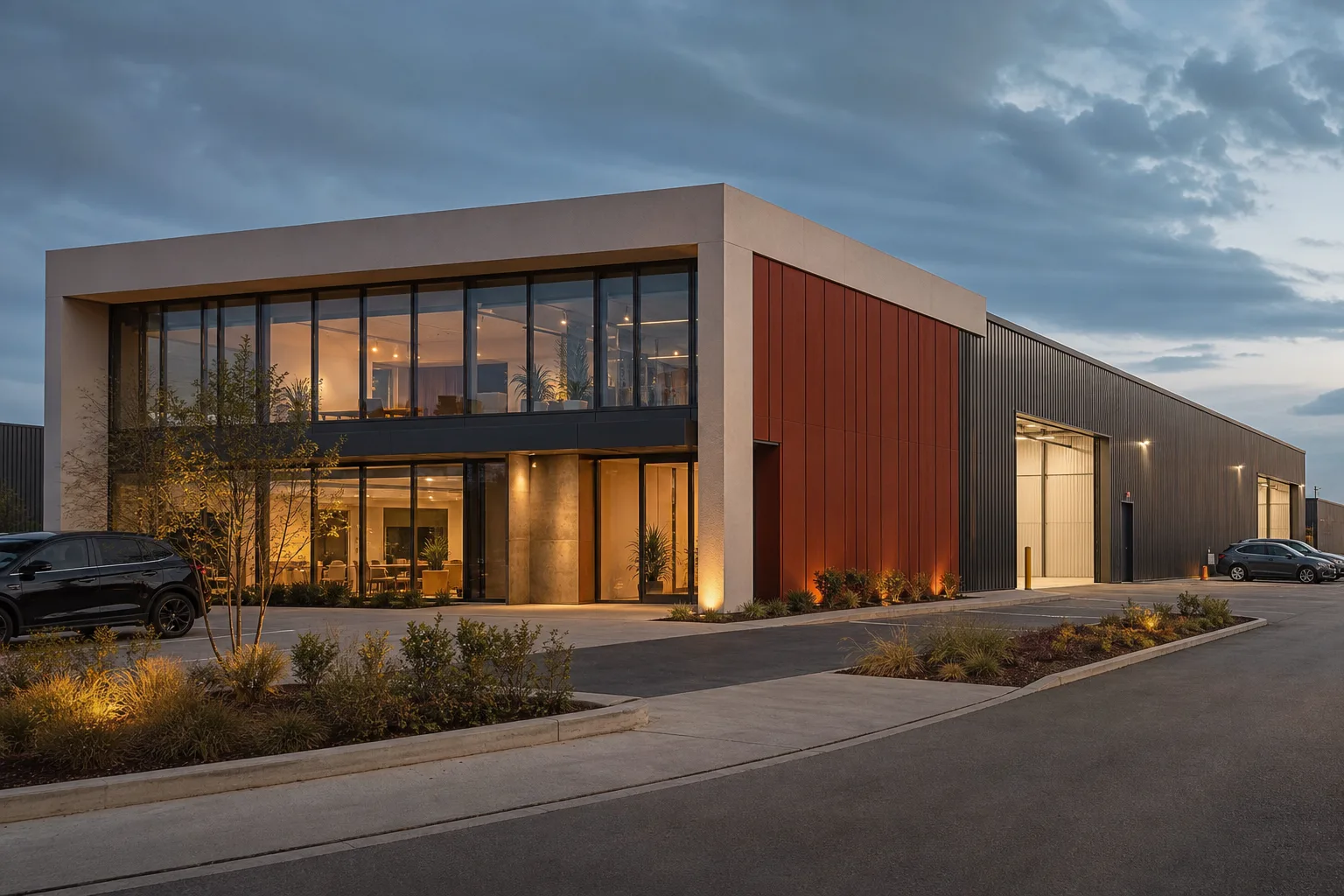
A hybrid industrial unit is a building that combines a meaningful amount of fitted office, showroom or studio space with industrial floor under one roof, typically as a two-storey glazed front section over and beside a workshop or warehouse area with its own loading door. The format suits businesses that design, sell and make in the same place: product companies with a showroom over the workshop, R&D firms pairing lab and assembly space, e-commerce brands running content, customer service and despatch together, and creative occupiers in studio workshop schemes.
Flex space takes the same physical idea and adds an operating model: a landlord or operator runs the building as managed workspace, letting units and studios on short, simple agreements with services included, the approach BizSpace and Flexspace built businesses on. That shift changes the finance. A hybrid unit let on a conventional lease funds like any industrial investment; a flex scheme produces operational income that lenders read more like serviced workspace, with a narrower lender field and underwriting closer to a trading business. We arrange debt across both, as arranger and introducer rather than lender.
What we fund
- Hybrid units pairing fitted offices or showrooms with industrial floor
- Studio workshop schemes let to makers and creative businesses
- Managed and flex workspace estates run on licence agreements
- Owner-occupied hybrid premises for design and make businesses
- Conversions and refurbishments creating flex space from tired stock
Indicative terms
- Typical lot size (indicative)£400k to £15m and above
- Investment LTV (indicative)Up to ~65 to 70% on conventional leases
- Refurbishment funding (indicative)Up to ~65 to 75% of cost
- Term rates (indicative)From around 6%
Indicative only. Terms vary by lender, asset and borrower and are not an offer of finance.
How is hybrid and flex industrial space financed?
The structure follows the income. A hybrid unit let to one tenant on a conventional lease supports a standard investment mortgage, indicatively up to 65 to 70 percent loan to value at rates from around 6 percent, and an owner-occupier buying a hybrid unit for its own business borrows on its accounts, indicatively up to 70 to 80 percent. A flex or managed workspace scheme is different: the income arrives through many short agreements and includes a service element, so lenders size debt on the scheme's sustainable net operating income, usually at more conservative leverage, and they underwrite the operator as much as the building. Where the plan is to create flex space by refurbishing tired stock, we arrange the works funding at indicatively up to 65 to 75 percent of cost, with bridging where timing demands it, and the refinance onto term debt once the income has built. Throughout we arrange and introduce; we do not lend.
Which lenders fund flex industrial schemes?
The lender field splits cleanly. Hybrid units on conventional leases sit within ordinary commercial investment appetite, and most banks active in industrial property will quote, with the usual attention to the unit, the tenant and the rent. Flex and managed workspace schemes draw from a narrower pool: lenders comfortable underwriting operational income, often the same teams that consider serviced offices and other operational property, because the analytical problem is the same. They test occupancy history and churn across the agreements, the achieved rate for space and services, the cost base of running the scheme, and the gap between gross receipts and the net operating income that actually services debt. Operator capability is underwritten alongside, since the income only persists if lettings, billing and service delivery keep running. The narrower field is not a closed one; schemes with a trading record and clean management accounts fund well. Our work is presenting that record in the form an operational credit team expects, and approaching only the lenders genuinely active in it.
What is the market for hybrid and flex space?
Demand for hybrid and flex space draws on a structural change in how small businesses occupy property: more of them want offices, showrooms and workspace in the same building, on terms that flex as they grow, and conventional stock offers little of either. Studio workshop schemes in urban areas let strongly to makers and creative businesses, while managed workspace operators have shown the model works at scale across regional estates. For owners the exits follow the two income types. A conventionally let hybrid unit sells into the ordinary industrial investment market or refinances on its lease income. A stabilised flex scheme can sell to specialist operators and investors who buy on operational earnings, refinance against its trading record, or revert to conventional lettings if that ever prices better. The asset's flexibility is itself the safety net, and lenders give credit for it.
Finance that suits this asset class
- Commercial mortgagesTerm debt on hybrid units and stabilised flex scheme income.
- Development financeFunding conversion and refurbishment works against cost.
- RefinanceMoving onto term debt once flex income is proven.
Useful calculators
Related guides
Fund a hybrid and flex deal
A view on fundability within one working day.
What is a hybrid industrial unit?
A hybrid industrial unit is a single building that deliberately mixes use types: fitted office, showroom or studio space, usually glazed and heated to office standard, combined with industrial floor served by a loading door. The common formats are a two-storey office front over a workshop, a showroom wrapping the front of a warehouse, and studio space above ground-floor making or storage areas. Planning treats most of this within Class E(g), which covers offices, research and development and light industrial use in one class, giving hybrid buildings unusual freedom to rebalance between uses without a planning application.
The format answers a real occupier problem. A product business does not want its design team in one building and its assembly bench in another; an e-commerce brand wants the studio, the stock and the despatch desk together. Conventional industrial property serves none of this well, and conventional offices serve it worse. Hybrid units fill the gap, which is why well-specified examples let quickly and why the format has attracted both developers and the managed workspace operators who run it as flex space.
How does flex workspace income change the underwriting?
A conventional industrial loan is underwritten on a lease: one document, one tenant, a rent that arrives quarterly whatever the landlord does. A flex scheme replaces that with operational income, namely dozens of short licence and lease agreements, service charges and sometimes meeting room, storage and virtual services revenue, all of which exists only because the operator keeps letting space and serving customers. Lenders respond by underwriting the scheme the way they underwrite a trading business: sustainable net operating income after running costs, evidenced over time, with sensitivity to occupancy dips.
The practical consequences are predictable and manageable. Leverage on operational income sits below what an equivalent conventionally let asset would carry, the diligence asks for management accounts and occupancy schedules rather than a single lease, and lender selection matters far more, because most industrial lending teams simply do not hold the mandate for it. The compensation is on the income side: well-run flex schemes achieve materially more per square foot than a single lease on the same building would, and a scheme with a proven trading record can refinance on terms that recognise it. We set the leverage expectation honestly at the start, then place the deal where operational income is genuinely understood.
Who occupies hybrid and flex industrial space?
The occupier base is the widest of any industrial format because the building meets several needs at once. Product and design businesses take hybrid units for the showroom and workshop pairing; engineering and R&D firms use the office and lab over the test floor; e-commerce brands run studio, stock and fulfilment from one address; and makers, framers, ceramicists and small food producers fill studio workshop schemes in urban areas. Tradespeople and service businesses take the smaller units for the same reason they always have: somewhere affordable, secure and close to customers.
For a lender this breadth converts directly into re-letting depth, the question behind every industrial credit decision. Flex agreements churn by design, so what matters is how quickly space re-lets and at what rate, and schemes in dense catchments answer that with their own letting history. One boundary is worth drawing: this is the small and mid-sized end of the market, and where a requirement is really a single large distribution unit, big-box logistics sheds are set out on our distribution and logistics warehouses pages, with our sibling site Warehouse Property Finance on the very largest. Within its own range, a well-located hybrid scheme rarely waits long for occupiers.
What do lenders test on the building itself?
The first question is the balance between office and industrial content, because it drives both value and risk. A unit that is mostly industrial floor with a sensible office front values on industrial evidence and re-lets readily; a building that is mostly office with a token loading door starts to be judged as secondary office space, a harder market with stricter expectations. Valuers and lenders look at the realistic alternative uses, and the most fundable hybrid buildings are the ones that could revert to straightforward industrial occupation without major surgery.
Specification questions follow from the dual character. The industrial element is tested as usual: working height, loading access, power and yard. The office and studio element brings its own list: natural light, heating and cooling, and above all EPC trajectory, since fitted office space faces the same MEES tightening as any office building and a flex operator's covenant to its customers depends on comfortable, compliant space. Refurbishment plans that lift EPCs and reconfigure space flexibly strengthen the credit, and we arrange works funding within the facility where the plan calls for it.
How do you fund creating flex space from existing units?
Most flex schemes are made, not built: an investor or operator takes a tired estate or a plain industrial building and converts it, subdividing space, adding fitted offices and studios, upgrading services and branding the scheme. The funding runs in the staged way conversion projects always do. The purchase is carried on bridging or acquisition finance if the building is part-vacant or the income is short, the works are funded against cost, indicatively up to 65 to 75 percent, and the position refinances onto term debt once lettings have built a provable net operating income.
The credit hinges on the letting-up assumptions, so we have them evidenced rather than asserted: local demand for studio and small workspace, achieved rates at comparable schemes, and a cost base that survives contact with real occupancy. Operators with an existing scheme bring their own trading record, which materially widens the lender field for the next one. First-time operators can still fund, usually at more conservative leverage, sometimes with mezzanine or joint venture capital completing the stack. We structure the first scheme so its record becomes the borrowing power behind the second.
Worked example: converting a tired terrace into managed flex space
Take an illustrative project: an operator buys a part-vacant terrace of six plain industrial units for £1.6m and plans £500k of works, creating fitted studio offices over the workshop floors and rebranding the terrace as managed flex workspace. These figures are illustrative only, not a quote, and any real facility would be sized on the actual asset, costings and trading record.
The purchase runs on a bridging facility at 70 percent of the price, advancing £1.12m, with the works funded against cost as the conversion proceeds unit by unit, so the let units keep producing income through the programme. Agreements are written on simple flexible terms with services included, and the operator's management accounts track occupancy, achieved rates and running costs from the first letting.
Suppose that after two years the scheme runs at strong occupancy and produces around £230k of net operating income after costs. A term facility sized on that operational income refinances the bridge and the works funding, at leverage more conservative than a conventionally let asset would carry but against income materially higher than the old passing rent. The operator now holds a trading record that funds the next scheme, which is the real return on structuring the first one properly.
Illustrative worked example only. Figures vary by lender, asset and borrower and are not an offer of finance.
Frequently asked questions
What use class covers hybrid industrial units?
Most hybrid space sits within Class E(g), which brings offices, research and development and light industrial use into a single class, so a building can rebalance between office and workshop content without a change of use. Heavier processes need Class B2 and storage-led uses Class B8, so the consent should always be checked against what the occupier actually does.
Is a hybrid unit valued as office or industrial property?
Usually as industrial property with an enhanced specification, provided the industrial floor remains the dominant element and the building could revert to ordinary industrial use. Where office content dominates, valuers begin comparing it with secondary offices instead, which changes the evidence base and usually the lending terms, so the balance of space matters to the finance.
Can flex workspace licence income support a commercial mortgage?
Yes, once it is proven. Lenders treat licence and short-agreement income as operational, sizing debt on the scheme's sustainable net operating income evidenced through management accounts, usually at more conservative leverage than a conventional lease would support. A stabilised scheme with a clean trading record funds well with the right lender; the field is simply narrower.
Is lending on flex and hybrid industrial space regulated by the FCA?
Lending to companies, investors and operators secured on commercial workspace is generally an unregulated commercial contract. Regulation can be engaged in specific situations, for instance where a loan to an individual is secured on a property that includes a dwelling they occupy. We act as arranger and introducer, not as a lender, and each lender applies its own permissions.
Funding a hybrid and flex asset?
Tell us about the deal and we will come back with a view on fundability and likely terms.