Trade counter finance
Funding for trade counter units and trade parks, where national trade brands on long leases meet roadside industrial property.

Funding trade counters
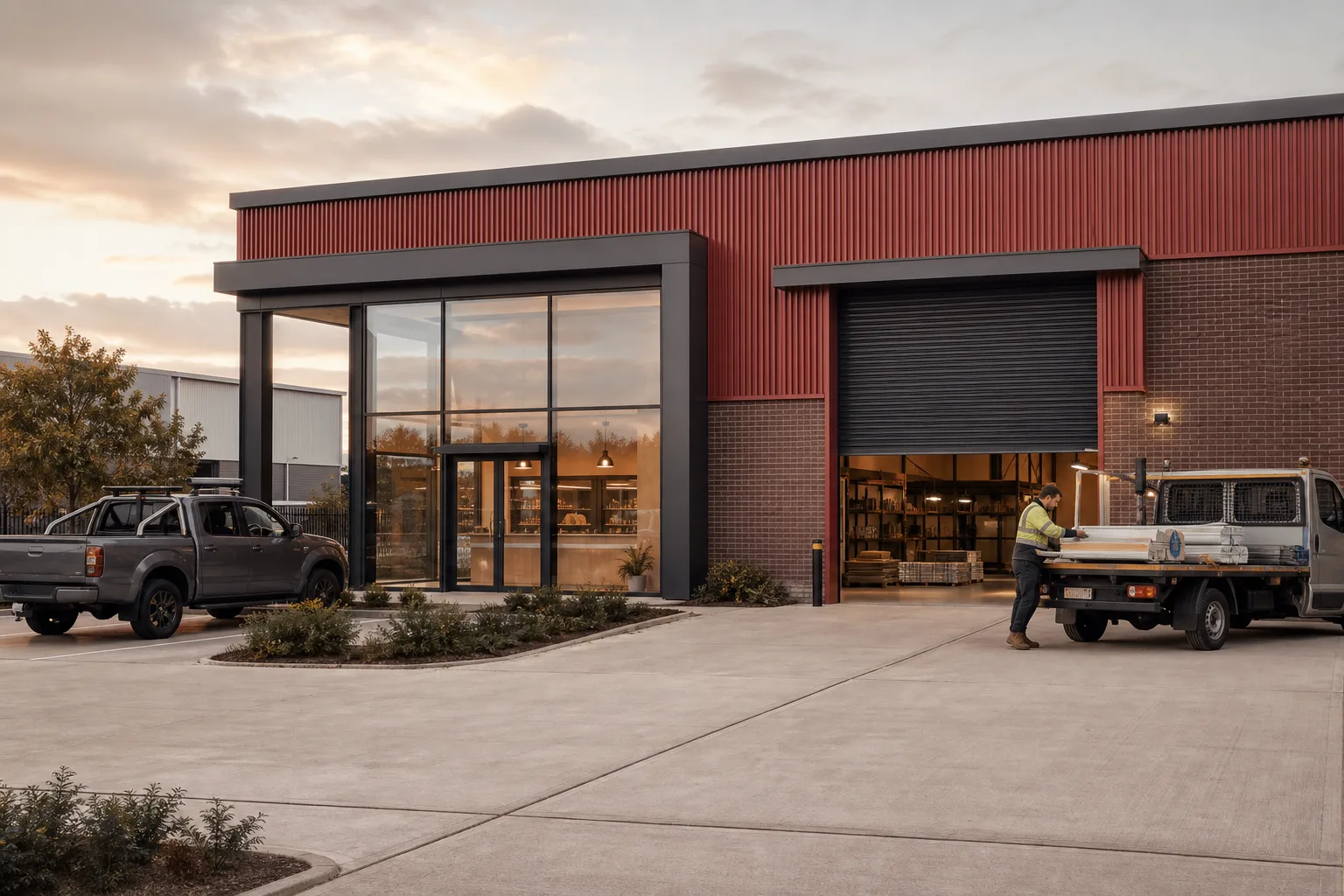
A trade counter is an industrial unit with a sales counter and showroom at the front, selling building materials, tools, plumbing, electrical and similar goods primarily to trade customers, with warehouse space and customer parking behind. The occupiers are the format's defining feature: national brands of the Howdens, Screwfix and Toolstation class take these units in volume, on leases that are typically longer and on covenants that are typically far stronger than the SME tenancies found on a standard industrial estate. A trade park is simply a terrace or cluster of these units sharing a prominent roadside site.
For lenders that combination is attractive and unusual in equal measure. The income can read almost like long-dated retail warehouse income, with a national covenant and a long lease, yet the building underneath is a simple industrial shell that would re-let readily as ordinary industrial space if the trade occupier ever left. We arrange investment mortgages, acquisition funding and refinancing against single trade counters through to whole trade parks, acting as arranger and introducer rather than lender.
What we fund
- Single trade counter units let to national trade brands
- Trade parks of several units on prominent arterial road sites
- Mixed estates where trade counters anchor standard industrial units
- Owner-occupied trade counter premises for merchant businesses
- Trade counter developments and pre-let funding subject to covenant
Indicative terms
- Typical lot size (indicative)£750k to £15m and above
- Investment LTV (indicative)Up to ~65 to 70% of valuation
- Owner-occupier LTV (indicative)Up to ~70 to 80%
- Term rates (indicative)From around 6%
Indicative only. Terms vary by lender, asset and borrower and are not an offer of finance.
How is a trade counter investment financed?
We arrange term investment debt against the lease income, and on trade counters that income often supports the strongest terms in the light industrial market. A unit let to a national trade brand on a long lease can achieve up to 65 to 70 percent loan to value on an indicative basis at rates from around 6 percent, with interest cover tested against rent that lenders regard as well secured. For purchases we arrange acquisition finance to deadline, including bridging where an auction or receiver sale demands speed, with the term refinance planned from day one. For merchant businesses buying their own premises, owner-occupier funding runs indicatively up to 70 to 80 percent, sized on the trading accounts rather than a lease. We arrange and introduce across all of it; we do not lend.
How do lenders underwrite trade counter income?
Covenant strength leads the underwriting. A trade counter let to a national brand gives the lender a tenant whose accounts can be read and whose business depends on a network of exactly this kind of unit, which makes the rent more predictable than almost any SME tenancy. Lenders then test what sits behind the covenant: the remaining lease term, the rent against open market evidence, and crucially the alternative-use value of the unit itself. A trade counter is at heart a well-located industrial shell, so if the trade occupier ever vacated, the unit would re-let as trade, quasi-retail or plain industrial space. That dual support, strong income above and a re-lettable roadside building below, is why the format prices keenly. The caution runs the other way: where a rent has been pushed above what the unit would achieve as ordinary industrial space, lenders will size debt with the over-rent in mind, and we flag that early rather than late.
Who buys trade counters and what is the exit?
Trade counters sit in steady demand from private investors, property companies and institutions precisely because the income is long and the buildings are simple. The exit options follow: sell the unit or park into an investment market that prices national-covenant industrial income keenly, refinance onto better terms as rent reviews land, or hold long income with modest management demands. The format also benefits from the strength of the occupier market itself, since the national trade brands continue to compete for prominent roadside pitches, which supports both re-letting prospects and the residual value lenders care about. A well-let trade counter is among the most liquid assets in the light industrial market, and the debt terms available reflect that.
Finance that suits this asset class
- Commercial mortgagesTerm debt against trade counter lease income and covenants.
- Acquisition financeFunding purchases to deadline, including auction timescales.
- RefinanceRe-gearing as rent reviews land or fixed terms mature.
Useful calculators
Related guides
Fund a trade counters deal
A view on fundability within one working day.
What is a trade counter property?
A trade counter property is an industrial unit configured for selling goods to trade customers: a counter and showroom area at the front, racked warehouse behind, roller shutter loading, and parking laid out for vans making quick collections. The customer base is builders, plumbers, electricians and other trades, though most operators also serve the public. The format is the physical network behind brands such as Howdens, Screwfix and Toolstation, alongside builders' merchants, tile, plumbing and electrical specialists.
What distinguishes a trade counter from a standard industrial unit is the blend of uses inside one building. It trades like retail at the counter, operates like a warehouse behind it, and occupies industrial property economics throughout. That hybrid character shapes everything that follows: the planning consent it needs, the rent it commands, the covenant that pays the rent and the way a lender values the whole package.
Why do national trade covenants change the lending?
Most light industrial lending is lending against SME risk: short leases, small covenants, and income that depends on re-letting depth. Trade counters invert that. A national operator signs a longer lease, often with indexed or stepped reviews, because the unit is part of its branch network and relocation is disruptive and expensive. The lender is therefore underwriting an income stream closer to long-dated credit than to estate churn.
The practical effect shows in the terms and in the process. Interest cover on a strong covenant supports fuller leverage, fixed rates sit comfortably against a long lease, and the diligence focuses on the lease and the covenant rather than a tenancy schedule of dozens of names. The comparison with a multi-let estate is a genuine portfolio choice: MLI offers reversion and diversification with management intensity, while trade counters offer secure income and simplicity with concentration in a single tenant. Many of our borrowers hold both, and we arrange debt structured to each.
How does planning treat trade counter use?
Trade counters occupy an unusual planning position because they straddle retail and industrial activity. Many operate from industrial consents within Class B8 storage and distribution or Class E(g) light industrial use, often with conditions or personal permissions limiting sales to trade customers, restricting the proportion of floorspace used for display, or capping the counter area. Others carry specific consents recognising the mixed character of the use.
Those conditions matter directly to the finance. A consent that permits the trade counter use cleanly supports the rent a national operator pays; a consent with restrictive or ambiguous conditions can cap what the unit could achieve on re-letting, and a unit trading outside its conditions is a risk no lender prices kindly. As part of packaging a deal we have the planning position evidenced up front, because it protects the valuation on which the whole facility is sized. Where the consent is generous, the reverse applies: latitude for quasi-retail use can add genuine alternative-use value above plain industrial levels.
What makes a strong trade park location?
Roadside prominence is the defining requirement. Trade operators choose units their customers can reach quickly and find easily, so the strongest pitches sit on arterial roads and ring roads with visible frontage, easy access and generous parking for vans. A prominent corner site near a dense population of trades and ongoing building activity will attract national operators in a way an estate buried in the back of an industrial area never will.
Unit fundamentals complete the picture: clear-span space that racks out efficiently, eaves height for storage, a good loading door, a yard that vans can turn in, and an EPC rating that keeps the unit lettable as MEES requirements tighten. Trade counter units are mostly modest in scale, suited to branch operations rather than bulk distribution; where a requirement grows into a single large distribution shed, that big-box end of the market is set out on our distribution and logistics warehouses pages, with our sibling site Warehouse Property Finance on the very largest. For the trade park investor, the location quality is the durable asset: operators may come and go, but a prominent roadside pitch keeps finding tenants.
Worked example: buying a two-unit roadside trade park
Take an illustrative purchase: an investor buys a prominent two-unit trade park on an arterial road for £2.4m. One unit is let to a national trade brand with eight years remaining at £85k a year; the second is let to a regional plumbing merchant with four years remaining at £65k a year. These figures are illustrative only, not a quote, and any real facility would be sized on the actual asset, leases and valuation.
An investment mortgage at 65 percent loan to value advances £1.56m, with the lender taking comfort from the national covenant on the larger unit and testing the second unit's rent against local industrial evidence in case it ever needs to re-let as ordinary workspace. Interest cover passes comfortably on the combined £150k rent, and a five-year fixed rate sits naturally against the lease profile.
Three years on, an indexed review lifts the national operator's rent and the merchant renews. The investor refinances on the improved income to release equity toward the next purchase, or holds an asset that now combines secure income with a proven roadside pitch. Either route was preserved by sizing the original debt sensibly, which is the part we manage.
Illustrative worked example only. Figures vary by lender, asset and borrower and are not an offer of finance.
Frequently asked questions
What is the difference between a trade counter and a retail warehouse?
A retail warehouse is a retail property selling primarily to the public from a retail planning consent. A trade counter is an industrial unit with a sales counter serving mainly trade customers, usually operating from an industrial consent with conditions limiting retail activity. The distinction drives planning, rent and valuation, so lenders check it carefully.
What are the four classifications of property?
Commercial property is conventionally grouped into four broad classifications: retail, office, industrial and leisure, with land sometimes treated as a fifth. Trade counters are interesting precisely because they straddle two of them, combining retail-style selling with an industrial building, which is why their planning consent and valuation need particular care.
Can you legally live in a commercial property in the UK?
Not without consent. Residential occupation of a commercial unit generally breaches the planning use, the lease and the building's insurance, and converting a commercial property to live in requires a change of use through the planning system. On trade counter sites the question rarely arises, but lenders do check that the actual use of a building matches its consent.
Is trade counter lending regulated by the FCA?
Lending to a company or commercial investor secured on a trade counter is generally an unregulated commercial contract. FCA regulation can be engaged in particular circumstances, such as lending to an individual secured on a property that includes a dwelling they occupy. We act as arranger and introducer only; the lenders we introduce apply their own regulatory permissions.
Funding a trade counters asset?
Tell us about the deal and we will come back with a view on fundability and likely terms.