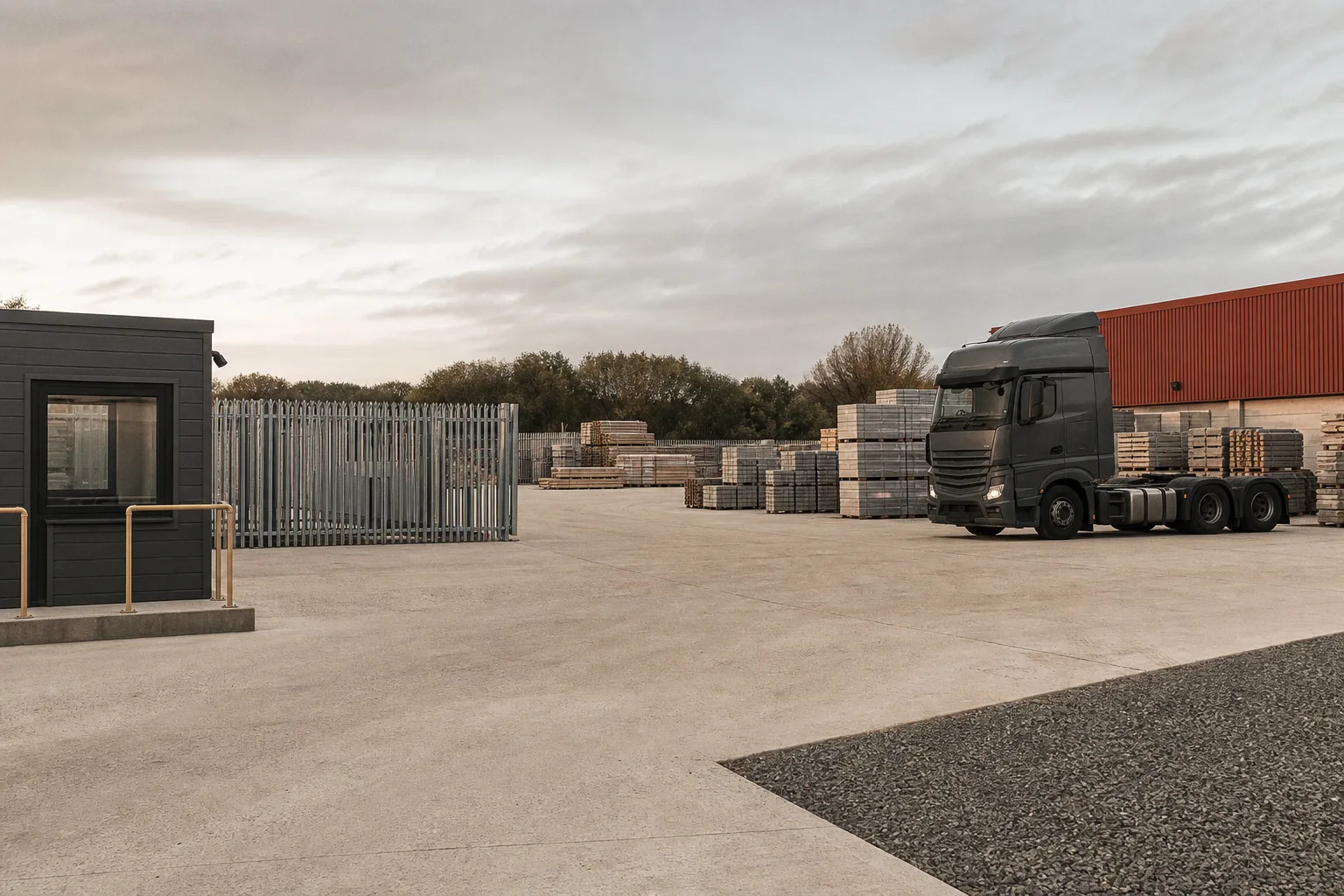
Open storage and industrial yard finance
Funding for open storage land and industrial yards, from haulage and vehicle yards to builders merchants and container parks, where the value sits in the land itself.

Funding open storage yards
Industrial open storage, often shortened to IOS, is land used for storing goods, vehicles, plant or materials in the open rather than inside a building. A typical yard is surfaced and fenced with low site cover, perhaps a small office or workshop on an otherwise open site, and is occupied by businesses that need secure land more than they need a shed: hauliers parking fleets, builders merchants holding stock, vehicle storage and rental operators, container parks and plant hire firms. The value sits mostly in the land and its planning position rather than in buildings.
Open storage has moved from an overlooked corner of the industrial market toward an asset class that institutional investors take seriously, because occupier demand for well-located yards is persistent and genuinely suitable sites are scarce. Lending has been slower to follow: security made of land rather than buildings, and income from operational occupiers on short agreements, sits outside many credit policies. A meaningful and growing group of lenders does fund yards well, and our work is matching each site to them. We arrange purchase, refinance and bridging debt as arranger and introducer, not as a lender.
What we fund
- Haulage, fleet and vehicle storage yards on surfaced, secure sites
- Builders merchants, plant hire and construction material yards
- Container parks and open storage land let to logistics occupiers
- Yards with ancillary offices or workshops on low site cover
- Sites with sui generis open storage or Class B8 planning positions
Indicative terms
- Typical lot sizeFrom around £250k per yard (indicative)
- Investment LTVAround 55 to 65 percent of valuation (indicative)
- Term ratesFrom around 6 percent (indicative)
- BridgingFrom around 0.75 percent per month (indicative)
Indicative only. Terms vary by lender, asset and borrower and are not an offer of finance.
Financing open storage land and yards
We arrange finance across the life of a yard. For an investor buying open storage land with an occupier in place we source term debt sized off the net income, at leverage that reflects the land-based security, indicatively around 55 to 65 percent loan to value. For purchases where the income is not yet bankable, a vacant yard, a site bought from a distressed seller, or land where the planning position needs regularising before term lenders will engage, we arrange bridging finance and plan the refinance route from the outset. For operators buying their own yard we arrange owner-occupier facilities underwritten on the trading business. We act throughout as arranger and introducer to lenders, not as a lender ourselves.
How lenders approach open storage security
Open storage tests the habits of property lenders because the two things they usually lean on, buildings and long leases, are mostly absent. The security is land value, which moves with planning status and location rather than bricks, and the income often comes from operational occupiers on short leases or licences. Lenders that fund yards well underwrite accordingly: they test the planning position first, since consented open storage use is what separates an investment-grade yard from a field with vehicles on it, then the quality of the location against occupier demand, then the durability of the income, looking at how long the occupier has actually been there and what the site would re-let for if they left. The lender pool is narrower than for built industrial stock, but it is growing as the asset class institutionalises, and placing the deal with the right credit team is most of the outcome.
The market for industrial yards and open storage
Open storage is in the unusual position of having stronger occupier and investor demand than lending coverage. Hauliers, merchants and logistics businesses need yards near road networks and urban areas, supply of consented sites is constrained because such land is routinely lost to higher-value development, and institutional investors have moved into the sector to capture rental growth driven by that scarcity. For an owner that means several exits: sale to the increasingly deep investor market, sale to an occupier who wants control of a site their business depends on, or a long hold on income that has tended to be re-lettable. For a lender it means the security, well-located consented land, sits in a market with structural demand behind it, which is the foundation we build each funding case on.
Finance that suits this asset class
- Bridging financeBuying yards before the income or planning position is term-fundable.
- Commercial mortgagesTerm debt against let yards and owner-occupied operational sites.
- RefinanceMoving from bridging onto term debt once the yard is let and consented.
Useful calculators
Related guides
Fund a open storage yards deal
A view on fundability within one working day.
What is industrial open storage (IOS)?
Industrial open storage is land used commercially for storing things in the open: trailers and tractor units on a haulage yard, aggregates and timber at a builders merchant, cars awaiting distribution or repair, shipping containers stacked at a container park, plant and machinery between hires. The defining features are low site cover, most of the site is open land rather than buildings, a secure boundary, a surfaced or hardcore working area, and a location that works for the occupier, typically near trunk roads, ports or the edge of towns and cities.
The IOS label matters because it marks the moment the sector acquired an identity. What was once treated as leftover land, the yard behind the units, has been recognised as infrastructure that logistics and construction businesses cannot operate without, and investors now analyse yards with the same seriousness as built industrial stock. For borrowers the practical effect is real: valuation methods are maturing, letting evidence is better recorded, and lenders have a growing body of transactions to underwrite against, all of which makes open storage land easier to finance than it was.
How do lenders value open storage land?
A yard is valued on the income it produces and the land it stands on, and the second part does most of the work for a lender. Because there is little built fabric, the question is what the land itself is worth with its consented use, which turns on location, access, surfacing and services, site area and shape, and above all the planning position. Two visually identical yards can carry very different values if one has a clean consent for open storage use and the other relies on an undocumented history.
This is why leverage on open storage sits below built industrial stock, indicatively around 55 to 65 percent loan to value rather than the 65 to 70 percent typical of warehouses. Lenders hold back a wider margin where the security is land whose value is planning-dependent and where the income, however reliable in practice, is contracted on shorter terms. Within that range the strongest cases combine consented use, a surfaced and serviced site, an occupier paying a market rent and letting evidence from comparable yards nearby. We assemble exactly that evidence when we take a yard to lenders, because each element recovers leverage that a bare application would leave behind.
What planning permission does an open storage yard need?
Planning is the single most important diligence item on any yard. Open storage use is commonly treated as sui generis, a use in a class of its own, although some yards operate within Class B8 storage and distribution, and the right answer is site-specific. Using land for open storage generally needs permission for that use, and the conditions attached can shape the income as much as the permission itself: limits on hours, stacking heights, the goods that can be stored, vehicle movements and surfacing all decide what an occupier can actually do and therefore what rent the site commands.
Where a yard has operated for many years without an explicit consent, a lawful development certificate can formalise the position, and obtaining one is often the unlock that moves a site from bridging-only to term-fundable. We flag planning at the first conversation because it sets the funding terms: a yard with clean consent and sensible conditions funds at materially better leverage and pricing than one with an ambiguous position, and where work is needed to regularise the use we arrange bridging that buys the time to do it properly.
How is yard income underwritten when occupiers sit on short agreements?
Open storage income often arrives in forms that conventional property credit finds awkward: licences rather than leases, rolling or short-term agreements, and occupiers whose covenant is an operating business rather than a rated entity. Lenders that know the sector look through the paperwork to the substance. An occupier that has parked its fleet on a yard for a decade on a rolling licence is, in practice, durable income; the agreement is short because the occupier values flexibility, not because the demand is weak.
Underwriting therefore concentrates on replaceability. What would the site re-let for, how quickly, and to whom, given the location and the consented use? A yard near a motorway junction in a catchment short of consented open storage land carries re-letting risk a lender can price even on a rolling agreement, while a remote site with one possible occupier cannot lean on the same logic. Where the borrower can move an occupier onto a longer lease before completion, that single change often improves the available terms, and we advise on sequencing the letting and the finance so each supports the other.
Can you finance buying open storage land before it is let?
Yes, with the right structure. A vacant or owner-vacated yard produces no income, so term debt is rarely available on day one; the purchase runs on bridging finance, indicatively from around 0.75 percent per month, underwritten on the land value and the credibility of the letting or occupation plan. Lot sizes start small by industrial standards, viable yards fund from around £250k on an indicative basis, which makes open storage one of the more accessible entry points into industrial property ownership.
The bridge needs an exit designed before it is taken. For an investor that means letting the yard to an operational occupier and refinancing onto term debt against the income; for an operator it means getting the business trading from the site so an owner-occupier facility can take the position over. Site works, surfacing, fencing, lighting, weighbridges or wash bays, can be funded alongside the purchase where they clearly support the letting case. We structure the whole sequence at the outset so the short-term debt never runs out of road before the term refinance is ready.
Worked example: yard purchase to term refinance
Take an illustrative purchase of a 1.5 acre surfaced yard near a motorway junction, with consent for open storage use, bought vacant for £600k. A bridging loan at 65 percent of the purchase price advances £390k at an indicative 0.75 percent per month with interest rolled, while the buyer funds the balance and modest site works, new fencing, lighting and gate automation, from equity. These figures are illustrative only, not a quote, and any real facility would be sized on the actual site, planning position and income.
Within six months the yard lets to a regional haulier on a five year lease at £72,000 a year, a rent supported by lettings on comparable yards in the corridor. With contracted income in place, the position refinances onto a term facility at 60 percent of a valuation that now reflects the let investment, repaying the bridge in full and putting the owner on term pricing from around 6 percent indicatively.
From there the owner holds a consented, income-producing yard in a supply-constrained corridor. The exits are a continued hold as rents in the sector move, a sale to an investor now that the income is contracted, or a sale to the occupier, and the refinanced structure leaves each route open. Every figure in this example is illustrative and intended only to show how the funding sequence works.
Illustrative worked example only. Figures vary by lender, asset and borrower and are not an offer of finance.
Frequently asked questions
What loan to value can I get on open storage land?
Indicatively around 55 to 65 percent of valuation, below the 65 to 70 percent typical of built industrial units, because the security is land whose value depends on its planning position and the income is often on short agreements. Consented use, a surfaced site and a market rent all push toward the top of the range.
Do I need planning permission to use land for open storage?
Generally yes. Open storage is commonly a sui generis use, with some yards operating within Class B8, and using land for storage without the right consent puts both the income and the land value at risk. Where a yard has operated for many years without explicit consent, a lawful development certificate can formalise the position and materially improve the funding terms.
Is a loan secured on an industrial yard a regulated mortgage?
Normally no. Lending against commercial land to a business or investor sits outside FCA mortgage regulation, so regulated-mortgage protections do not apply. If a proposed structure would involve security over your home or otherwise fall within regulated lending, it needs a suitably authorised adviser, and we will tell you so rather than arrange it. We are a broker and introducer of unregulated commercial finance, not a lender.
Why is investor and lender interest in open storage growing?
Because occupier demand from haulage, logistics and construction businesses is persistent while consented yard land keeps being lost to other uses. That scarcity has drawn institutional investors into the sector, and lender appetite has followed, with more credit teams now treating well-located, consented yards as fundable income-producing assets.
Funding a open storage yards asset?
Tell us about the deal and we will come back with a view on fundability and likely terms.