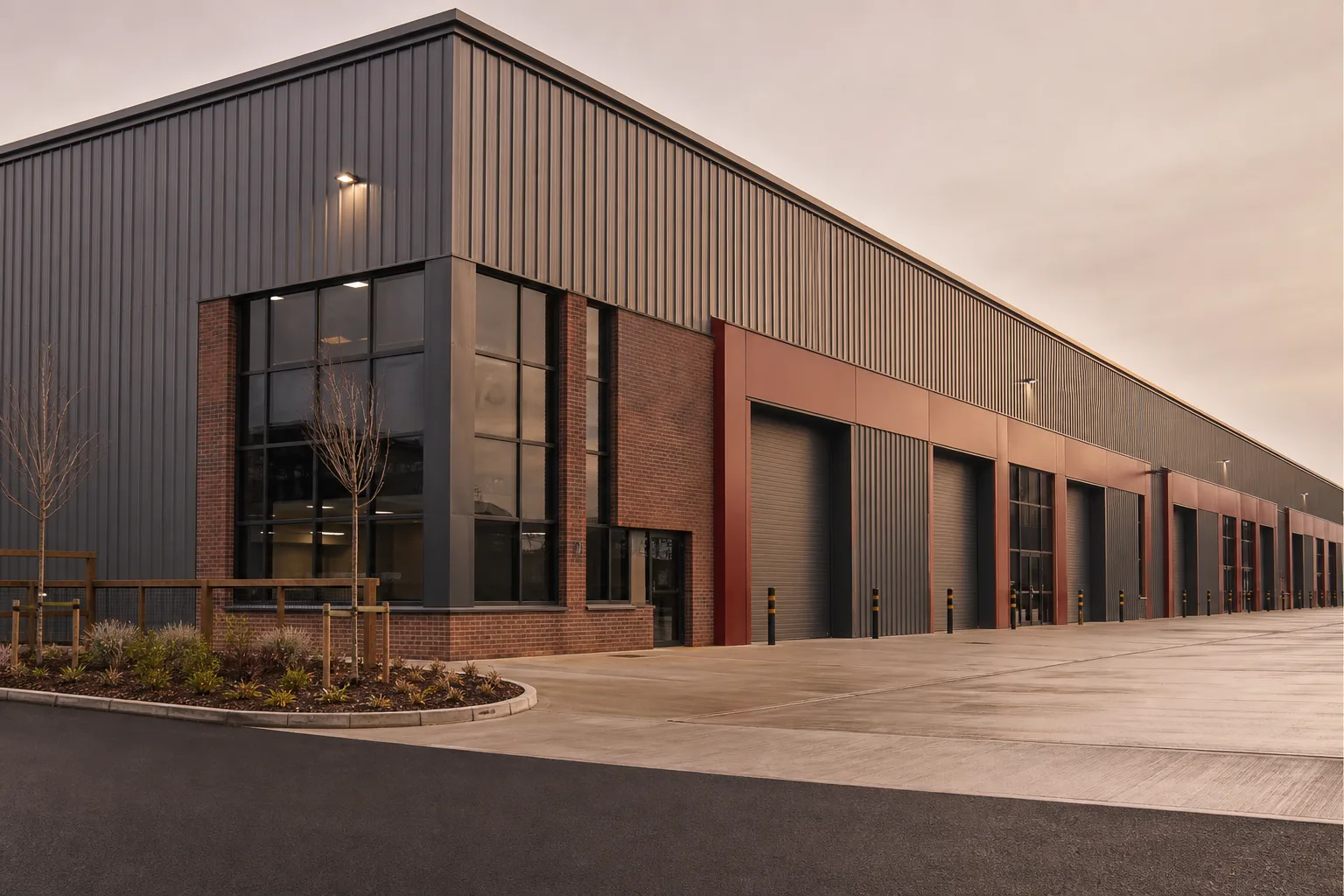
How to buy an industrial unit
Buying an industrial unit is the purchase of a commercial building designed for manufacturing, workshop, storage or distribution use, either as premises for you

Key takeaways
- Industrial units reach buyers through four channels: the property portals, specialist agents, auctions and off-market sales, and no single source shows more than a fraction of what is genuinely for sale.
- Due diligence has to clear title, planning use class, condition and the EPC before the price is fixed, because each of those can be an expensive surprise after exchange.
- Most purchases are funded with a commercial mortgage, indicatively 70 to 80 percent loan to value for owner-occupiers and 65 to 70 percent for investors, with bridging used where speed or condition rules out term debt.
- Speed of funding wins competitive units: a buyer with terms agreed in principle can offer on a short timetable and mean it.
- A clean freehold purchase with finance commonly takes eight to twelve weeks from accepted offer to completion when the funding is started on day one.
Buying an industrial unit is the purchase of a commercial building designed for manufacturing, workshop, storage or distribution use, either as premises for your own business or as an investment let to tenants. The market behind that sentence is big but tight: UK multi-let industrial stock alone is conservatively estimated at more than 500 million sq ft (Gerald Eve Multi-Let, Winter bulletin 2024), yet well-located small units are persistently scarce because land keeps being lost to housing and higher-value uses faster than new units are built. That scarcity shapes everything that follows, from how units reach the market to how hard buyers have to compete for them, and it rewards buyers who prepare before they start viewing.
This guide covers the full process: where industrial units come up for sale, what due diligence should examine, freehold against leasehold, how the unit will be valued, the costs on top of the price, the funding routes and what happens between offer and completion. We arrange the finance side of these purchases as a broker and introducer working across high street banks, challenger banks and specialist lenders. We are not a lender, and nothing in this guide is financial, legal or tax advice.
Where do industrial units come up for sale?
Industrial units reach buyers through four main channels. The commercial sections of Rightmove and Zoopla carry the broadest open-market flow, alongside EG Propertylink and CoStar's LoopNet, which lean towards agent-instructed commercial stock. Behind the portals sit the agents themselves: national firms such as Savills, JLL and Knight Frank handle the larger estates and investments, while regional industrial specialists dominate the small-unit market in their own patches and often know about stock months before it is marketed. Our companion guide to finding industrial units for sale maps every channel in detail; the short version is that no single source shows you more than a fraction of what is genuinely available.
Auctions are the third channel, led by houses such as Acuitus and Allsop, and they carry a steady diet of vacant units, short-let investments and buildings that need work. The fourth channel is off market entirely. Many owner-occupiers sell directly to a neighbouring business, and many investors sell estate by estate to buyers their agents already know. Because openly marketed units attract multiple bids in most regions, serious buyers register with the local industrial agents, set portal alerts, watch the auction catalogues and make it known what they want to buy. Patience is part of the method: in tight markets the right unit can take months to surface, and the buyers who are ready when it does are the ones who treated the search as a process rather than an event.
| Channel | What it carries | Best for |
|---|---|---|
| Property portals | Rightmove and Zoopla commercial, EG Propertylink, LoopNet | The broadest open-market flow, with day-one alerts |
| Specialist agents | National firms on estates and investments, regional firms on small units | Stock known months before it is marketed |
| Auctions | Acuitus, Allsop and others: vacant units, short-let investments, buildings needing work | Marketed deadlines and motivated sellers |
| Off market | Neighbour deals, quiet agent sales, investor-to-investor trades | Units that never reach a portal at all |
Whichever channel produces the unit, speed of funding decides who wins it. A buyer with finance terms agreed in principle can offer with a short timetable and mean it, which matters to sellers choosing between similar bids. We arrange terms in principle before clients start offering for exactly this reason.
In tight markets the right unit can take months to surface, and the buyers who are ready when it does are the ones who treated the search as a process rather than an event.
What due diligence does an industrial unit need?
Due diligence on an industrial unit is the investigation of whether the building you are buying can legally and physically do what you intend to do with it. Title comes first: your solicitor confirms the seller owns what they are selling, checks for restrictive covenants, rights of way across the yard, shared access arrangements and any overage clauses left by a previous developer. Industrial land has often passed through several hands and uses, so title queries here are more common than on a house purchase, and they take longer to resolve than buyers expect.
Planning and use class come next. Most industrial uses sit in class B2 for general industrial or B8 for storage and distribution, with lighter uses in class E(g). The label on the listing is not evidence; the planning history on the council's portal is. A unit sold as a warehouse may have consent only for a use you do not intend, conditions limiting operating hours, or a personal consent that dies with the current occupier. Condition and environment complete the picture: commission a building survey covering the roof, frame, floor slab and services, check the asbestos register on older stock, and take the environmental search seriously, because industrial land carries genuine contamination risk that lenders will also probe.
Finally, check the EPC. An industrial unit generally needs a rating of E or better before it can be let under the minimum energy efficiency standard, and the government has consulted on tighter targets. Owner-occupiers are not letting the building today, but a poor rating still affects value, future flexibility and some lenders' appetite, so price any upgrade works into your offer.
Should you buy the freehold or a leasehold?
Freehold ownership is the outright purchase of the building and the land beneath it, while leasehold ownership is the purchase of a lease, a right to occupy for a fixed period on the terms the lease sets out. Most single industrial units in the UK sell freehold, but long leaseholds are common on managed estates, where a ground landlord retains the freehold and units are held on leases of 99, 125 or 999 years with a ground rent and often an estate service charge.
For most buyers a long leasehold with well over 70 to 80 years unexpired behaves much like a freehold, and lenders fund both, though they will scrutinise the lease length against the mortgage term, the service charge history and any clauses restricting use or alterations. Short leaseholds are a different proposition: a unit with 30 years left is a depreciating right, not an appreciating asset, and the pool of willing lenders narrows sharply. Whichever tenure is on offer, get the lease or title read early, because tenure problems discovered after the valuation has been paid for are expensive problems.
Where the unit is leasehold, three documents deserve particular care. The ground rent provisions matter because aggressive review clauses, doubling rents or index-linked uplifts on short cycles, erode value and unsettle lenders. The service charge accounts for the last three years show what the estate actually costs to run, and whether a major item such as road resurfacing is about to land on the new owner. And the alterations and use clauses determine whether your fit-out, your signage and your trade are permitted at all. None of this is a reason to avoid leasehold stock, much of which is excellent; it is a reason to price the lease, not just the building.
How will the unit be valued?
Industrial units are valued primarily from rental evidence, even when the buyer intends to occupy rather than let. A valuer establishes what the unit would let for per square foot from comparable lettings nearby, then applies a yield to turn that rent into a capital value, cross-checked against actual sales of similar units. For context, multi-let industrial rents averaged £16.82 per sq ft across London and the South East and £8.40 per sq ft across the rest of the UK at Q3 2024 (Gerald Eve Multi-Let, Winter bulletin 2024), with the UK average prime multi-let equivalent yield at 5.45 percent on the same bulletin. Local evidence always trumps national averages, but those figures show why the same shed carries a very different price in Park Royal and in Port Talbot.
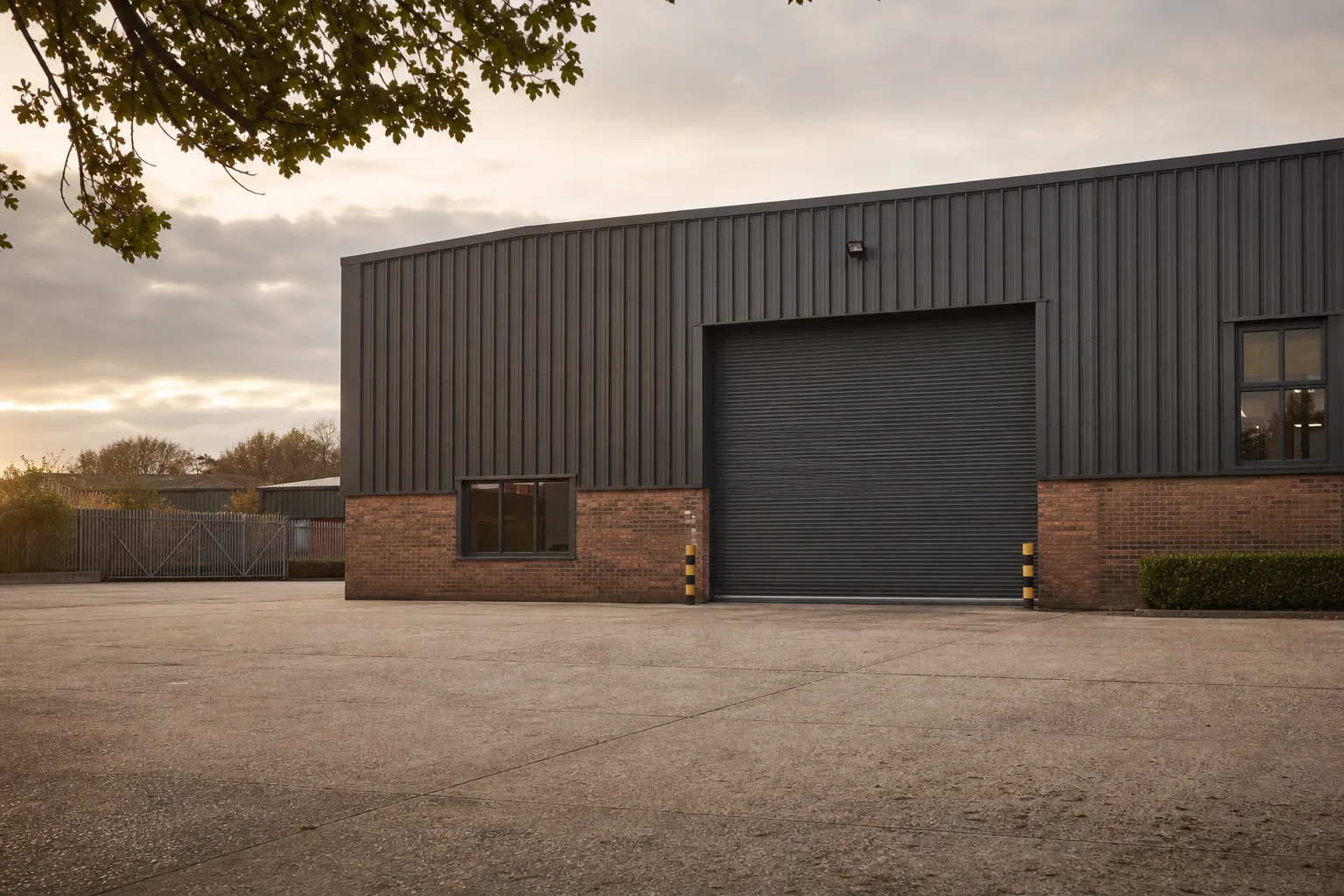
The features that move an individual unit's figure are physical and practical: eaves height, the size and number of loading doors, the depth and security of the yard, the power supply, the office content and the EPC rating. Small units also benefit from a depth-of-demand premium, because far more buyers can afford a 3,000 sq ft unit than a 30,000 sq ft one, and vacant units in good locations often sell above their investment value simply because owner-occupiers compete for possession. Our guide to how industrial property is valued covers the mechanics, the ERV question and the multi-let wrinkles in depth.
When you apply for finance, the lender instructs its own valuer under the RICS Red Book, and that figure, not the price you agreed, is what the loan is sized against. If the valuation comes in below the price, the loan shrinks and the buyer funds the gap or renegotiates. We see this regularly on units bought in competitive bidding, which is one reason we sense-check pricing against rental evidence before clients commit.
What does the purchase cost beyond the price?
Plan for a layer of costs on top of the headline price. The largest is usually stamp duty land tax, charged at the non-residential rates: at the time of writing, nothing on the first £150,000, 2 percent on the portion from £150,001 to £250,000 and 5 percent on everything above that. On a £600,000 unit that is £19,500. Our commercial stamp duty calculator runs the numbers for any price, and Scotland and Wales apply their own equivalent taxes with different bands.
Then come the professional and lending costs: legal fees on both the purchase and the lender's security, the lender's valuation fee, a building survey, searches, and lender arrangement fees that commonly run to a low single-digit percentage of the loan, all indicative and varying by deal. Two tax items deserve early attention rather than late surprise. If the seller has opted the building to tax, VAT at 20 percent is added to the price, which is usually recoverable for VAT-registered buyers but must be cash-flowed and inflates the stamp duty calculation. And capital allowances on plant within the building can be worth real money if dealt with in the contract. Both are accountant territory; the practical point is to ask the questions before exchange, not after.
Budget for the ownership costs that start the day after completion too. Business rates on an occupied industrial unit are a significant running cost and are checkable in advance through the property's rateable value. Buildings insurance becomes your problem rather than a landlord's, estate service charges continue on managed estates, and most units need at least some immediate spend, on doors, lighting, security or the office, before the business moves in. Buyers who commit every available pound to the deposit and stamp duty, leaving nothing for the first quarter of ownership, create their own cash flow squeeze; a sensible completion budget always has a contingency line.
How do buyers fund an industrial unit?
Most industrial purchases are funded with a commercial mortgage, and the shape depends on who is buying. Businesses buying premises to trade from use an owner-occupier commercial mortgage, where lenders look at the accounts and typically lend around 70 to 80 percent of value on indicative terms, because the business's trading income services the debt. Investors buying tenanted units gear a little lower, indicatively around 65 to 70 percent loan to value, with the rent doing the servicing. Indicative rates start from around 6 percent and vary with the lender, the asset and the borrower's strength; our commercial mortgage calculator turns any loan and rate into a monthly payment.
Term debt is not the only tool. Where a unit is bought at auction, needs refurbishment before a term lender will take it, or simply has to complete faster than a mortgage can be arranged, bridging finance completes the purchase at indicative rates from around 0.75 percent per month, with a refinance onto a commercial mortgage once the unit is ready. Buildings bought as shells or sites for new units move into development finance territory instead.
Our role across all of these routes is the same: we package the deal, match it to lenders who actually like the asset type, and manage the application through valuation, credit and legal completion. Appetite for small industrial assets varies more between lenders than borrowers expect, and the difference between the best and worst terms available to the same buyer on the same unit can be measured in whole percentage points of leverage and rate. We act as an arranger and introducer, not a lender, and indicative terms are not an offer of finance.
What happens between offer and completion?
Once an offer is accepted, the agent issues heads of terms recording the price, the parties, the tenure and any conditions, and both sides instruct solicitors. From that point three workstreams run in parallel: legal due diligence on title, planning and searches; the survey and any specialist reports; and the finance application, where the lender underwrites the borrower, instructs the valuation and issues a formal offer. Exchange of contracts, usually with a 10 percent deposit, makes the deal binding, and completion follows on the agreed date, often one to four weeks later.
A clean freehold purchase with finance commonly takes eight to twelve weeks from accepted offer to completion, as a rule of thumb rather than a promise, and the finance is rarely the slowest part when it is started early. The transactions that drag are the ones where the valuation is instructed late, a title or planning wrinkle surfaces after week six, or the buyer starts the mortgage application only after solicitors are already deep into contracts. Running the funding from day one, which is the part we manage, keeps the timetable honest and keeps the seller from looking at other buyers.
Buyers can shorten their own timetable with unglamorous preparation. Have your accounts, bank statements and identification ready before the lender asks, because underwriting stalls on missing documents more often than on difficult questions. Reply to your solicitor's enquiries within days, since each round trip with the other side costs a week. Book the surveyor and give the valuer access early, as both visits gate later steps. And agree a realistic completion date in heads of terms rather than an optimistic one, because a missed date sours a deal faster than a slightly longer honest one.
What are the pitfalls of buying commercial property?
The recurring pitfalls are mostly avoidable. Buyers overpay in competitive markets by anchoring on the asking price rather than the rental evidence underneath it. They under-budget by forgetting stamp duty, VAT on opted buildings, fees and immediate repairs. They discover after exchange that the use class does not cover their operation, that a covenant on the title restricts their trade, or that the yard they assumed was theirs is shared. On older stock, roof condition and the floor slab are the classic expensive surprises, and on estates, the service charge history tells you what the managing agent will cost you each year.
The financing pitfalls are just as common: leaving the mortgage application too late, sizing the borrowing against the agreed price rather than the likely valuation, and stretching the deposit so thin that there is nothing left for fit-out or the first slow quarter. None of this argues against buying. Industrial has been the strongest-performing mainstream commercial property sector of recent years precisely because demand for ordinary units keeps outrunning supply. It argues for doing the work in the right order: evidence first, diligence second, funding arranged early, and an honest budget that survives contact with the building.
The cheapest insurance against all of these pitfalls is the right professional team, instructed early. A commercial property solicitor who works on industrial transactions weekly will spot the covenant and access problems a generalist misses. A building surveyor who knows portal-frame sheds will price the roof works within a sensible margin rather than guessing. An accountant consulted before heads of terms keeps the ownership structure and VAT options open. And on the funding side, our job is to make sure the lender, the leverage and the structure fit the building and the buyer, so that the finance is the most predictable part of the transaction rather than the least.
How to buy an industrial unit: common questions
What is the 2 percent rule for property?
The 2 percent rule is an American residential rule of thumb suggesting monthly rent should be around 2 percent of the purchase price. It has no real currency in UK commercial property, where industrial units are priced on annual rent per square foot and yields instead. A more useful UK sense check is to compare the price against local rental evidence capitalised at a sensible yield, which is how the valuer will look at it.
How much does an industrial unit cost to build?
Typical UK construction costs for warehouses and stores run at £1,100 to £1,220 per sq m, roughly £102 to £113 per sq ft, excluding land, fees and VAT (Costmodelling, rebased to April 2026). Large distribution boxes build cheaper per square metre and small bespoke units dearer. Comparing that build cost with local asking prices is a quick test of whether buying existing stock or building new offers better value in your area.
How much deposit do I need to buy an industrial unit?
Indicatively, owner-occupiers borrow around 70 to 80 percent of value, implying a deposit of 20 to 30 percent, while investors typically gear to around 65 to 70 percent and put down 30 to 35 percent. Add stamp duty, fees and a working buffer on top. Actual leverage depends on the lender, the asset and the strength of the borrower, and any figure here is indicative rather than an offer.
Can I buy an industrial unit through my limited company?
Yes, and most owner-occupier and investment purchases we arrange complete in a limited company, whether the trading business itself or a separate property company. Lenders are comfortable with both and will usually want personal guarantees from directors. The right ownership structure has tax consequences that differ case by case, so take advice from your accountant before heads of terms, not after.
Is finance for buying an industrial unit regulated?
Lending to limited companies, investors and business borrowers for industrial property is generally unregulated commercial lending outside the FCA's regulated mortgage perimeter. Some lending to individuals, for example secured on a property connected to the borrower's home, can be a regulated mortgage contract; where a transaction would be regulated or otherwise require FCA authorisation, we refer it to an appropriately authorised firm. We arrange finance as a broker and introducer and do not provide financial, legal or tax advice.
Ready to talk about a real deal?
Send us the deal and we will come back with a view on fundability and likely terms within one working day.