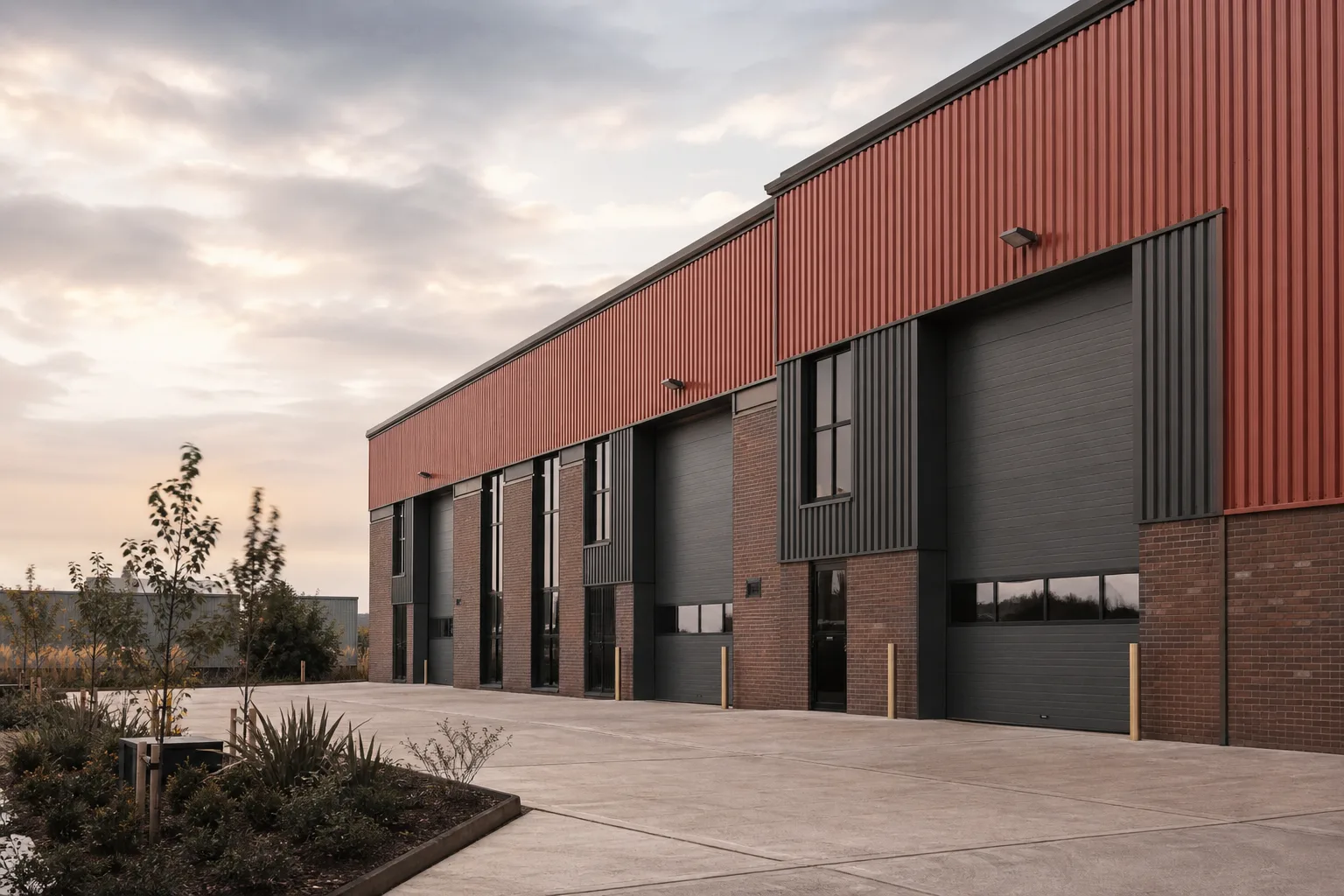
Industrial units for sale in the UK
Industrial units for sale are commercial buildings, from single workshops and small warehouses up to whole multi-let estates, offered freehold or leasehold for

Key takeaways
- Industrial units for sale are fragmented across the portals, trade-facing sites, specialist regional agents and auction houses, and a meaningful share never reaches a portal at all.
- Supply is genuinely tight: UK multi-let stock is estimated above 500 million sq ft, yet vacancy across institutionally held industrial property was just 9.4 percent in December 2025 (MSCI, Q4 2025).
- Price from evidence, not the asking figure: gather comparable rents, capitalise at a local yield, and the lender's valuer will run the same arithmetic after you do.
- Auction purchases exchange on the fall of the hammer and usually complete inside about 20 business days, which is why they are funded with bridging arranged in principle before bidding.
- The prepared, funded buyer regularly beats the better-capitalised one, because off-market sellers trade certainty for a quieter process and engage with buyers who can demonstrably complete.
Industrial units for sale are commercial buildings, from single workshops and small warehouses up to whole multi-let estates, offered freehold or leasehold for purchase rather than rent. Finding them takes more than one portal search, because the market is fragmented by design: the big property websites carry part of the picture, specialist agents and auction houses carry another part, and a meaningful share of stock changes hands without ever being advertised. Supply is also genuinely tight. UK multi-let industrial stock is estimated at more than 500 million sq ft (Gerald Eve Multi-Let, Winter bulletin 2024), but the vacancy rate across institutionally held UK industrial property stood at just 9.4 percent in December 2025 (MSCI UK Quarterly Property Index, Q4 2025), and the ordinary small units businesses actually want, the 1,000 to 10,000 sq ft workshops and warehouses on established estates, are the scarcest slice of it. The buyers who succeed in this market treat the search as a system, several sources watched continuously with funding ready, rather than an occasional browse.
This guide maps the whole search: where industrial units are listed, why so many sell off market, how to read a listing like a surveyor rather than a browser, what prices look like and what drives them, how the auction route works, which unit types come up most often, and how purchases are funded. We arrange that funding as a broker and introducer across high street, challenger and specialist lenders, and we see every week how the prepared buyer beats the better-capitalised one. We are not a lender or a selling agent, and nothing here is financial, legal or tax advice.
Where are industrial units for sale actually listed?
Start with the two consumer-facing giants. Rightmove's commercial property section and Zoopla's commercial listings carry the broadest agent-instructed flow of industrial units for sale, searchable by location, size and price, and both let you set alerts so new instructions reach you on day one. Their coverage skews towards smaller lot sizes and owner-occupier stock, which suits most first-time buyers, but neither carries everything, because plenty of commercial agents do not list there at all. The archive is useful as well as the live stock: sold and under-offer listings on the same estates are free pricing evidence for whatever you eventually bid on, so save them as you go. Check the listings weekly rather than monthly, because well-priced small units in strong areas regularly go under offer within days of appearing, and the alert email is only as useful as the speed of the response to it.
The trade-facing portals fill much of the gap. EG Propertylink, run by Estates Gazette, aggregates instructions from commercial agencies that never touch the consumer portals, and CoStar's LoopNet does the same with an increasingly UK-deep database alongside the CoStar subscription product that agents and investors use professionally. NovaLoca adds a further independent layer with strong regional agency coverage, the auction houses publish their catalogues weeks before each sale, and for larger investments the national firms, Savills, JLL, Knight Frank, Lambert Smith Hampton and their peers, publish their sale instructions directly on their own sites. Searching only one of these sources means seeing perhaps half of the openly marketed stock in your area, and the overlap between them is smaller than most buyers assume. The agents' own websites repay direct visits too, partly for instructions that have not been syndicated yet and partly for their market reports, which often disclose the achieved rents and yields that turn a guess at value into an evidenced one.
The final listed channel is the specialist regional industrial agent. Every industrial market in the country has two or three firms that dominate it, the way Bulleys does across the Black Country or equivalent firms do in Leeds, Bristol or Glasgow. Their boards are on the estates, their applicant lists are where landlords go first, and registering with them is the single highest-value step in any serious search. Make the registration specific: the size band in sq ft, the postcode districts that work, freehold or leasehold, vacant or income-producing, and the budget with funding status attached. Vague applicants get filed; precise, funded applicants get the first call when something fits, which is the whole point. Portals show you what is marketed; the local agent tells you what is coming.
Why do many industrial units sell off market?
A large share of industrial sales never reaches a portal because the buyer was found before marketing was needed. The most common pattern is the neighbour deal: the business next door has wanted the unit for years, the owner knows it, and a price is agreed directly or through a single agent letter. The second pattern is the agent's quiet sale, where a firm tests its own applicant register before launching a campaign, saving the seller fees, time and the signal to tenants that the estate is for sale. The third is the investor-to-investor trade, where estates and portfolios move between funds and property companies through relationships rather than advertisements, the way the largest deals in the sector do; when Blackstone took Industrials REIT private in June 2023 it paid £511 million for 104 urban multi-let estates in a recommended offer, not an auction catalogue (Industrials REIT and Blackstone offer announcement, April 2023). A fourth source worth knowing is the sale and leaseback, where an occupier sells its freehold to raise capital and stays in as tenant; these deals are negotiated directly with investors and create income-producing stock that was never advertised as being for sale at all.
Buyers can put themselves into this hidden flow deliberately. Register with every active industrial agent in the target area and be specific, because vague applicants get forgotten and precise ones get called. Drive the estates you want to own and write to the owners of units that fit; Land Registry title data makes owners findable for a few pounds per title, and a short, credible letter with proof of funding gets read far more often than people expect. Tell your accountant, solicitor and bank manager what you are looking for, since plenty of deals start as a conversation between advisers, and keep a simple record of every approach, because the owner who says no this year is often the seller of two years' time. Persistence matters more than polish in this channel: the buyers who assemble units and estates off market are usually the ones who wrote, called and stayed in touch politely for years, not the ones who sent a single letter and waited.
Credibility is the entry ticket. Off-market sellers are trading certainty for a quieter process, so they engage with buyers who can demonstrably complete, and they drop buyers who cannot evidence funds the moment a better-prepared rival appears. Having finance agreed in principle before approaching owners, which we arrange for clients as standard, converts a speculative letter into a real offer and is frequently the difference between a reply and silence.
How do you read an industrial sales listing?
Read the floor area first and check what it measures. Industrial space is usually quoted as gross internal area in sq ft, and the figure should reconcile with the EPC record and any lease plans; mezzanines are sometimes counted, sometimes not, and a listing that quotes a total including an uncounted mezzanine flatters the price per sq ft. Then read the eaves height, the clear height to the underside of the frame, because it determines racking, stacking and which occupiers the unit can ever serve. Units below about 4 metres suit workshops and trade uses; modern logistics users want considerably more, and the market prices the difference. Where a listing quotes price on application, treat it as an invitation to call rather than a warning sign, but go into that call with your own per sq ft arithmetic already done. Dividing every asking price by every floor area as you search builds an instinct for the local per sq ft range within a week, and that instinct is what lets you recognise the underpriced listing the morning it appears.
Next, the practical kit: the number and size of loading doors, whether loading is level or via a dock, the power supply, since three-phase capacity is a dealbreaker for many manufacturers, the office content as a percentage of the floorplate, and the yard. A secure, self-contained yard with genuine circulation space adds real value, and shared yards on tight estates subtract it. Check the rateable value too, which is public and free, because business rates are a material running cost the listing will not volunteer. The photographs usually tell you more about the roof, cladding and floor than the text does, and what the listing does not mention, asbestos surveys, roof age, flood history, is the list of questions for the agent. On managed estates, ask for the service charge budget alongside the brochure, because an estate with barriers, CCTV and landscaping is charging someone for them, and that someone is about to be you.
Finally, the legal facts: tenure, use class and occupancy. Freehold and long leasehold are different purchases, as our buying guide explains, and the planning use, B2 general industrial, B8 storage and distribution or class E(g) lighter uses, needs to match your intentions rather than the agent's adjective. If the unit is sold with a tenant in place, you are reading an investment listing, and the lease length, rent against market evidence and tenant strength matter more than the paint; ask for the tenancy schedule before viewing rather than after. If it is vacant, you are buying possession, and your own diligence does all the work.
What do industrial units cost, and what drives the price?
Industrial pricing starts with rent, because capital values are capitalised rental values. Multi-let industrial rents averaged £16.82 per sq ft across London and the South East and £8.40 per sq ft across the rest of the UK at Q3 2024 (Gerald Eve Multi-Let, Winter bulletin 2024), around a national average of roughly £10.90 per sq ft (Gerald Eve Multi-Let, derived, Winter bulletin 2024). Yields convert those rents into prices: the UK average prime multi-let equivalent yield stood at 5.45 percent at Q3 2024 on the same bulletin, ranging from 4.75 percent in Inner London to 6.50 percent in South Wales, with ordinary secondary stock pricing at softer yields than prime in every region. As purely illustrative arithmetic, a unit letting at £10 per sq ft valued at a 7 percent yield implies roughly £143 per sq ft of capital value; the same rent at 5.5 percent implies £182. Real transactions sit around such numbers: the Industrials REIT portfolio traded at around £100 per sq ft derived on its roughly £700 million enterprise value (Industrials REIT and Blackstone offer announcement, April 2023).
What moves an individual unit up or down that scale is mostly location and scarcity, then specification, then tenure. Urban units near motorway junctions and dense populations command premium rents because last-mile occupiers, trade counters and local services compete for them, while the same shed in a thin catchment can struggle to find any bidder. Eaves height, yard, power, office content and condition adjust the figure, and small units often achieve a higher rate per sq ft than big ones simply because more buyers can afford them; vacant small units can sell above their investment value altogether when owner-occupiers compete for possession. The direction of travel has favoured owners: rental growth is forecast to average 4.6 percent a year over 2024 to 2028 for UK multi-let industrial (Gerald Eve Multi-Let, Winter bulletin 2024), which is one reason occupiers increasingly prefer buying to renting. Condition and compliance increasingly carry pricing weight of their own: a unit with a new roof, a strong EPC and clean asbestos records sells faster and funds more easily than its tired twin, because both buyers and lenders can see the capital expenditure that someone else has already absorbed.
The practical lesson for a buyer is to price from evidence, not from the asking price. Gather the asking and achieved rents on comparable units within a few miles, apply a yield consistent with what investments in the area actually sell at, and compare the answer with what is being asked. Where the asking price runs well ahead of that arithmetic, either the seller knows something the listing does not say, or the price is simply ambitious; both are worth knowing before you offer. The same arithmetic is what the lender's valuer will run after you do, and a price the valuer cannot support becomes a funding gap at the worst possible moment, so the evidence file you build during the search pays for itself twice. Remember also that the right price differs by buyer: an owner-occupier weighing the mortgage against the rent it replaces can rationally pay more than a yield-driven investor for the same vacant unit, and in undersupplied markets that owner-occupier premium on small freeholds is real and persistent.
Searching only one of these sources means seeing perhaps half of the openly marketed stock in your area, and the overlap between them is smaller than most buyers assume.
How do industrial property auctions work?
Commercial property auctions are a major sales channel for industrial units, led by houses such as Acuitus and Allsop, whose catalogues regularly include vacant workshops, let investment units, yards and buildings with problems that suit a marketed deadline better than a private treaty sale. The appeal for sellers is certainty: when the hammer falls, contracts are exchanged. The implication for buyers is that all of the work happens before the auction, not after it. Note the difference between the guide price, the marketing figure that draws bidders in, and the reserve, the confidential minimum the seller will accept; guides are routinely set below where lots actually sell, so budget from your own analysis rather than the catalogue number. It is also worth asking why a lot is in the room at all: executors, lenders in possession and funds tidying portfolios sell good buildings at auction for speed, while some lots are there because private treaty buyers kept finding problems, and the legal pack usually tells you which kind you are looking at.
The mechanics are standard. Each lot has a legal pack, containing title, searches, leases and special conditions, published before the sale, and bidders are expected to have read it, because you buy subject to everything in it; sellers sometimes tuck unusual costs, such as the buyer paying the seller's fees, into the special conditions. Most sales now run online or in hybrid form, with bidders registered in advance, proof of identity and funds lodged, and proxy or telephone bids available. On the fall of the hammer or acceptance of the final online bid you exchange immediately, typically paying a 10 percent deposit plus auction fees, and completion commonly follows within 20 business days under standard conditions, though the special conditions of each lot can vary that. There is no subject-to-survey and no subject-to-finance; if you cannot complete, the deposit is forfeit and the seller can pursue the difference. Pre-auction offers are also common: a strong bid lodged before the sale can secure the lot on the same contract terms and is worth considering when a unit fits perfectly. Whatever route the purchase takes, count backwards from the completion deadline on day one: solicitor review of the pack, funding approval, insurance from exchange and the completion monies all have to land inside the same few weeks, and the calendar is the auction buyer's real opponent.
Review the legal pack
Have your solicitor read the title, searches, leases and special conditions before the sale, because you buy subject to everything in it, including any costs tucked into the special conditions.
Arrange the bridge in principle
Get bridging credit-approved against the legal pack before bidding, since standard conditions require completion in around 20 business days and a term mortgage seldom completes that fast.
Set a hard maximum
Write down a ceiling that includes works, fees and the bridge cost itself, and do not move it once the room warms up.
Register and bid
Lodge identity and proof of funds in advance, then bid in person, online or by proxy; the guide price is marketing, the reserve is the real floor.
Exchange and complete
On the fall of the hammer you exchange immediately and pay a 10 percent deposit plus fees, then complete inside the deadline and refinance onto a commercial mortgage afterwards.
That timetable is why auction purchases are usually funded with bridging finance rather than a term mortgage. A bridging loan, at indicative rates from around 0.75 percent per month, can credit-approve against the legal pack and complete inside the auction deadline, with the buyer refinancing onto a cheaper commercial mortgage once the unit is secured, let or refurbished. The disciplined approach is to arrange the bridge in principle before bidding, set a hard maximum that includes works, fees and the bridge cost itself, and treat the legal pack review by your solicitor as non-negotiable. We arrange auction funding on exactly this basis, and the buyers who do well at auction are invariably the ones whose maximum bid was written down before the bidding started.
Which types of industrial unit come up for sale most often?
The most numerous lots are small single units: workshops and starter units from a few hundred to a few thousand sq ft, sold by retiring owner-occupiers, downsizing businesses and small investors. They are the natural first purchase for a trades or manufacturing business, and competition for them is intense because the same unit suits dozens of local buyers at once, from the joiner and the vehicle repairer to the e-commerce business outgrowing a garage. Above them sit mid-size warehouses and hybrid units, typically 2,000 to 25,000 sq ft with offices attached, which serve distribution, wholesale and growing manufacturers and form the backbone of the owner-occupier market. New-build small unit schemes add a periodic supply of freehold stock, often sold off plan or at practical completion, and they let well-funded buyers secure modern, EPC-compliant space without the refurbishment risk that comes with older sheds, at a price premium the market has generally been willing to pay.
Income-producing lots are the second family. Single-let investment units come with a tenant, a lease and a rent, and are priced on yield rather than vacant value, which makes the tenancy schedule the real subject of the purchase; the building is what you insure, but the lease is what you bought. Multi-let industrial estates, several units around a shared yard with a spread of tenants, are the institutional favourite, and they reach the open market less often precisely because funds and property companies compete to buy them privately; Sirius Real Estate's £101 million purchase of the Hartlebury Trading Estate in Worcestershire, the largest of four UK acquisitions totalling £166.2 million in its FY2026 year, is the current reference point for that appetite (Sirius Real Estate FY2026 annual results).
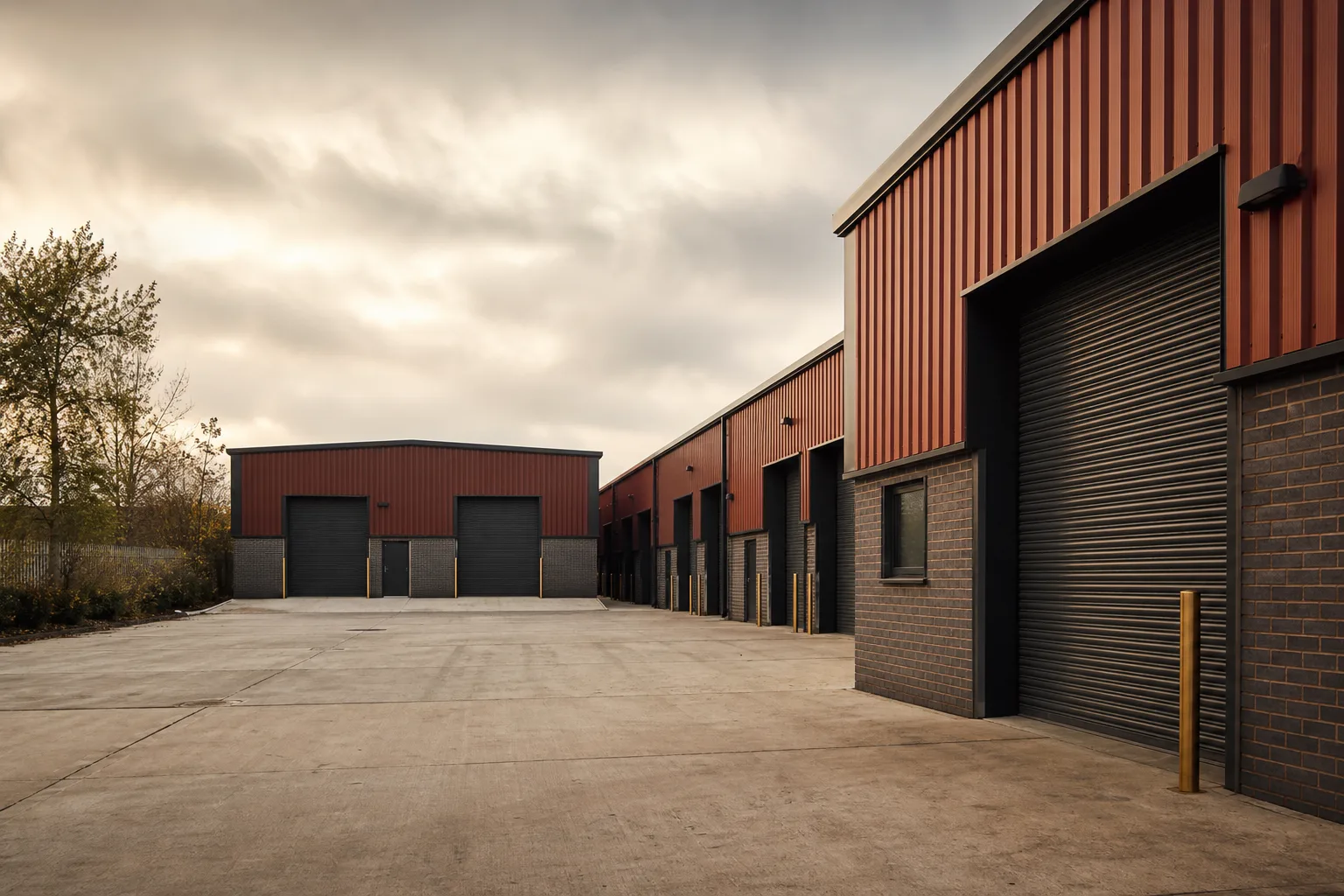
Around the edges sit the specials: trade counter units fronting main roads, which command premium rents from national brands; open storage yards with little or no building, increasingly traded as an asset class in their own right; units with development or change-of-use angles; and short-leasehold or ground-lease stock that prices cheaply for a reason. Each type carries its own funding logic, from straightforward owner-occupier mortgages on small warehouses to estate-level facilities on multi-let purchases, and identifying which type you are actually looking at is the first step in pricing it properly. It also pays to match the type to the plan rather than the bargain: a business that needs a workshop should not talk itself into a yard with a development angle, because the discount that makes a special cheap is the same complication that delays the day the business actually moves in.
What should you check before viewing or offering?
A short filter applied from your desk saves wasted viewings. Confirm the tenure and ask for the title number, since Land Registry documents cost pounds and reveal covenants, rights of way and the seller's actual ownership. Check the planning history on the council portal for the use class, conditions and anything outstanding, including enforcement. Pull the EPC, which is public, free and tells you both the rating and the recorded floor area, and check the rateable value for the business rates bill. Ask the agent directly about asbestos, roof age, flood history and any service charge if the unit sits on a managed estate. Ten minutes of this regularly disqualifies a listing before you have driven anywhere, and it sharpens the questions for the listings that survive.
At the viewing, look up and look down: the roof and the floor slab are the two most expensive things to fix in an industrial building. Check eaves height with more than a guess, test the doors, find the electrical intake and confirm the supply, walk the yard boundaries against the title plan, and look at what the neighbours do, because estates have characters and your insurer and your customers will both notice. Visit at different times if you can; an estate that is quiet at 11am may be gridlocked at 8am, and access that works for a van may not work for an articulated delivery. If the unit is let, ask for the lease, the rent payment history and the tenant's accounts; if it is vacant, ask why, and how long it has been. Neighbouring occupiers are an underused source: five minutes with the business next door tells you about flooding, break-ins, the landlord's responsiveness and the estate's real character faster than any report.
Then, before offering, line up the money. An offer backed by a decision in principle, with solicitor named and survey booked, reads as a completion plan rather than a hope, and sellers' agents rank offers on exactly that basis; in a multiple-bid situation the best-funded offer beats a marginally higher speculative one more often than not. The offer itself should state the price, the funding position, the solicitor, the survey timetable and the target exchange date in plain terms, because every specific commitment in the letter is a reason for the agent to recommend you. We prepare finance in principle for buyers at this stage, often within days, so the offer letter can say so.
How do you fund the purchase of an industrial unit?
Most purchases complete with a commercial mortgage, shaped by who is buying. A business buying its own premises borrows against both the property and its trading accounts, indicatively at around 70 to 80 percent loan to value, with the loan serviced from profits; lenders test that the business's earnings cover the payments with a margin, and they like the fact that an owner-occupier stops paying rent on the day it completes. An investor buying a tenanted unit borrows against the rent, indicatively at around 65 to 70 percent loan to value, with the lender testing how comfortably the rent covers interest. Indicative rates start from around 6 percent and vary with lender, asset and borrower; terms commonly run from 5 to 25 years, repayment or part interest-only, with fixed and variable options. As a purely illustrative example, a business buying a £400,000 unit at 75 percent loan to value would borrow £300,000 and fund a £100,000 deposit plus stamp duty and fees; at an indicative 6.5 percent over 20 years on repayment, the payments run to roughly £2,200 a month, a figure many occupiers recognise as close to the rent they already pay.
Purchases that do not fit a term lender's timetable or condition standards use shorter money first. Auction buys, units needing refurbishment, and sellers demanding a four-week completion are bridging territory, at indicative rates from around 0.75 percent per month, refinanced onto term debt once the unit qualifies. Buyers assembling several units, or buying an estate with vacancies to fill, often use structured acquisition finance that anticipates the asset management plan rather than freezing the day-one picture, with the facility sized against where the income will be rather than where it starts.
The packaging matters as much as the product. Lenders price industrial deals on the evidence file: accounts or rent schedule, the comparable evidence behind the price, the EPC position, the planning fit and the borrower's track record, and the same deal presented well and presented badly can come back with visibly different terms. Our work as a broker and introducer is assembling that file, matching it to the lenders who genuinely like the asset type, and managing valuation, credit and legals to completion. Terms in principle can usually be produced within days of receiving the core documents, which is why the funding conversation belongs at the start of the search rather than the end of it. We are not a lender, and all figures in this section are indicative rather than an offer of finance.
Are cheap or derelict industrial buildings worth pursuing?
Searches for cheap or abandoned industrial buildings are perennial, and the honest answer is that cheap industrial property is almost always cheap for a reason you will pay for later. The usual reasons are condition, with failed roofs, contaminated slabs or asbestos throughout; location, on estates or in towns where occupier demand is thin; tenure, with short leases or awkward ground rents; or planning, where the lawful use is narrower than the building suggests. The price discount is the market's estimate of those costs, and a buyer's job is to estimate them better than the market has, not to assume they do not exist. Genuinely abandoned buildings add a further layer, because years without maintenance, insurance or security leave legacies, from stripped services to squatters' damage, that no desktop appraisal captures.
Done well, this is a legitimate strategy rather than a trap. A structurally sound unit with a tired roof and a poor EPC in a good location can be bought, repaired, re-rated and either occupied, let or sold, and the build-cost backdrop frames the opportunity: typical construction for new warehouse space runs at £1,100 to £1,220 per sq m, roughly £102 to £113 per sq ft, excluding land, fees and VAT (Costmodelling, rebased to April 2026), so buying a repairable shell well below replacement cost leaves genuine margin for works. The funding follows the plan: bridging or refurbishment finance through the works, then a term refinance against the improved value once the unit is lettable or occupied, with the uplift between purchase price and end value carrying the project's return.
The discipline is to price the exit before the entry. Get contractor estimates rather than guesses, confirm the planning position will allow your intended use, test the environmental risk properly because remediation costs can swallow any discount, and assume the works take longer and cost more than the first estimate. Lenders apply the same lens: a bridging application supported by a costed schedule of works, a contractor and a credible end value gets approved, while one supported by enthusiasm does not. We arrange the bridge-to-term funding behind these projects regularly, and the ones that work are always the ones where the buyer knew the all-in cost and the end value before exchange, not after.
Finding industrial units for sale: common questions
Where can I find small industrial units for sale near me?
Combine the portals with the local specialists: set alerts on Rightmove commercial, Zoopla commercial and EG Propertylink for your area and size band, then register directly with the two or three industrial agents most active on your local estates, since much of the small-unit stock sells through their applicant lists before reaching the portals. Auction catalogues from houses such as Acuitus and Allsop are worth watching for the same areas, and a direct letter to the owner of a unit you want remains surprisingly effective. Expect the search to take months rather than weeks in tight markets, and have funding in principle ready so a good unit can be offered on the day it appears.
How much does an industrial unit cost in the UK?
It varies enormously by location, size and specification, which is why the market prices per square foot rather than per unit. The underlying rents average £16.82 per sq ft in London and the South East and £8.40 per sq ft elsewhere (Gerald Eve Multi-Let, Winter bulletin 2024, Q3 2024 data), and capital values capitalise those rents at local yields; as one sourced capital-value reference, the Industrials REIT portfolio traded at around £100 per sq ft derived on its enterprise value in 2023 (offer announcement, April 2023). Local comparable evidence, not national averages, should set your number.
Can you buy an industrial unit at auction with a mortgage?
Rarely in practice, because standard auction conditions commonly require completion within around 20 business days and a term mortgage seldom completes that fast from a standing start. Most auction buyers complete with bridging finance, at indicative rates from around 0.75 percent per month, arranged in principle before bidding, then refinance onto a commercial mortgage afterwards. The legal pack should always be reviewed by a solicitor before you bid, and your maximum price should include the bridging cost.
Are industrial units a good investment?
The sector's fundamentals have been the strongest in mainstream UK commercial property: rental growth is forecast at 4.6 percent a year on average over 2024 to 2028 for multi-let industrial (Gerald Eve Multi-Let, Winter bulletin 2024), and vacancy across institutionally held UK industrial stood at 9.4 percent in December 2025 (MSCI UK Quarterly Property Index, Q4 2025), reflecting persistent occupier demand against constrained supply. Individual outcomes still depend on the unit, the tenant and the price paid, and nothing here is investment advice.
Is the finance for buying an industrial unit regulated?
Lending to companies, investors and business borrowers on industrial property is generally unregulated commercial lending outside the FCA's regulated mortgage perimeter, though some lending to individuals, for example secured on a property linked to the borrower's home, can be a regulated mortgage contract. Where a transaction would be regulated or otherwise require FCA authorisation, we refer it to an appropriately authorised firm. We act as a broker and introducer, not a lender.
Ready to talk about a real deal?
Send us the deal and we will come back with a view on fundability and likely terms within one working day.