The UK open storage market
Industrial open storage, usually shortened to IOS, is land used commercially without substantial buildings on it: surfaced yards occupied by lorries, building m

Key takeaways
- Industrial open storage (IOS) is commercial land where the value lies in the surfaced, secured yard rather than any building, typically half an acre to ten acres, let to hauliers, builders merchants, plant hire firms and vehicle and container operators.
- Scarcity of urban yard land, structural occupier demand and rising rents have turned IOS into an institutional asset class in its own right.
- Planning is the heart of due diligence: many yard uses are sui generis, so a clean, unrestricted consent is worth materially more than a fragile one.
- Lending leans on land value and planning rather than building quality, so leverage is lower at around 55 to 65 percent loan to value, below the 65 to 70 percent on built industrial.
- Term debt funds let yards with clean consents from around 6 percent; bridging from around 0.75 percent per month carries vacant sites and planning plays.
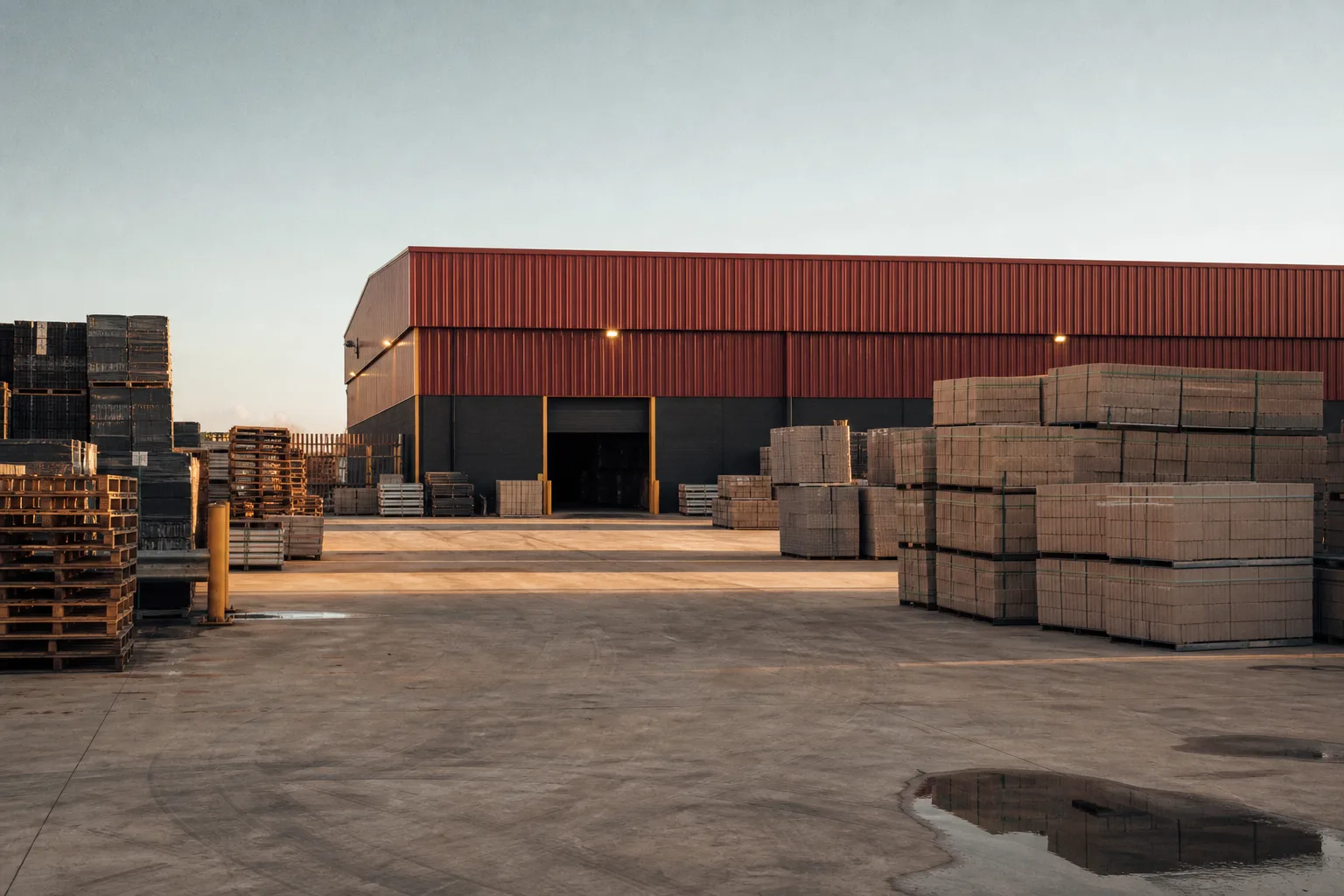
Industrial open storage, usually shortened to IOS, is land used commercially without substantial buildings on it: surfaced yards occupied by lorries, building materials, vehicles, containers and plant rather than by a shed. For decades these yards were the forgotten corner of the industrial market, priced as little more than land awaiting a better use. That has changed. Occupier demand from logistics, construction and vehicle businesses has collided with a shrinking supply of urban yard land, rents have risen sharply, and institutional capital now treats UK open storage as an asset class in its own right.
This article explains what counts as industrial open storage, who occupies yards and why, how planning treats the use, what drives rents and values, why institutional money arrived, and how open storage sites are financed, which differs in important ways from lending on built industrial space. Our open storage yards page is the commercial companion to this guide, covering the funding products in detail. We arrange that funding as a broker and introducer, not a lender, and nothing here is financial, legal or tax advice.
What is industrial open storage?
Industrial open storage is commercial land where the value lies in the surfaced, secured yard rather than in any building standing on it. A typical IOS site is between half an acre and ten acres, surfaced in concrete or compacted hardcore, fenced and gated, with power and water if the occupier is lucky and a small office, weighbridge or workshop at most. The asset is the land, its surface, its security and above all its location.
The term IOS arrived from the United States, where industrial outdoor storage became an institutional investment theme during the logistics boom, and the UK market has adopted both the acronym and the investment thesis. UK agents and investors now track yard rents, yield benchmarks and supply in a way nobody did ten years ago, and the major agencies publish dedicated research on the segment, a reliable sign that a market has come of age.
What open storage is not also matters. It is not a development site in waiting, or at least it should not be priced purely as one; the occupational demand is real and durable. And it is not simply vacant land: an unsurfaced, unsecured field has little IOS value. The premium sits in yards that are surfaced, drained, secured, powered and lawfully usable, and the gap between a raw site and a compliant one is exactly where many value-add business plans, and many of the funding requests we see, are built.
Who occupies open storage yards?
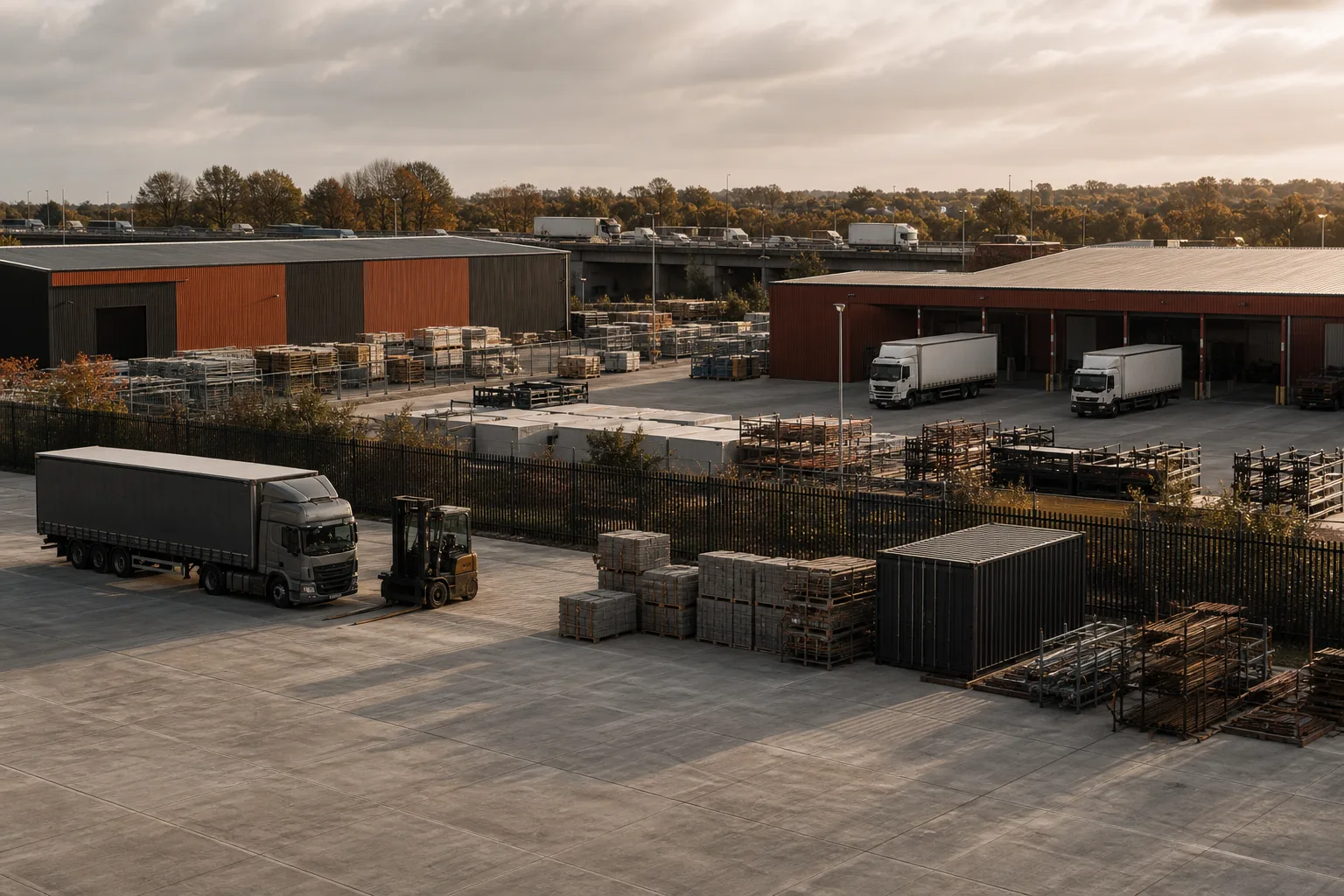
Haulage and logistics operators are the anchor occupiers. Lorry parking, trailer drop yards, van fleet bases and last-mile delivery hubs all need secure surfaced land near motorways and towns, and a parcel operation can need more yard than warehouse. Closures of older urban sites have made compliant lorry parking genuinely scarce around most UK cities, which keeps this occupier group competing for the same yards.
Construction is the second pillar: builders merchants holding bricks, timber and aggregates, plant hire firms parking diggers and access equipment, scaffolders, groundworkers and utility contractors staging materials near their sites. Vehicle uses form the third: car dealerships overflow, auction and rental fleets, vehicle transporters and salvage operations, all storing rolling stock that needs land rather than buildings. Container handling and storage rounds out the core demand, from port-adjacent box parks to inland depots serving rail freight terminals.
The common thread is that these businesses pay for position and compliance, not for fabric. An occupier choosing between a tired shed on two acres and a clean, secured yard of the same size will often take the yard at a similar rent if the location works, because the building was never the point. That occupational reality, many trades, short leases, recurring local demand, looks a lot like the multi-let industrial market next door, which is precisely why investors who understood estates moved into yards.
Why has institutional capital moved into open storage?
The institutional case starts with scarcity. Yard land in and around UK cities has been consumed for decades by housing, sheds and infrastructure, and planning policy rarely allocates new land for open uses, so supply falls while the occupier base grows. Investors recognised a segment where the structural story rhymed with the one that had already repriced built industrial space: durable demand, shrinking supply and rents starting from a low base.
The wider industrial evidence frames the appetite. UK industrial investment ran at £6.6 billion in 2023 with £4.8 billion transacted over the first three quarters of 2024 on the Gerald Eve (Newmark) Multi-Let Winter bulletin 2024, and the same wave of capital that took Industrials REIT private for £511 million in 2023 (Industrials REIT / Blackstone offer announcement, April 2023) has been hunting adjacent niches ever since. Open storage offers what that capital wants: industrial-flavoured income with almost no building obsolescence, minimal capital expenditure, no EPC exposure on the open land itself, and reversionary leases in a rising rental market.
Specialist IOS platforms, private equity vehicles and traditional industrial investors have all assembled UK yard portfolios as a result, and professional management has followed: institutional leases, indexed reviews, proper surfacing and security investment. For the original owner-occupier and private landlord community, the arrival of institutional buyers has deepened exit liquidity, and for lenders it has made the asset class legible. Both effects feed directly into the financing market described below.
How does planning treat open storage land?
Planning is the single most important technical issue in the open storage market. Most yard uses do not fit neatly into the standard use classes: B8 storage and distribution covers storage as a use, and some open land genuinely operates within it, but many characteristic yard operations, vehicle storage, plant hire depots, haulage and lorry parks, waste transfer and aggregates, are treated as sui generis, a use in a class of its own. A sui generis consent is specific to the permitted operation, so changing the use of a yard usually needs a fresh planning permission rather than a permitted change.
That makes the planning audit the heart of due diligence. Many yards operate on historic, personal or temporary consents, on certificates of lawful use built up over years, or under conditions restricting hours, HGV movements, stacking heights or open burning. The difference in value between a yard with a clean, unrestricted consent for its use and an identical yard trading on a fragile permission is substantial, and buyers, valuers and lenders all price it.
Planning is also where much of the sector's value creation happens. Regularising a lawful use, lifting restrictive conditions, or winning consent to surface and secure a rough site can transform both rent and capital value without laying a single brick. Those planning plays are typically carried on bridging finance, because term lenders prefer to fund the yard after the consent position is clean, not before. None of this is planning advice; a planning consultant should confirm the position on any specific site.
Identify the lawful use
Establish whether the yard operates within B8 storage and distribution or as a sui generis use such as vehicle storage, plant hire, haulage or waste, because each carries different planning consequences.
Check the basis of the consent
Many yards run on historic, personal or temporary consents, certificates of lawful use, or conditions restricting hours, HGV movements, stacking heights or open burning. Each restriction prices into value.
Map the value-creation route
Regularising a lawful use, lifting restrictive conditions, or winning consent to surface and secure a site can transform rent and capital value without laying a brick.
Fund the gap, then refinance
Carry the planning play on bridging finance, because term lenders prefer to fund the yard once the consent position is clean, then refinance onto term debt.
What drives open storage rents and values?
Yard rents are quoted per acre per year rather than per square foot, and the drivers are qualitative but consistent. Location leads: proximity to motorway junctions, ports, rail terminals and dense urban catchments commands the premium, because the occupiers are logistics and trades businesses whose economics depend on position. The South East, the port corridors and land around the major conurbations price far ahead of yards in remote locations, mirroring the geographic split visible across all industrial property.
Specification comes next. A concrete-surfaced, drained, lit and fenced yard with three-phase power and a gatehouse lets faster and at materially higher rent than rough hardstanding behind a padlocked gate; surfacing alone can move a yard up a rental tier, which is why surfacing programmes feature in so many value-add plans. Planning certainty, as the previous section set out, then multiplies or divides everything: an unrestricted consent supports institutional leases and keen pricing, while a personal or temporary consent caps both.
On values, open storage is priced off its income like any other investment, with the land itself providing an unusually solid floor: a yard that lost its tenant tomorrow would still be development-adjacent land in a supply-starved industrial market. The wider sector backdrop, prime multi-let equivalent yields averaging 5.45 percent at Q3 2024 on the Gerald Eve (Newmark) Multi-Let Winter bulletin 2024, frames where institutional industrial income trades; yards price at a spread to built industrial that has narrowed as the asset class has matured, with the exact figure set deal by deal on planning, tenure, tenant and location.
How are open storage yards financed?
Lending on open storage differs from lending on sheds in three ways. First, leverage is lower: where a let industrial unit might support around 65 to 70 percent loan to value, yards typically fund at around 55 to 65 percent, indicatively, because lenders apply wider margins to an asset class with thinner transactional evidence and more planning risk. Second, the security analysis leans on land value: credit teams take comfort that the site is worth something substantial with or without the current occupier, and they will test what the bare land would fetch. Third, planning documentation does far more work in the legal process than on a standard unit purchase.
The product set follows the asset's state. A let yard with a clean consent and a decent tenant supports a term facility through our commercial mortgages service, indicatively priced from around 6 percent like other industrial term debt, with the lower leverage noted above. Yards bought vacant, bought at auction, or bought ahead of a planning regularisation are bridging territory, indicatively from around 0.75 percent per month, with the exit onto term debt once the income and consent are in place. Surfacing and infrastructure programmes can be funded within a bridge or as light development finance from around 8 percent indicatively. All figures here are indicative, not offers of finance.
| Yard state | Product | Indicative pricing | Indicative leverage |
|---|---|---|---|
| Let, clean consent, sound tenant | Term facility / commercial mortgage | From around 6% a year | Around 55 to 65% LTV |
| Vacant, auction, or pre-regularisation | Bridging finance | From around 0.75% per month | Lower, against current-use value |
| Surfacing and infrastructure works | Bridge or light development finance | From around 8% a year | Cost-driven, staged drawdowns |
Yards fund on land value and planning, not building quality, which is why leverage is lower and the legal pack is heavier than on a standard unit.
Owner-occupiers, the haulier or merchant buying its own yard, follow the same pattern with affordability tested on the trading business rather than rent, and they are often the strongest covenants in the sector because the yard is operationally essential to them. One regulatory note: lending to companies on commercial yards is generally outside Financial Conduct Authority regulation, but where a loan is secured on or near a borrower's home, as can happen with yards attached to houses or smallholdings, it may be a regulated mortgage contract, and we always confirm the position first.
How does open storage compare with built industrial space?
For occupiers the comparison is straightforward: a yard is cheaper per acre than a shed of the same footprint, carries no internal repairing burden on a building, and can often be occupied faster. The trade is weather exposure and the limits of what can lawfully and practically be stored outside. Many businesses run both, a unit for the workshop and stock that must stay dry, with yard space for vehicles, materials and plant, which is why estates that combine units and yards let so well.
For investors the contrasts are sharper. Open storage carries no building depreciation, no EPC cliff on the open land and minimal capital expenditure, against built space where roofs, cladding and energy compliance absorb real money over a hold. Set against that, yards offer thinner comparable evidence, more planning fragility and, historically, shorter and more informal leases, though institutional arrival is professionalising the letting market quickly. Income from a well-let yard now looks much more like estate income than it did a decade ago.
For lenders the two assets are cousins rather than twins: the same demand base and the same scarcity story, but with the credit weight sitting on land value and planning for yards, and on building quality and tenancy schedule for units. In funding terms that resolves, as set out above, into lower leverage and a heavier legal pack for open storage, at pricing that is otherwise recognisably industrial. We arrange acquisition finance across both, frequently for the same borrowers.
Where is the UK open storage market heading?
The direction of travel is towards further institutionalisation. More platforms are assembling portfolios, more agents publish dedicated IOS research, leases are lengthening and indexing, and valuers are building the comparable evidence base that was missing five years ago. Each step makes the next investor and the next lender more comfortable, which is how a niche becomes a sector; UK multi-let industrial walked exactly this path a decade earlier.
Supply will stay tight. Urban land continues to leak to housing and other higher-value uses, planning rarely creates new open storage land, and the occupier base, haulage, construction, vehicles and containers, is structural rather than cyclical. The plausible risks are also worth naming: yields could soften with the wider market, individual locations can be hurt by infrastructure changes, and a yard is only ever as resilient as its planning position. Sourced sector-wide rent and yield series for IOS remain thinner than for built industrial, so anyone quoting precise national yard statistics should be asked for their source.
For borrowers the practical conclusion is that this is now a fundable asset class with a deepening lender panel, on terms that reward preparation: a clean planning file, evidence of occupational demand, and a sensible leverage expectation of around 55 to 65 percent. We track which lenders are actively writing yard deals at any given time, and our open storage yards page is the place to start when a specific site is in view.
The UK open storage market: common questions
What does industrial open storage (IOS) mean?
Industrial open storage, or IOS, is commercial land used for open-air operations rather than buildings: surfaced, secured yards occupied by hauliers, builders merchants, plant hire firms, vehicle operators and container businesses. The value sits in the land, its surface, its security and its location rather than in any structure standing on it.
What planning permission does an open storage yard need?
It depends on the operation. Some open land operates within B8 storage and distribution, but many yard uses, such as vehicle storage, plant depots and lorry parks, are sui generis, meaning a use in a class of its own that needs its own specific consent. Many yards trade on historic, personal or conditioned permissions, so the planning position should be verified by a planning professional on every site.
Why are investors buying open storage yards?
Because demand from logistics, construction and vehicle occupiers is structural while supply of urban yard land keeps shrinking, and because yards carry almost no building obsolescence or capital expenditure. The same institutional wave that repriced UK multi-let industrial, evidenced by £6.6 billion of UK industrial investment in 2023 on the Gerald Eve (Newmark) Multi-Let Winter bulletin 2024, has moved into the adjacent IOS niche.
How much can you borrow against an open storage yard?
Indicatively around 55 to 65 percent loan to value for a let yard with a sound planning consent, below the roughly 65 to 70 percent available on built industrial investments, with term pricing from around 6 percent and bridging from around 0.75 percent per month for vacant sites and planning plays. Exact terms depend on planning, tenancy, location and the borrower, and these figures are indicative rather than an offer of finance.
What makes one yard more valuable than another?
Location near motorways, ports and urban catchments; specification, meaning surfacing, drainage, fencing, lighting and power; and above all planning certainty. A concrete, secured yard with an unrestricted consent lets faster, supports institutional leases and funds at better terms than rough hardstanding on a fragile permission, even where the two sit side by side.
Ready to talk about a real deal?
Send us the deal and we will come back with a view on fundability and likely terms within one working day.