The industrial property market in 2026: what the registers actually say
Most commentary about industrial property is written from agency research: prime yields, headline rents, big-ticket investment volumes. Useful, but it describes

Key takeaways
- Secured lending against industrial property is growing again: 911 new charges were registered against industrial units, estates and warehouses in the first half of 2026, up 29 percent on a year earlier, while the whole charge register grew 17 percent (Companies House).
- More borrowers are getting funded, not just bigger ones: distinct industrial borrowers rose 30 percent to 713 in H1 2026, and more than one facility in seven went to a company less than a year old, which is new buyers entering, not just old debt recycling.
- The typical registered sale at an industrial address was £380,000 in 2025, back at its 2022 peak, but on the thinnest volume in six years of HM Land Registry data: owners are holding and refinancing rather than selling.
- The refinance window has visibly reopened: loans originated in 2024 are being repaid within 18 months at the fastest rate on record in the register, after the 2022 rate shock froze borrowers in place.
- Supply is building: 547 industrial and logistics planning applications were filed across 83 council registers in H1 2026, 23 percent more than the previous half, so occupiers get more choice from 2027 while today's owners still enjoy scarce stock.
Most commentary about industrial property is written from agency research: prime yields, headline rents, big-ticket investment volumes. Useful, but it describes the market of £50m sheds. The market most of our clients actually transact in, units and estates from a few hundred thousand pounds to a few million, shows up somewhere else entirely: in the public registers. Every mortgage on an industrial unit leaves a charge at Companies House. Every completed sale leaves a price at HM Land Registry. Every new shed starts life as a planning application on a council register.
We have been through those three registers for the year to August 2026, working with the research desk at our network partner Construction Capital, and this article sets out what they say and what it means if you are buying, refinancing or building industrial property this year. We are a finance arranger and introducer, not a lender, and nothing here is financial, tax or investment advice; it is the data we use when we advise on structuring a deal, shared openly.
Lenders re-rated industrial property in the first half of 2026
When a company borrows against a property, the lender registers a charge at Companies House, so the charge register is the closest thing there is to a live count of secured lending decisions. In the first half of 2026, 911 new charges were registered whose filing particulars name industrial property: industrial estates and units, trading estates, warehouses and trade counters. That is up 29 percent on the 706 registered in the first half of 2025, and it is not just the market tide rising: the whole charge register grew 17 percent over the same period. Industrial is outgrowing the lending market around it.
Two details in that data matter more to a borrower than the headline. First, the number of distinct borrowers rose faster than the number of facilities, 30 percent against 29 percent, which means the growth is breadth: more separate businesses and investors getting funded, not a handful of large sponsors stacking up debt. Second, the honest caveat: industrial lending fell behind the wider market during 2025, and 2026 is a recovery as much as a boom. As a share of all UK charge registrations, industrial collateral was 0.82 percent in H1 2024, dipped to 0.68 percent in H1 2025 and has recovered to 0.75 percent now. The direction is what counts: appetite is back and rising.
First time industrial borrowers are getting funded
The most encouraging line in the register for anyone buying their first unit: 15.4 percent of H1 2026 industrial-secured facilities were written to companies less than a year old, up from 12.5 percent two years earlier (Companies House). A company that young is almost always a special purpose vehicle formed for the purchase, which means these are acquisitions, new entrants buying industrial property through fresh structures, not established owners refinancing.
Lenders funding brand-new SPVs at a rising rate tells you the market is open to borrowers without a landlord track record, provided the deal is structured to compensate: sensible leverage, clear serviceability from rent or trading income, personal guarantees where proportionate, and sponsors whose wider experience can be evidenced. That packaging is most of the work on a first deal. If that is you, start with our guides to the cost of buying an industrial unit and acquisition finance, and come to us before you bid rather than after.
What industrial units actually sold for
HM Land Registry records the price of every registered commercial transfer, and filtering its Price Paid Data to sales at industrial addresses, industrial estates and parks, trading estates and named industrial units across England and Wales, gives the clearest available picture of the owner-occupier and private-investor market, the end of the market where most of our work sits. It excludes portfolio and company-share deals, which is fine, because so does most borrowing.
| Year | Registered sales | Median price |
|---|---|---|
| 2020 | 1,910 | £300,000 |
| 2021 | 2,193 | £350,000 |
| 2022 | 2,001 | £380,000 |
| 2023 | 1,841 | £375,000 |
| 2024 | 1,966 | £365,000 |
| 2025 | 1,668 | £380,000 |
Two things stand out. The 2025 median of £380,000 is back at the 2022 peak, so the pricing correction of 2023 and 2024 has fully retraced at this end of the market. And it happened on 1,668 registered sales, the lowest full-year volume in the series, which is the signature of a market where owners do not need to sell. That squares exactly with the lending data: stock is being refinanced and held, not traded. For buyers it means choice is thin and good units sell without being marketed; for owners it means the equity in the shed is real and lenders will now lend against it.
Regionally, over the twelve months to August 2026, the Midlands led on volume with 168 registered sales at a median of £397,800, while London and the South East set the highest median at £450,000 on 125 sales. The South West was the cheapest region at a £318,615 median, and Wales, at £374,500, priced above the North West at £355,000 (HM Land Registry). A median around £380,000 also frames the finance conversation: at a typical 70 percent loan to value, that is roughly £114,000 of deposit plus costs, illustrative arithmetic only, which you can test against your own numbers with our loan repayment calculator.
The refinance window has reopened
The register also shows how quickly loans are repaid, and the pattern tells the interest rate story of the last four years in one series. Of industrial-secured facilities originated in 2022, straight into the rate shock, only 7.1 percent were fully repaid within 18 months, and the 2023 cohort was slower still at 6.8 percent. Borrowers who fixed or bridged in 2022 and 2023 had nowhere better to go, so they sat. The 2024 cohort jumped to 9.0 percent, the fastest in the series; on the occupier side of the market the 2024 figure is 13.5 percent, also a record (Companies House, all cohorts measured over a complete 18 month window).
Loans repaying early means exits are working again: bridges are refinancing onto term debt, refurbished units are letting and remortgaging, and lenders are competing for the completed asset. If you are still sitting on 2022-vintage debt, on a rate or a structure agreed at the worst possible moment, the data says the market has moved and the pool of borrowers in your position is being worked through steadily. That is precisely the conversation our refinance desk exists for, and our pillar guide to whether industrial property stacks up as an investment covers how the exit assumptions feed the whole deal.
The redemption data is the quantitative version of what we feel on the desk every week: the industrial refinance market reopened through 2024 and it has stayed open. The borrowers who moved first got the best of it, but the window is still wide.
Supply is coming: what the planning registers show
Today's scarcity is not permanent. Across 83 local planning authority registers with continuous coverage, 547 industrial and logistics planning applications were filed in the first half of 2026, 23 percent more than in the second half of 2025 on identical coverage, with quarterly filings stepping from 215 and 230 up to 277 and 270 (local planning authority registers via the Construction Capital data lake). Over the rolling year the pipeline is 1,001 applications, and the 32 schemes that state floorspace total at least 872,799 sq m, a floor rather than a total since most applications do not state a figure.
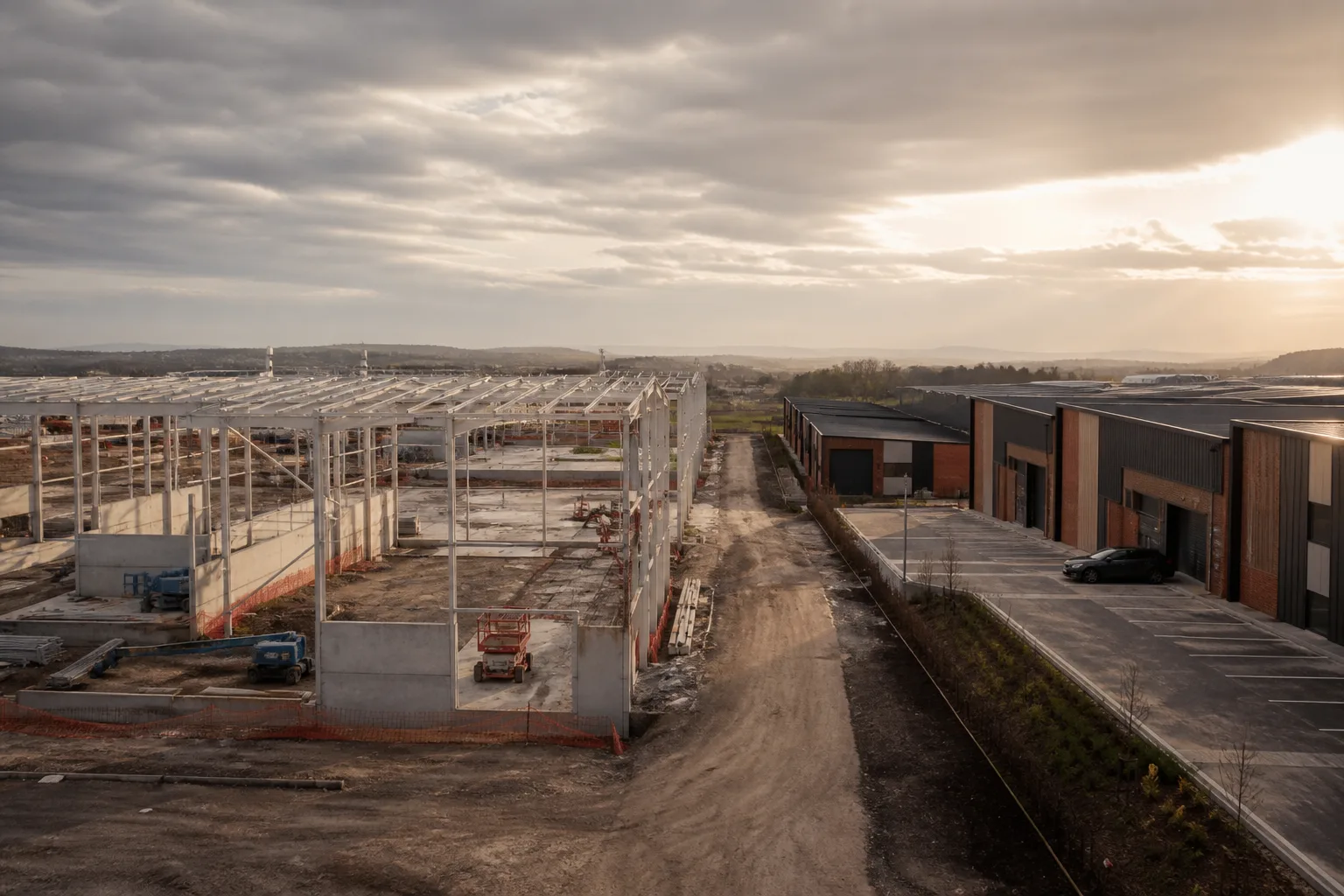
The shape of the pipeline matters as much as its size. Only 15 percent of applications are big-box distribution and logistics schemes; the rest is the multi-let, trade counter, workshop and open-storage economy that never makes the headlines. And the geography is telling: London and the South East file the most applications at 269, but the Midlands holds by far the most proposed floorspace, 386,446 sq m of it, anchored by schemes of 104,430 sq m in Derby and 60,000 sq m in Harborough, with a single Greater Cambridge application proposing up to 230,000 sq m for the East of England. The biggest sheds are being planned where the motorways cross. Our guide to big box versus multi-let industrial explains why those two pipelines serve different markets.
One caution sits in the same registers: lending to industrial occupiers, the warehousing, haulage and freight companies that fill these units, grew only 5 percent year on year while lending against the property itself grew 29 percent (Companies House). Investors are moving faster than tenants. That gap eventually closes one way or the other, so we would underwrite rent growth conservatively and treat pre-lets and strong covenants as worth paying for.
How we would read 2026 before committing to a deal
Buying a unit to occupy
Values are at their 2022 peak but lender appetite is the strongest in three years, so the constraint is finding stock, not funding it. Get terms agreed in principle before you hunt, because well-priced units are selling on thin supply.
Buying to let
The register shows more first-time SPVs funded than at any point in the data. Underwrite the rent conservatively, occupier lending is lagging, and let the lender competition work on your pricing rather than accepting the first term sheet.
Sitting on 2022 or 2023 debt
The fastest-redeeming cohorts on record say your refinance has probably been possible for a while. Price the exit penalty against current terms; the arithmetic has moved more than most borrowers assume.
Building or converting
A pipeline up 23 percent half on half means your future competition is already in the registers. Check what is consented within your catchment before fixing the scheme, and size the facility for a realistic letting period.
Every number in this article comes from a public register: Companies House charge filings, HM Land Registry Price Paid Data, and local planning authority registers. That is deliberate. Agency research tells you what the prime end of the market thinks; the registers tell you what actually completed, what actually got funded, and what is actually being planned. We run this analysis because it makes our advice concrete, and we will happily walk you through what the data says about your specific deal, area or asset type. Start a conversation through our contact page.
The Industrial Property Market in 2026: What the Data Says: common questions
Is 2026 a good time to buy an industrial unit?
The data says funding is the easy half and stock is the hard half: industrial-secured lending rose 29 percent in H1 2026 against 17 percent for the whole Companies House register, while registered sales in 2025 were the thinnest in six years of Land Registry data. Values at the £380,000 median are back at their 2022 peak. Buyers with finance agreed in principle move fastest in a thin market; whether the price stacks up is deal-specific and depends on the income.
Can a new company with no track record get industrial property finance?
Yes, and increasingly so: 15.4 percent of industrial-secured facilities in H1 2026 went to companies less than a year old, up from 12.5 percent in 2024 (Companies House). These are almost all new SPVs formed to buy. Lenders compensate for the missing track record through structure: sensible leverage, evidenced serviceability, proportionate guarantees and a sponsor story that holds up.
What does a typical industrial unit cost in 2026?
The median registered sale at industrial addresses in England and Wales was £380,000 in 2025, with twelve-month regional medians running from £318,615 in the South West to £450,000 in London and the South East (HM Land Registry Price Paid Data). At a typical 70 percent loan to value, a £380,000 purchase needs roughly £114,000 of deposit plus costs, as illustrative arithmetic.
Should I refinance industrial property debt taken out in 2022?
The register suggests most borrowers in that position eventually do: loans originated in 2024 are redeeming within 18 months at the fastest rate in the data, after the 2022 cohort was frozen at 7.1 percent by the rate shock. If your debt was priced at the 2022 peak, current terms are usually worth testing against any exit costs. We arrange that comparison across the whole market rather than a single lender's product sheet.
Will new industrial supply hurt values?
Supply is building but from a controlled base: 547 applications were filed in H1 2026 across 83 councils, up 23 percent half on half, yet only 15 percent are big-box schemes and stated floorspace concentrates in a handful of Midlands and East of England sites. Occupier lending growing at just 5 percent is the number to watch: if tenant demand stays cautious while floorspace arrives from 2027, rent growth assumptions, not capital values, are where we would be conservative first.
Ready to talk about a real deal?
Send us the deal and we will come back with a view on fundability and likely terms within one working day.