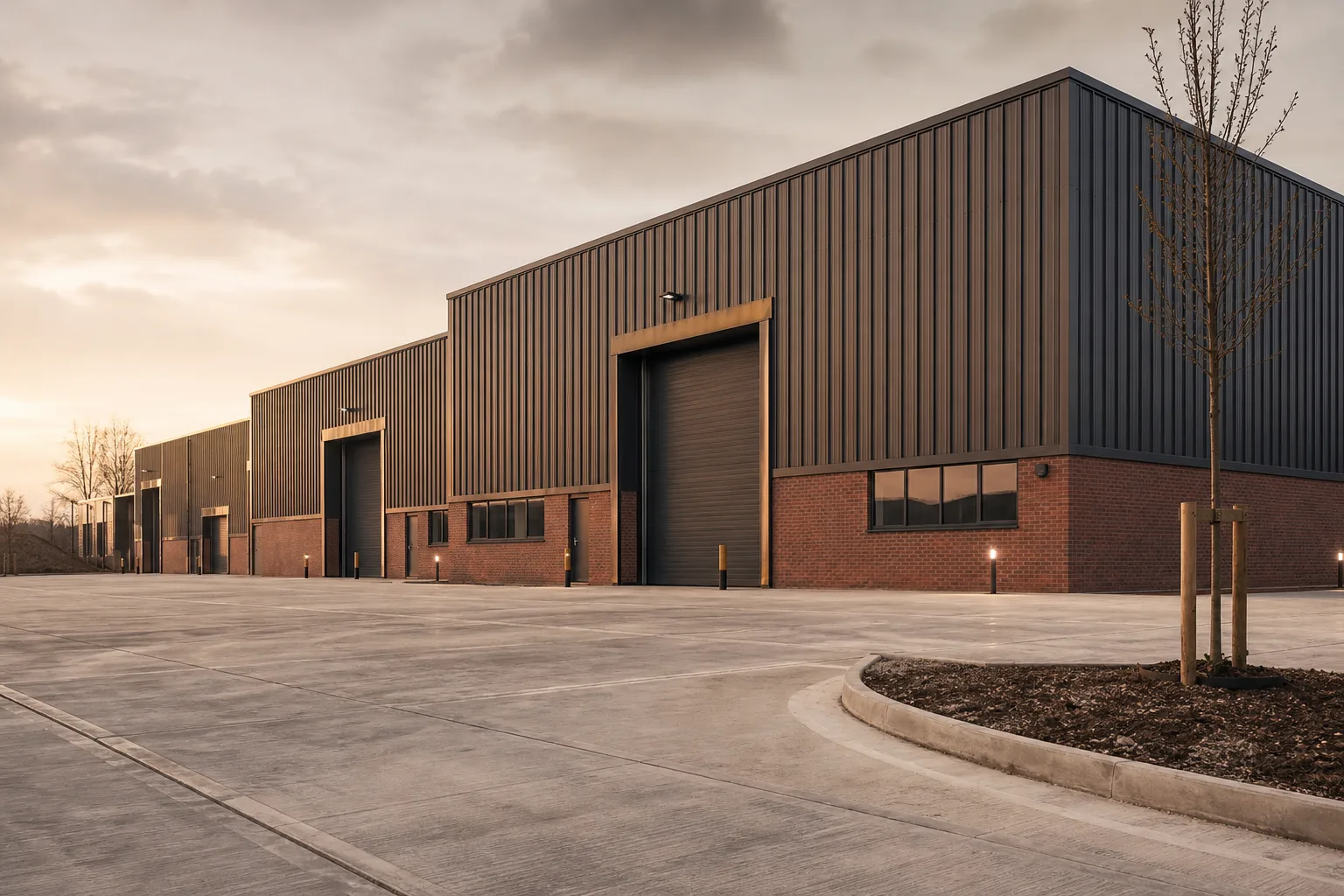
Industrial unit construction costs in the UK
Industrial units are among the cheapest buildings to construct per square foot in the UK, which is exactly why so many get built: a steel portal frame, metal cl

Key takeaways
- Conventional warehouses and stores cost £1,100 to £1,220 per sq m, roughly £102 to £113 per sq ft, excluding land, fees and VAT (Costmodelling Limited, rebased April 2026).
- Scale changes everything: large distribution boxes fall to £540 to £660 per sq m, while small terraces of starter units sit at or above the headline range.
- A credible budget is built from parts: land, construction, externals, abnormals, professional fees at a low double-digit percentage, and 5 to 10 percent contingency.
- Senior development facilities commonly fund around 65 to 75 percent of total project cost, with pricing from roughly 8 percent a year plus fees.
- Viability is one comparison: yield on cost against market yield. If the scheme only matches the market yield, it creates no value.
Industrial units are among the cheapest buildings to construct per square foot in the UK, which is exactly why so many get built: a steel portal frame, metal cladding, a concrete floor and a roller shutter door enclose lettable space faster and for less money than almost any other commercial product. But cheap per square foot is not the same as cheap, and the gap between a bare shell price and a completed, lettable, financeable scheme catches out first-time developers every year.
This guide sets out what an industrial unit costs to build on sourced data, what a steel portal frame shell includes, the factors that push cost up or down, the particular economics of small-unit schemes, the fit-out and external costs that sit on top, professional fees and contingency, how development finance funds the build, and the viability arithmetic that decides whether the scheme is worth doing at all. We arrange development finance for industrial schemes as a broker and introducer; we are not a lender, and nothing here is financial, tax or legal advice. Build costs are project-specific, so treat every range below as a starting point for a proper cost plan, not a substitute for one.
How much does it cost to build an industrial unit in the UK?
The most useful sourced benchmark puts the construction cost of warehouses and stores generally at £1,100 to £1,220 per sq m, roughly £102 to £113 per sq ft, excluding land, professional fees and VAT, on Costmodelling Limited's typical UK building costs rebased to April 2026. That is the all-in build figure for a conventional unit of reasonable specification, and it is the number to anchor on when an early-stage appraisal needs a defensible cost line.
Scale changes the figure materially. The same Costmodelling data shows large distribution boxes coming in far cheaper, at £540 to £660 per sq m on a 10,000 sq m footprint, because a big rectangle of space amortises its expensive elements, the doors, the offices, the services connections and the external works, across a vastly larger floor area. Small units sit at or above the headline range for the mirror-image reason: every terrace of starter units carries a high ratio of expensive wall, door and service connection to cheap open floor.
Treat any single number with respect for what it excludes. Land, site abnormals, external works beyond the basic, professional fees, finance costs and VAT cashflow all sit outside a per square metre build benchmark, and on small schemes those items together can approach the build cost itself. The sections below take the components in turn, because a credible budget is built from parts, not quoted from a chart.
What does a steel portal frame shell include?
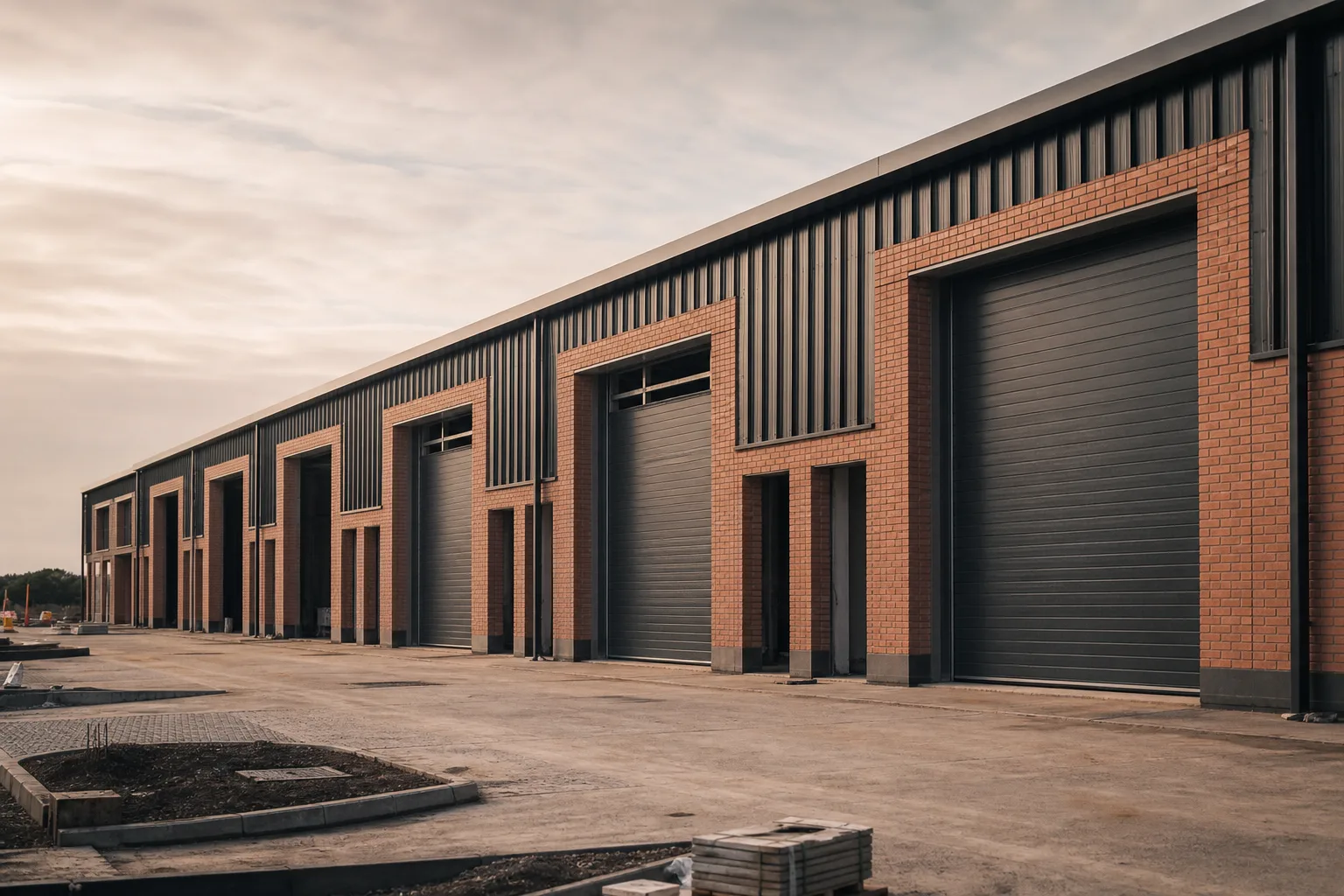
A steel portal frame is the structural skeleton of almost every modern industrial unit: a series of steel columns and rafters connected by rigid joints, repeated at regular bays, which spans wide floor areas without internal supports. On that frame the contractor hangs the building. A standard shell specification includes the frame itself, profiled metal or composite panel cladding to walls and roof, roof lights to bring in daylight, a power-floated reinforced concrete ground slab, one or more sectional or roller shutter loading doors, personnel doors, and basic rainwater goods and drainage connections.
What a shell does not include matters just as much when comparing quotes. A developer's shell typically arrives without heating, without lighting beyond a contractor's minimum, without office accommodation or sometimes with only a first-floor slab ready for offices, without a fitted electrical distribution beyond the incoming supply, and without yard surfacing, fencing or landscaping priced beyond the base allowance. Two quotes £15 per sq ft apart are often describing two different buildings, so the first discipline in cost control is a written specification that every tender prices identically.
The portal frame format is also why industrial build costs are comparatively predictable. The frame is fabricated off site to a known design, erection is fast, and the trades sequence cleanly, so a competent contractor can put up a straightforward unit in months rather than years. Speed is money in development: every month saved is a month less of finance interest, and lenders read a realistic, evidenced programme as carefully as the cost plan.
What drives industrial build costs up or down?
Specification is the first driver. Cladding choice, insulation values, roof light coverage, floor slab loading and flatness tolerances, door count and quality, and the standard of the electrical and mechanical installation all move the per square foot figure. Eaves height is a particularly pure example: taller buildings cost more per square foot of floor because there is simply more wall, steel and bracing per unit of footprint, but occupiers increasingly pay rent for volume, so height often earns its cost back in value.
Office content is the second big swing. Industrial space is cheap to build; offices within an industrial unit are not, since they carry partitions, ceilings, heating and cooling, lighting, glazing, welfare provision and often a lift if first-floor. Moving a scheme from 5 percent office content to 15 percent can shift the blended cost markedly, which is why hybrid units with generous office content, the product covered in our guide at /property-types/hybrid-flex-space/, sit well above bare warehouse benchmarks.
The third driver is everything outside the walls. External works, the yards, parking, drainage attenuation, retaining structures, fencing, lighting and landscaping, are routinely underestimated, and on a generous-yard scheme they are a major budget line in their own right. Then come site abnormals: poor ground needing piling or stabilisation, contamination from previous uses, demolition, diverted services, ecology and archaeology conditions, and awkward access. Abnormals are the reason two identical buildings on different sites can carry very different total costs, and they are the first thing a development lender's monitoring surveyor will probe.
What do small-unit industrial schemes cost to deliver?
Small-unit schemes, terraces of units from roughly 1,000 to 5,000 sq ft of the kind covered in our small warehouses guide at /property-types/small-warehouses/, are the most consistently undersupplied product in UK industrial property, and their economics explain why. Per square foot, they are the expensive end of industrial construction: more party walls, more doors, more electrical intakes, more drainage connections and more wasted circulation per lettable square foot than a single large box. A terrace of eight starter units can cost meaningfully more per square foot than one unit of the same total area.
The compensation is on the revenue side. Small units let at materially higher rents per square foot than large ones, to a deep market of trades, services and growing SMEs, and they sell well to owner-occupiers, who pay for control rather than yield. A well-designed scheme also de-risks itself: eight units can be sold or let one at a time, so the developer is not betting the whole exit on a single occupier decision.
The market context strengthens the case. The UK multi-let development pipeline stood at just 11.9m sq ft at December 2025, mostly still at planning stage, with the 29 percent under construction equating to just over one month of national take-up, against annualised UK multi-let take-up of 33m sq ft in the 12 months to Q3 2025 (Newmark, Multi-Let Winter Bulletin 2025). New small-unit supply is structurally scarce, which supports both the letting and the lending case for well-located schemes, but it does not rescue a scheme whose costs were guessed rather than planned.
What fit-out extras sit on top of the shell cost?
The shell benchmark gets a building watertight and lettable in the most basic sense; what happens next depends on the letting strategy. A developer aiming at the institutional letting market will typically add LED high-bay lighting, a heated and carpeted office fit-out with WCs and a kitchenette, an electric vehicle charging provision, photovoltaic panels or at least a roof designed to take them, and the energy performance measures needed to reach a strong EPC rating, which has become a letting and lending issue rather than a nice-to-have.
Occupier-specific extras go further: three-phase power upgrades, compressed air lines, mezzanine floors, racking, extraction, cranage and secure stores. The general rule for a speculative scheme is to build flexibility rather than guesses, providing the capacity, the power supply, the floor loading, the eaves height, without the occupier-specific kit, because the wrong fit-out is worse than none. For pre-let schemes the tenant's requirements are priced into the building contract and reflected in the agreed rent.
Budget realism matters here because fit-out is where costs creep after the headline budget is set. A sensible appraisal carries the shell cost from a sourced benchmark, an explicit fit-out allowance matched to the letting strategy, and external works priced from the actual site plan rather than a percentage guess. Where a client's numbers carry a single round figure for everything past the frame, a lender's monitoring surveyor will usually find the gap before the second drawdown, which is a bad time to find it.
How much should you allow for professional fees and contingency?
Professional fees on an industrial scheme typically run to a low double-digit percentage of construction cost, covering the architect, structural and civil engineers, the quantity surveyor or cost consultant, the principal designer for CDM compliance, building control, warranties, and the planning consultants and surveys that precede them all. Simple repeat-design schemes sit at the lower end; constrained sites with abnormals, complex drainage or contested planning sit higher. On planning matters specifically, take advice from a planning consultant early, because a condition that delays discharge by three months costs real interest.
Contingency is the line that signals competence to a lender. A construction contingency of around 5 to 10 percent of build cost is the conventional range, set towards the higher end where ground conditions are unproven or the design is bespoke, and a development lender will generally expect to see it in the appraisal rather than admire its absence. The contingency is not pessimism; it is the priced acknowledgement that no project survives contact with the ground unchanged.
Two further allowances complete an honest budget. Finance costs, the interest and fees on the development facility, accrue through the build and are usually capitalised into the loan, so they belong in the appraisal even though no invoice arrives monthly. And a letting or sales cost allowance, agents' and legal fees plus incentives such as rent-free periods, sits between practical completion and stabilised income. An appraisal that runs from land purchase to stabilised investment, with every stage costed, is the document that gets funded.
| Cost line | Typical basis | Why it sits outside the per sq m build figure |
|---|---|---|
| Land and acquisition | Purchase price plus SDLT and fees | The build benchmark excludes land entirely |
| Construction | £1,100 to £1,220 per sq m for warehouses (Costmodelling, Apr 2026) | The benchmark itself, before everything below |
| Site abnormals | Priced after ground investigation | Piling, contamination and demolition are site-specific |
| External works | Priced off the actual site plan | Yards, drainage and fencing scale with the plot, not the floor |
| Professional fees | Low double-digit percentage of build cost | Architect, engineers, QS and CDM sit on top of the contract |
| Contingency | Around 5 to 10 percent of build cost | The priced acknowledgement that the ground holds surprises |
| Finance costs | Interest and fees, usually capitalised | Accrue through the programme, not in the build rate |
How do you procure the build and keep the cost fixed?
Procurement decides how much of the cost risk you keep. The dominant route for industrial schemes is design and build, where a single contractor takes responsibility for completing the design and constructing it for a lump sum, leaving the developer one contract and one throat to choke. Industrial buildings suit it well: steel portal frame design is standardised, the major contractors price it competitively, and a tightly drafted employer's requirements document keeps the specification from being quietly thinned. The alternative, a traditional contract with a fully designed scheme tendered to contractors, can yield keener pricing on simple schemes but leaves design risk with the developer's team.
Get at least three tenders on an identical written specification, and treat the spread between them as information: a contractor pricing 15 percent below the pack has usually missed something or intends to find it back in variations. Check what the lump sum actually fixes, because provisional sums for ground works, drainage or external services are the polite name for parts of the price that are not fixed at all, and a contract sum riddled with them is a fixed price in name only. Payment terms, retention, liquidated damages for delay and a performance bond or parent company guarantee on larger contracts all belong in the negotiation, not the file.
Cost control then runs through the build. A quantity surveyor administering valuations and change control is worth their fee many times over, since most overruns arrive as a procession of small variations rather than one disaster. Development lenders reinforce the discipline: their monitoring surveyor reviews the contract before the facility completes and certifies each drawdown against work actually done, so a clean procurement package, fixed price, low provisional sums, credible contractor, speeds up both credit approval and every drawdown that follows. We see the difference in funding terms when the contract documents arrive tidy.
How does development finance fund an industrial build?
Development finance is a staged loan that funds a build as it happens. The lender typically advances a portion of the land cost on day one, then funds the construction in arrears against certified progress, with a monitoring surveyor inspecting and signing off each drawdown. Interest usually rolls up into the facility rather than being paid monthly, and the whole loan is repaid at the end from sales or from a refinance onto investment debt once the scheme is let.
Indicative shapes for industrial schemes: senior development facilities commonly run at around 65 to 75 percent of total project cost, with pricing from roughly 8 percent a year plus arrangement and exit fees, and stretch or mezzanine layers available above the senior loan for experienced borrowers at a price. The strength of the scheme moves the terms: a consented small-unit scheme in a proven letting market with a credible contractor and a realistic cost plan borrows better than a speculative punt, and pre-lets or pre-sales improve everything. Our development finance page at /services/development-finance/ covers structures in more detail, and our development finance calculator at /calculators/development-finance-calculator/ lets you test facility sizes against your own appraisal.
Lenders underwrite the people as hard as the project. Track record, the contractor's covenant and the professional team all carry weight, and first-time developers usually achieve better terms by pairing with an experienced project manager or contractor on a design and build contract. For schemes with a heavy construction element beyond our industrial specialism, our sister business Construction Capital at https://constructioncapital.co.uk arranges development debt across the wider construction sector. Most development lending to companies is unregulated; where a loan would be secured on a borrower's home or otherwise falls within FCA regulation, different rules apply and we say so at the outset.
How do you test whether an industrial scheme is viable?
Viability is one comparison: what the finished scheme is worth against what it costs to create, with a profit margin wide enough to absorb the things that go wrong. Build the cost side from land, stamp duty and acquisition fees, construction from a sourced benchmark such as Costmodelling's £1,100 to £1,220 per sq m for warehouses rebased to April 2026, externals, abnormals, professional fees, contingency and finance. Build the value side from evidenced local rents capitalised at a realistic yield, or from evidenced capital values per square foot for owner-occupier sales.
The two summary metrics lenders look for are profit on cost, conventionally targeted somewhere around 15 to 20 percent for speculative schemes, and yield on cost, the rent the finished scheme produces divided by total project cost. Yield on cost against market yield is the development trade in one line: if the scheme produces a 7.5 percent yield on cost in a market where completed estates trade near the 5.45 percent UK prime multi-let equivalent yield reported at Q3 2024 (Gerald Eve / Newmark, Multi-Let Winter bulletin 2024), the gap is the developer's profit. If yield on cost only matches the market yield, the scheme creates no value and the appraisal is telling you not to build it.
Sensitivity testing finishes the job. Rerun the appraisal with construction 10 percent higher, the programme six months longer, rents 10 percent lower and the exit yield half a point softer, and see whether profit survives. Rental growth helps the patient: Gerald Eve's Winter bulletin 2024 forecast UK multi-let rental growth averaging 4.6 percent a year over 2024 to 2028, but a viable scheme should not depend on forecast growth arriving on schedule. We stress appraisals this way before approaching lenders, because the lender will do it anyway and it is better to have answered the question first.
Industrial unit construction costs: common questions
How much do industrial units cost to build per square foot?
The sourced benchmark for warehouses and stores generally is £1,100 to £1,220 per sq m, roughly £102 to £113 per sq ft, excluding land, professional fees and VAT, on Costmodelling Limited's typical UK building costs rebased to April 2026. Small units and high office content push above that range; very large distribution boxes fall well below it, at £540 to £660 per sq m on a 10,000 sq m footprint on the same data. Site abnormals and external works then move the total project cost materially either way.
How much does construction cost per square metre in the UK?
It varies enormously by building type, which is why a type-specific benchmark beats a national average. For industrial buildings, Costmodelling Limited's data rebased to April 2026 puts warehouses and stores at £1,100 to £1,220 per sq m excluding land, fees and VAT. Offices, schools and residential all cost more per square metre because they carry far more internal fit-out, services and compliance. Always benchmark against the right building type and then have a quantity surveyor price your actual design.
What is a realistic construction budget for an industrial scheme?
One built from parts: land and acquisition costs, construction from a sourced per square metre benchmark, external works priced off the site plan, an explicit allowance for site abnormals after ground investigation, professional fees at a low double-digit percentage of build cost, contingency of around 5 to 10 percent, and finance costs through the programme. A budget quoted as a single per square foot number with nothing behind it is not a budget, and development lenders treat it accordingly.
Is it cheaper to build one big industrial unit or several small ones?
One big unit, per square foot, every time: fewer walls, doors, service intakes and connections per square foot of floor. But small units typically let and sell at significantly higher values per square foot, to a deeper market with structurally scarce supply, so the scheme with the higher build cost can comfortably be the more profitable one. Viability is decided by the gap between cost and end value, not by cost alone, which is why appraisals matter more than rules of thumb.
Can you get development finance to build industrial units speculatively?
Yes, for credible schemes. Lenders fund speculative small-unit and mid-box industrial development, typically at around 65 to 75 percent of total project cost with rates from roughly 8 percent, because the occupier market is deep and new supply is scarce: the UK multi-let pipeline stood at just 11.9m sq ft at December 2025 on the Newmark Multi-Let Winter Bulletin 2025. Terms improve with planning consent in place, a strong contractor, realistic costs and any pre-let or pre-sale evidence. We arrange these facilities as a broker across a panel of development lenders.
Ready to talk about a real deal?
Send us the deal and we will come back with a view on fundability and likely terms within one working day.