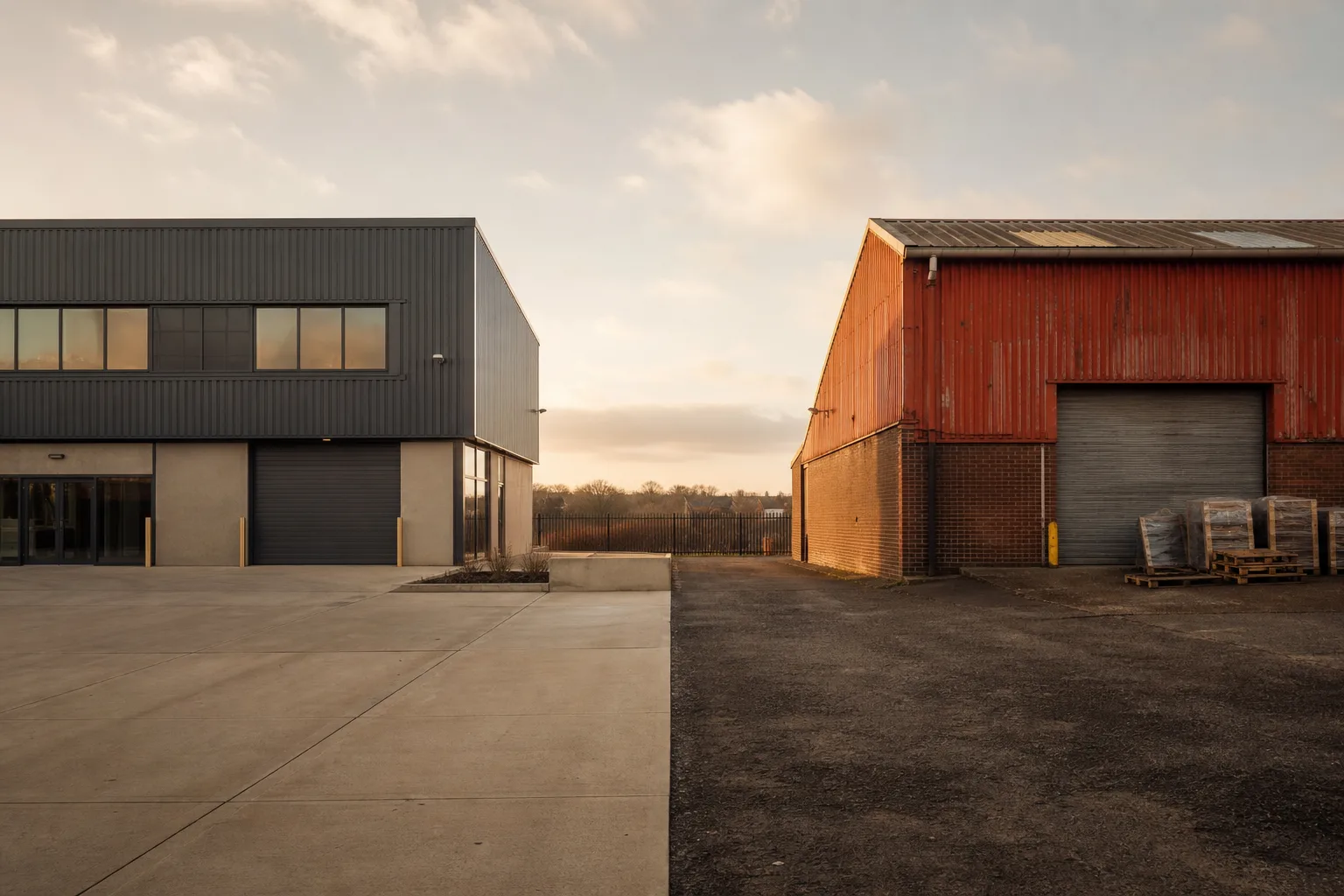
New build vs second-hand warehouse: which to buy
The choice between a new-build and a second-hand industrial unit is a trade between certainty and price. A new build arrives compliant, energy-efficient, warran

Key takeaways
- New-build units cost more up front but arrive compliant, efficient and with warranties; second-hand units are cheaper to buy but often carry capex and EPC risk.
- New build anchors on Costmodelling's £1,100 to £1,220 per sq m for warehouses (April 2026), before land; second-hand prices reflect age, condition and remaining life.
- EPC and MEES rules increasingly penalise older stock: since April 2023 it has been unlawful to let a commercial unit below EPC E in England and Wales.
- Lenders and valuers favour clean, compliant buildings; a doubtful second-hand unit borrows on tighter terms while the issues are priced in.
- Second-hand can be the better buy where the discount more than covers the works, which is the refurbishment-led play.
The choice between a new-build and a second-hand industrial unit is a trade between certainty and price. A new build arrives compliant, energy-efficient, warranted and ready to occupy, but costs more per square foot. A second-hand unit is cheaper to buy, often in a more established location, but can carry tired services, an EPC liability and a capex bill the next owner inherits. For an owner-occupier or investor the right answer depends on the discount, the condition and what the building will cost to bring up to standard.
This guide compares the two on cost, specification, energy performance, finance and value, and sets out when each wins. It draws on our pillar guide to industrial unit construction costs and our guide to refurbishing industrial units, which together cover the numbers behind both routes. We arrange finance on industrial property as a broker and introducer, not a lender, and nothing here is financial, tax or legal advice.
How do new-build and second-hand costs compare?
On a straight purchase price, second-hand almost always looks cheaper, because the buyer is paying for a depreciated asset rather than a new one. But purchase price is only part of the cost. A new build's price reflects current construction cost, which anchors on Costmodelling's benchmark of £1,100 to £1,220 per sq m for warehouses, roughly £102 to £113 per sq ft excluding land, fees and VAT (Costmodelling, April 2026), plus the land and a developer's margin. A second-hand unit's price reflects its age, condition, location and remaining economic life, and the keener headline figure can disguise the works needed to make it lettable or compliant.
The honest comparison adds the capex. A second-hand unit bought at a discount but needing a new roof, recladding, LED lighting and a yard rebuild can end up costing as much per usable square foot as a new build, with the disruption and uncertainty of works on top. The refurbishment numbers are set out in our guide to refurbishing industrial units, and the test is always whether the discount more than covers the works. Where it does, second-hand wins; where it does not, the new build was the cheaper building all along.
How do specification and energy performance compare?
On specification the new build usually wins outright. Modern units offer higher eaves, better loading, stronger floor loadings, more power, and the EV charging, photovoltaics and LED lighting that occupiers and lenders now expect, alongside structural warranties that cover early defects. Second-hand units vary enormously: a well-maintained unit from the last decade can match much of that, while a 1980s shed with single-skin cladding and old heating sits a long way behind on every measure.
Energy performance is where the gap bites hardest, because it is now a legal and financial issue rather than a preference. Since April 2023 it has been unlawful, subject to exemptions, to continue letting a commercial property in England and Wales rated below EPC E. Government has consulted on raising the minimum to EPC C and then B during the 2030s; those tighter dates are a proposed direction of travel, not settled law, but the direction is widely expected. A new build is designed to a strong rating from the outset; an older second-hand unit may need real spend to reach even the current standard, which is exactly the liability a valuer and lender will price.
Why don't lenders always like new builds?
New builds are not free of lender caution, and it is worth understanding why. On the residential side, lenders worry about a new-build premium that can fall away on resale; on the industrial side the concerns are different but real. A brand-new speculative unit has no letting track record, so its rental value is a forecast rather than an evidenced fact, and a unit sold by a developer at a full price into a strong market can look expensive if the market softens before the loan matures. Lenders also scrutinise the developer's valuation, distinguishing the price paid from the open-market value the loan is really secured against.
Second-hand units carry the opposite profile: an established letting history and evidenced rents, but condition and compliance risk. A lender weighing the two will favour whichever gives the cleaner, more certain security. A new, compliant, well-let unit on an evidenced rent is straightforward to lend against; a tired second-hand unit with a doubtful EPC and short income borrows on tighter terms, with lower leverage and closer attention to the capex plan, until the issues are resolved.
| Factor | New build | Second-hand |
|---|---|---|
| Purchase price | Higher; reflects current build cost plus margin | Lower; depreciated asset |
| Specification | Modern eaves, loading, power, EV, PV | Variable; can be dated |
| EPC and MEES | Designed to a strong rating | Often a capex liability on older stock |
| Capex risk | Low; warranted and new | Can be significant on tired units |
| Location | Often edge-of-town or new estates | Often established, well-connected areas |
| Finance | Clean if well-let and evidenced | Tighter where condition or EPC is doubtful |
| Best for | Occupiers and investors wanting certainty | Buyers who can price and fund the works |
How does value hold up over time?
Both routes can hold value well, but for different reasons. A new build holds value through specification and compliance: it stays lettable and financeable for longer because it meets modern occupier and regulatory standards out of the box, and it does not face the EPC capex cliff that older stock does. Its risk is that it bought into the market at full price, so a soft patch can erode the premium before the building's quality reasserts itself.
A well-bought second-hand unit holds value through location and price. The established estates where older units sit are often better connected and closer to labour than the edge-of-town sites where new schemes land, and a unit bought below replacement cost has a margin of safety a full-price new build does not. The risk is condition: deferred capex and EPC liabilities erode value steadily until they are dealt with. UK industrial as a sector has supported both, delivering a 7.2 percent total return over the 12 months to December 2025 (MSCI, as noted in our industrial property yields guide), but that sector tide lifts maintained buildings more reliably than neglected ones.
Which should you buy, and how is each financed?
Buy new if you want certainty, minimal early capex and a building that stays compliant and financeable without near-term spend, and you can fund the higher price. Buy second-hand if you can identify a unit whose discount more than covers the works needed, or one in a location a new scheme cannot match, and you have the appetite and funding to deal with condition. For many owner-occupiers the deciding factor is simply availability: the right second-hand unit in the right location may be the only option, since new small units are structurally scarce, a point our pillar guide on construction costs develops.
Financing follows the building. A completed new build or a sound second-hand unit bought to occupy or let is funded with a commercial mortgage. A tired second-hand unit bought to refurbish is more often funded with a bridge against the as-is value, then refinanced onto term debt once the works lift the valuation, the refurb-to-refinance play in our guide to refurbishing industrial units. Building new from scratch is funded through development finance, with mezzanine or JV equity filling any gap, and the site purchase through acquisition finance. We model the route across our lender panel and flag that most commercial lending is unregulated, while a loan secured on a borrower's home falls within FCA regulation and is handled accordingly. Demand differs by area, so it is worth checking your local market before deciding.
New build vs second-hand industrial units: common questions
Why don't lenders like new builds?
Lender caution on new-build industrial units comes from the lack of a letting track record: a brand-new unit's rental value is a forecast rather than an evidenced fact, and a unit sold by a developer at full price into a strong market can look expensive if the market softens before the loan matures. Lenders carefully distinguish the price paid from the open-market value the loan is secured against. A new build that is well-let on an evidenced rent is straightforward to fund; the caution applies most to unlet speculative units bought at full developer pricing.
Are new builds or old builds better for industrial use?
Neither is universally better; it depends on the discount and the works. New builds offer modern specification, strong EPC ratings, low early capex and warranties, but cost more. Older units are cheaper and often better located, but can carry tired services and an EPC liability that needs spend to clear. The right choice turns on whether a second-hand unit's discount more than covers the works needed to bring it up to standard. Where it does, the older unit can be the better buy; where it does not, the new build was the cheaper building all along.
Are new-build industrial units hard to resell?
Not generally, provided they are well-located and well-let. A modern, compliant, income-producing unit is among the easier industrial assets to sell or refinance, because it meets current occupier and regulatory standards and avoids the EPC capex cliff facing older stock. The main resale risk is having bought at a full developer price in a strong market, so that a softer market temporarily erodes the premium. Evidenced rent and a sound location are what make a new build straightforward to exit.
What devalues an industrial unit the most?
The biggest value drags on an industrial unit are a poor or non-compliant EPC rating, a failing roof or structure, short or weak income, a constrained or unauthorised planning use, and a poor location with thin occupier demand. Of these, energy performance has become one of the most acute because MEES makes a sub-standard rating a letting liability, not just a marketing weakness. A tired second-hand unit usually carries several of these at once, which is precisely why it sells at a discount to a new, compliant building.
Ready to talk about a real deal?
Send us the deal and we will come back with a view on fundability and likely terms within one working day.