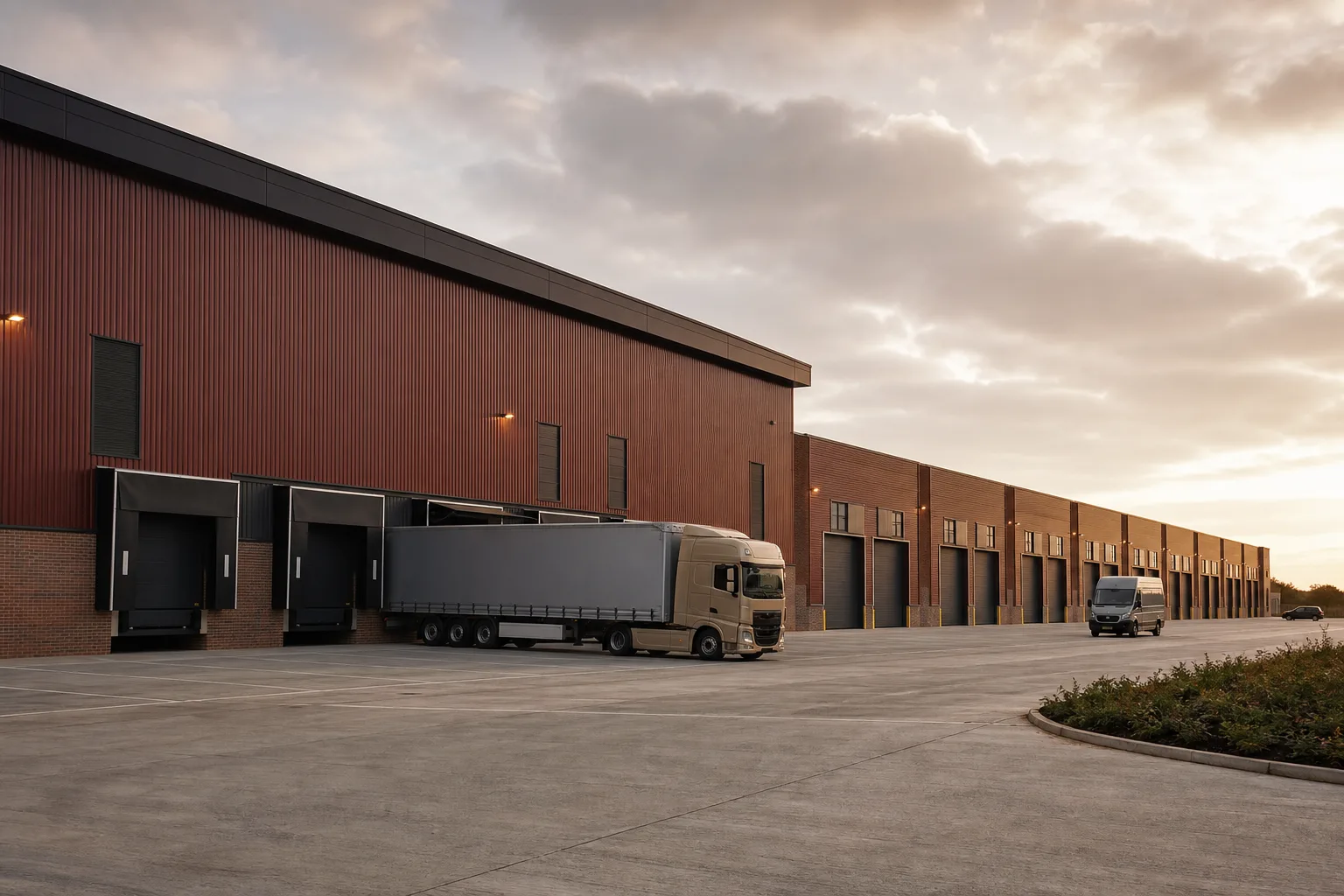
Industrial Property Finance in Blyth
Funding for industrial units, warehouses and multi-let estates in Blyth: commercial mortgages, acquisition finance, bridging, development, mezzanine and long-term debt.

Looking for funding on an industrial unit in Blyth? Blyth sits in Northumberland, within the North East industrial and logistics market. We are a finance arranger, not a lender: we arrange commercial mortgages and the full range of light industrial finance on Blyth property, from acquisition and bridging through development and mezzanine to long-term debt, across Northumberland.
Lenders underwrite a Blyth industrial deal on its own fundamentals first, the rent roll or the trading business, the tenants, the unit and the borrower, then test it against the wider market. Prime industrial and logistics rents in North East run to £8.50/sq ft (Allsop, Northern Industrial spotlight, Q1 2025), with prime equivalent yields around 6% (Allsop, Northern Industrial spotlight, Q1 2025). Prime rents in the region grew 3.6% over the year (Knight Frank, UK Logistics Market Dashboard, 12 months to Dec 2025).
Commercial mortgages on Blyth industrial units
A commercial mortgage is the core way to buy or refinance an industrial unit in Blyth. For investors, lenders size the loan against the rent: typically up to around 65 to 70 percent loan to value, tested so the net rental income covers the interest with a clear margin, with the tenancy schedule, the estimated rental value and the re-letting depth of the Blyth market all part of the assessment. For owner-occupiers buying their own premises the loan is underwritten on the trading business instead, its accounts and its debt service cover, and can reach around 70 to 80 percent for established firms. Terms run from 5 to 25 years. We place each facility with the lender that prices Blyth industrial property best across Northumberland.
Warehouses, multi-let estates and trade counters across Northumberland
Each property type is underwritten differently. We arrange finance for distribution and logistics warehouses, multi-let industrial estates, trade counters, workshops and light industrial units, hybrid and flex space, urban and last-mile logistics and open storage yards in Blyth and across Northumberland. A let distribution warehouse on a long lease to a single covenant, a fully let estate of small units with dozens of SME tenancies, and a vacant workshop bought at auction are credit-assessed in very different ways, and knowing which lender backs each format is the work we do before a deal reaches credit. Multi-let estates carry short leases that re-gear to market quickly, which lenders read as reversionary income, while distribution sheds and trade counters lean on the covenant strength and unexpired term of the tenant.
Finance we arrange in Blyth
- Industrial and logistics commercial mortgages
- Owner-occupier industrial mortgages
- Industrial and logistics acquisition finance
- Industrial bridging loans
- Industrial development and refurbishment finance
- Industrial and logistics refinance and equity release
- Industrial and logistics portfolio finance
- Mezzanine, equity and JV funding
How much you can borrow against Blyth industrial property
On an industrial investment in Blyth, a commercial mortgage usually reaches around 65 to 70 percent of value, so you would budget for equity of roughly a third of the price plus stamp duty and costs. The figure is driven by the quality of the income, the tenants, the unexpired lease terms and the condition of the unit, not the postcode. Vacant or part-let property is funded differently: bridging finance secures an auction purchase or a unit awaiting letting, typically to around 70 to 75 percent of value from around 0.75 percent per month, and development or refurbishment finance funds works to around 65 to 75 percent of cost, with mezzanine stretching the stack where the scheme supports it. Interest rates depend on the lender, the leverage and the income profile, so we quote them deal by deal rather than as a headline rate. We size the right facility, rate and equity requirement for your Blyth deal.
Where industrial property trades in Blyth
Blyth was once Europe's largest coal exporting port, shipping 5.5 million tons in 1930, and in 2000 it hosted the first two offshore wind turbines installed in UK waters. Blyth is served by A189 and A193, the kind of road access that drives occupier demand for industrial units and supports the rents an estate can sustain. Occupiers here draw staff and customers from across the town, from Cowpen, Newsham, Bebside and Cambois, the catchment a lender weighs when it considers re-letting risk. Planning applications for industrial use, including change of use within Class B2, B8 and E(g), are determined by Northumberland County Council.
Industrial demand signals in Blyth
As a local-economy signal, Blyth recorded 448 residential transactions in the last twelve months on HM Land Registry price paid data, at a median price of £140,000; that is housing-market context, not industrial volume, but it speaks to the depth of the local economy that fills small units. Nationally, industrial and logistics vacancy remains moderate at 7.08% (CBRE, UK Logistics Q4 2025, Q4 2025), against forecast rental growth of 2.7% (Savills, Big Shed Prospects 2026, 2026 forecast).
Blyth industrial market profile
- Planning authorityNorthumberland County Council
- Road accessA189, A193
- House sales (12m)448 · median £140,000
Location facts and Land Registry data. Market figures shown are national or North East-level, not Blyth-specific.
The North East industrial and logistics market
Blyth is a smaller or emerging industrial market within North East, where the strength of the individual unit, its occupier evidence and the borrower carry the financing. Lenders look closely at re-letting depth and the exit, and bridging or development finance often fits better than a long-term commercial mortgage until the income is proven.
The North East is the most affordable major UK industrial region but is supply-constrained, with high build costs and expensive development finance choking off speculative schemes and keeping vacancy tight.
Affordability and tight supply keep the North East attractive to occupiers, and Knight Frank forecasts among the strongest regional rental growth in 2026 as new development stays scarce.
Market commentary and figures for North East are drawn from Allsop (Northern Industrial spotlight, Q1 2025); Knight Frank (LOGIC North East and UK Logistics Market Dashboard, 2025 to 2026); Cushman and Wakefield (Prime industrial rents, Q3 2025).
Sources and methodology
Industrial and logistics market figures are published nationally or regionally, not per town, so the rents, vacancy and yields on this page are presented as context for a Blyth appraisal and attributed to their sources (Allsop, Northern Industrial spotlight; CBRE, UK Logistics Q4 2025). Town-level facts are different: road access, the named estates, the planning authority, and the Land Registry housing-transaction data are genuinely local and sourced. We do not publish a Blyth-specific rent or yield as if it were measured. Nationally, UK big-box logistics take-up reached 25.6m sq ft in 2025 (CBRE, UK Logistics Q4 2025, 2025).
Industrial property finance in Blyth: common questions
Can you get a mortgage on an industrial unit in Blyth?
Yes. An industrial unit in Blyth is financed with a commercial mortgage rather than a residential loan. We arrange them for owner-occupiers buying their own premises, underwritten on the trading business, and for investors buying let units or estates, underwritten on the rent, typically to around 65 to 70 percent loan to value, and we place each one with a lender that backs the sector.
How much deposit do I need to buy an industrial unit in Blyth?
Most lenders advance around 65 to 70 percent of value on a let Blyth industrial investment, so plan for equity of roughly 30 to 35 percent of the price plus costs. Established owner-occupiers can often reach around 70 to 80 percent against their own premises. A vacant or short-income unit is funded on more cautious terms, often via a bridge first.
What are Blyth industrial finance rates and terms?
Rates depend on the lender, the leverage and the income profile of the property, so we quote them deal by deal rather than as a headline. Indicatively, term debt starts from around 6 percent, development finance from around 8 percent and bridging from around 0.75 percent per month, with terms from months on a bridge to 25 years on a commercial mortgage. For market context, prime industrial and logistics rents in North East run to £8.50/sq ft (Allsop, Northern Industrial spotlight, Q1 2025).
Can I fund a multi-let estate or a yard in Blyth?
Yes. Multi-let industrial estates are funded on the rent roll, with the lender testing interest cover against the net income and the manager's ability to run dozens of small tenancies; open storage and industrial yards are funded against the land with more conservative leverage, typically around 55 to 65 percent. We arrange both routes across Northumberland.
Funding an industrial unit in Blyth?
Send us the outline and we will come back with a view on fundability and likely terms within one working day.