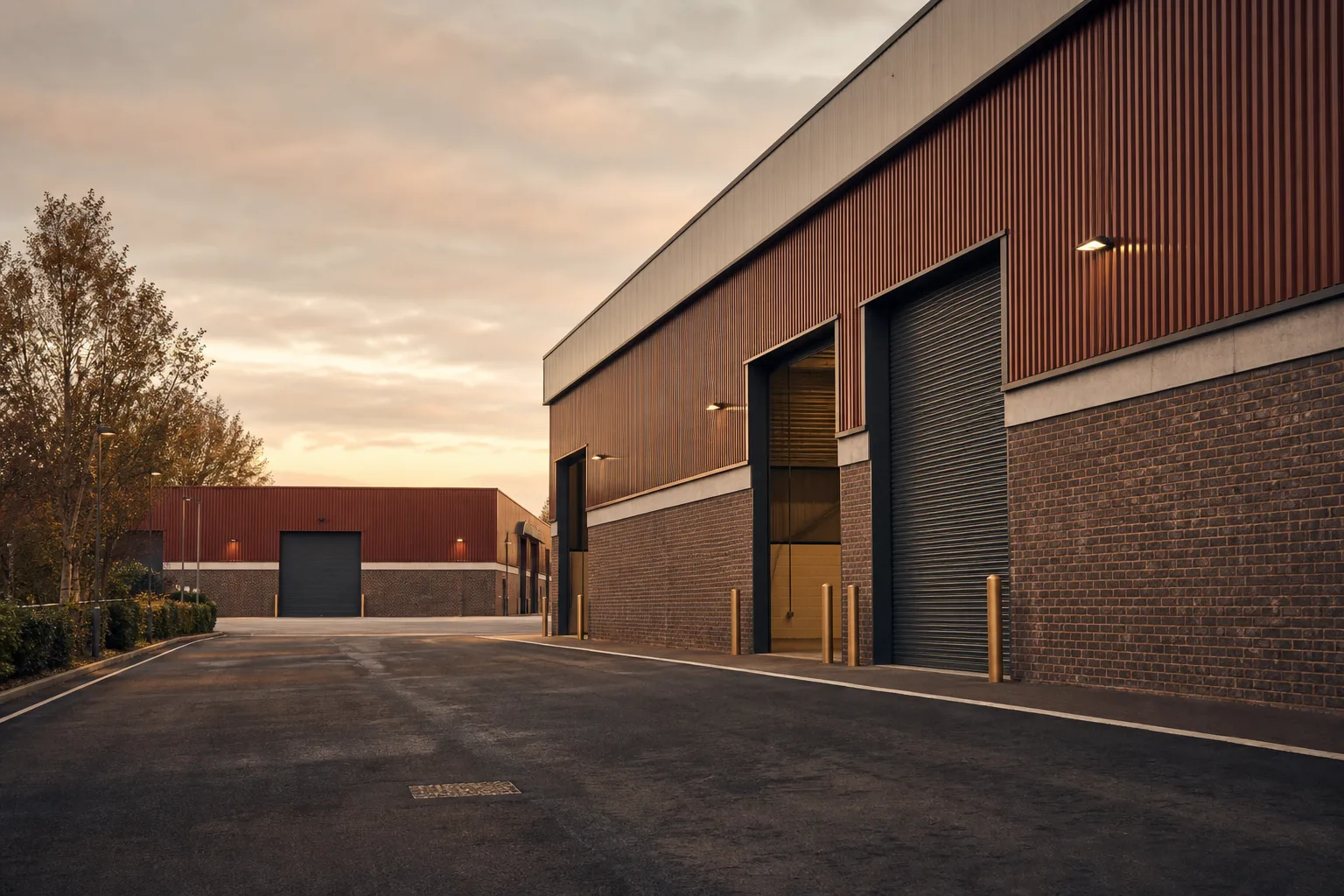
What is last-mile logistics property?
Last-mile logistics property is the real estate that handles the final, most expensive leg of a delivery: the journey from a local depot to the customer's front

Key takeaways
- Last-mile logistics property is the real estate that handles the final leg of delivery, from a local depot to the customer's door, so it sits close to where people live.
- Proximity to population is the whole point, which makes well-located urban sites scarce and valuable; the asset is priced on location more than on building quality.
- Building types range from converted industrial units and multi-let estates to purpose-built parcel hubs, often with cross-docked or E-shaped layouts to speed van loading.
- Last-mile assets price keenly because of structural demand and tight supply; UK logistics vacancy was 7.08 percent (CBRE, Q4 2025) and prime multi-let rent £15.55/sq ft (Colliers, H2 2025).
- We arrange finance on last-mile and urban logistics property as a broker and introducer, not a lender; nothing here is advice or an offer of finance.
Last-mile logistics property is the real estate that handles the final, most expensive leg of a delivery: the journey from a local depot to the customer's front door. Everything upstream, the port, the national distribution centre, the regional hub, exists to feed this last step, and the last step is the one the customer actually sees. The property that supports it has to sit close to where people live, which makes the right buildings in the right places genuinely scarce, and that scarcity is the heart of the investment case.
This guide explains what last-mile logistics property is and why it matters, the building types that serve it, how it relates to urban logistics, the supply problem that defines the market, and how these assets are valued and financed. We arrange the debt behind urban and last-mile logistics property as a broker and introducer; we are not a lender, and nothing here is financial, tax or legal advice. It sits within our wider distribution warehouse cluster, at the small, dense, urban end of the range.
What is meant by last-mile logistics?
Last-mile logistics is the final stage of getting a product to the person who ordered it, from the last local facility to the doorstep. It is called the last mile because it is the shortest leg of the journey in distance but, perversely, often the most costly and complex per item, since a single van drops many small orders across a scattered set of addresses rather than moving one big load between two points. The growth of online retail has made the last mile the part of the supply chain that customers judge a retailer by, on speed and reliability.
Last-mile logistics property is the building stock that makes this possible: the local depots, parcel hubs and urban units from which vans and couriers are loaded and dispatched. Because the defining requirement is to be near the customer, these buildings are pulled toward towns and cities, onto land that is in demand for many other uses, which is exactly why the right sites are hard to find and command a premium. The asset is, in a real sense, a piece of well-placed urban land with a shed on it.
Why does last-mile property matter so much now?
The shift to online ordering changed where logistics demand sits. As more goods are bought for home delivery, the network has had to push depots closer to consumers to keep delivery times short and costs manageable, which has moved demand from cheap, remote big-box land toward expensive, scarce urban land. Last-mile property is the real estate expression of that shift, and it has become one of the most sought-after corners of the industrial market precisely because the buildings sit where land is most contested.
Demand has held up across the wider logistics market, which supports the last-mile case from above. UK big-box take-up reached 25.6m sq ft in 2025, up 22 percent (CBRE, Q4 2025), and UK industrial and logistics investment hit £10.5bn, up 27 percent (Knight Frank, 2025), with rental growth forecast at 2.7 percent for 2026 (Savills, Big Shed Prospects 2026). The same forces, e-commerce, supply-chain resilience and a thin development pipeline, that drive the big sheds drive the small urban ones, but with an extra twist: there is far less developable urban land, so last-mile supply is tighter still.
What building types serve the last mile?
There is no single last-mile building. At the simplest end, ordinary industrial and warehouse units, often older multi-let stock on estates inside or near towns, are pressed into last-mile service because their location is right even if their specification is dated. At the more sophisticated end sit purpose-built parcel hubs designed around fast van loading, with layouts that let vehicles enter, load and leave with minimal manoeuvring. The common requirement across all of them is location: a building that is perfect in every respect but in the wrong place cannot serve the last mile.
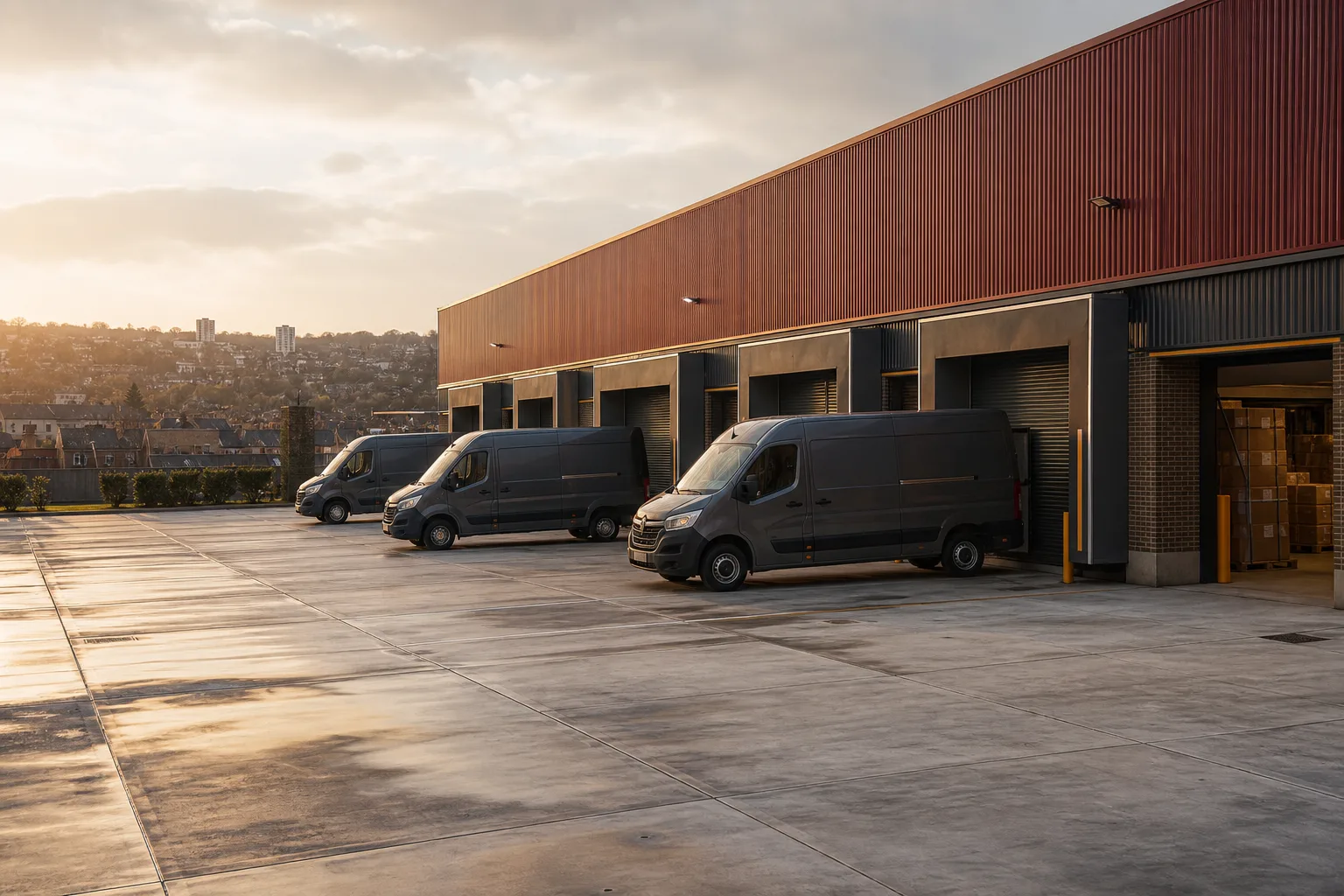
Specialist layouts have emerged to handle the particular flow of last-mile operations, which is many small outbound loads onto vans rather than a few large loads onto lorries. Cross-docked units, where goods pass straight through from one side to the other, and E-shaped or T-shaped urban units designed to maximise loading frontage, both speed the turnaround of a fleet of delivery vehicles. Yard space for vans, secure parking and good access at the times vans come and go all matter more than the deep HGV yards a big-box distribution centre needs.
| Type | What it is | Why it serves the last mile |
|---|---|---|
| Repurposed multi-let units | Older industrial units near towns | Right location, even if dated specification |
| Purpose-built parcel hubs | Modern depots designed for vans | Fast van loading and turnaround |
| Cross-docked units | Goods pass straight through | Speeds the flow onto delivery vehicles |
| E-shaped or T-shaped urban units | Layouts maximising loading frontage | More doors per site for van fleets |
Much of this stock overlaps with multi-let industrial estates, which is why investors in multi-let estates have benefited from last-mile demand even where the units were never marketed as logistics. A unit that simply happens to sit in the right place, with reasonable access and a lease that allows B8 distribution use, can let to a last-mile operator at a premium to its traditional industrial value. Our guide to big-box versus multi-let covers how this end of the market behaves.
How does last-mile relate to urban logistics?
Last-mile and urban logistics overlap heavily but are not quite the same thing. Urban logistics is the broader category: logistics property located in or close to urban areas, serving the city it sits in, whatever the specific function. Last-mile logistics is a use within that category, the final-delivery function, which by definition needs urban or near-urban property. So most last-mile property is urban logistics property, but not all urban logistics property is last-mile; an urban unit might serve regional distribution or trade supply rather than doorstep delivery.
The distinction matters for an investor because the demand drivers differ slightly. Urban logistics demand comes from everything that needs to be near a city, including last-mile delivery but also trade counters, service businesses and regional distribution. Last-mile demand comes specifically from the growth of home delivery. A building that can serve both is more resilient than one that depends on a single operator's delivery model, which is one reason flexible, well-located multi-let units have proved such durable assets.
Our companion guide to urban logistics property takes the wider category in full. The practical point for finance is that both are priced on location and supply scarcity, so both reward careful site analysis over building specification, which changes how lenders and valuers approach them.
What is the supply problem in last-mile property?
Last-mile property is defined by a supply problem. The land that makes a good last-mile site, close to dense population, with reasonable access, is exactly the land that towns and cities want for housing, offices and other higher-value or politically favoured uses. As a result, urban industrial land has been steadily lost over decades, and new last-mile development competes against alternatives that often pay more or face less planning resistance. The buildings that exist are therefore scarce, and the scarcity is structural rather than cyclical.
That scarcity supports both rents and values. With UK logistics vacancy at 7.08 percent (CBRE, Q4 2025) and a thin development pipeline, well-located urban stock lets readily and reprices upward as operators compete for the limited supply. For owners it is a benign position; for occupiers it means paying for location; and for new entrants it means that creating supply, by developing or converting urban sites, is difficult and expensive, which is part of why the existing stock holds its value.
The supply constraint also shapes strategy. Because you cannot easily build your way into the last-mile market, investors more often buy and reposition existing urban units, upgrading a tired but well-located building to last-mile standard, than develop from scratch. That repositioning play, buy in a good location, improve the building, re-let or refinance at a keener value, is a recurring theme in this part of the market, and it is one that the right finance structure is built to support.
How is last-mile logistics property valued and financed?
Valuation follows the same method as the rest of the sector, capitalising a market rent at a market yield, but with location doing more of the work. Because the scarcest, best-placed last-mile sites attract the keenest yields, the gap between a prime urban unit and a secondary one can be wide even where the buildings are similar, with the difference reflecting how easily each would re-let. An investor reads a last-mile asset first as a location, then as a building, and a valuer does the same.
On finance, a let last-mile unit is bought with an investment commercial mortgage, sized against the rent through an interest cover test, while an operator buying their own depot uses an owner-occupier mortgage sized on the business. Where the play is to reposition a tired but well-located unit, the route often runs through acquisition finance or a bridge to fund the purchase and works, then a refinance onto term debt once the building is upgraded and let. Our distribution warehouse finance guide works through these routes.
Most lending against last-mile property is unregulated; where a loan would be secured on a borrower's home or otherwise falls within the FCA perimeter, different rules apply and the matter is referred to an authorised firm. Because these assets turn on location and lease, we spend most of the underwriting conversation on exactly those points when arranging terms across our panel of lenders.
What is last-mile logistics property?: common questions
What is meant by last-mile logistics?
Last-mile logistics is the final stage of delivery, from the last local facility to the customer's door. It is the shortest leg of a product's journey but often the most expensive per item, because a single vehicle drops many small orders across scattered addresses rather than moving one large load. Last-mile logistics property is the building stock, the local depots and urban units, that makes this final delivery possible, and it has to sit close to where people live.
What are last-mile logistics assets?
Last-mile logistics assets are the urban and near-urban properties used to handle final delivery: local distribution depots, parcel hubs and well-located industrial or multi-let units from which vans and couriers are loaded. Their defining feature is proximity to population rather than building specification, so the value sits heavily in the location. They are valued and financed like other industrial property, by capitalising the rent, but location scarcity drives keener yields on the best sites.
What is the main problem with last-mile logistics?
The main problem for the property side is supply. Good last-mile sites need to be close to dense population, which is exactly the land that towns want for housing and other higher-value uses, so urban industrial land has been steadily lost and new supply is hard to create. Operationally, the last mile is also the most expensive part of delivery, because spreading one load across many doorsteps is far less efficient than moving goods between two large sites.
Who owns last-mile logistics property in the UK?
Ownership ranges from large institutional and listed investors focused on urban logistics through to property companies and private investors who hold well-located industrial and multi-let estates that happen to serve last-mile operators. Because the stock overlaps so much with ordinary urban industrial property, much of it is owned by investors who never set out to buy last-mile assets specifically but benefit from the demand. The buildings are then let to delivery and logistics operators on commercial leases.
Ready to talk about a real deal?
Send us the deal and we will come back with a view on fundability and likely terms within one working day.