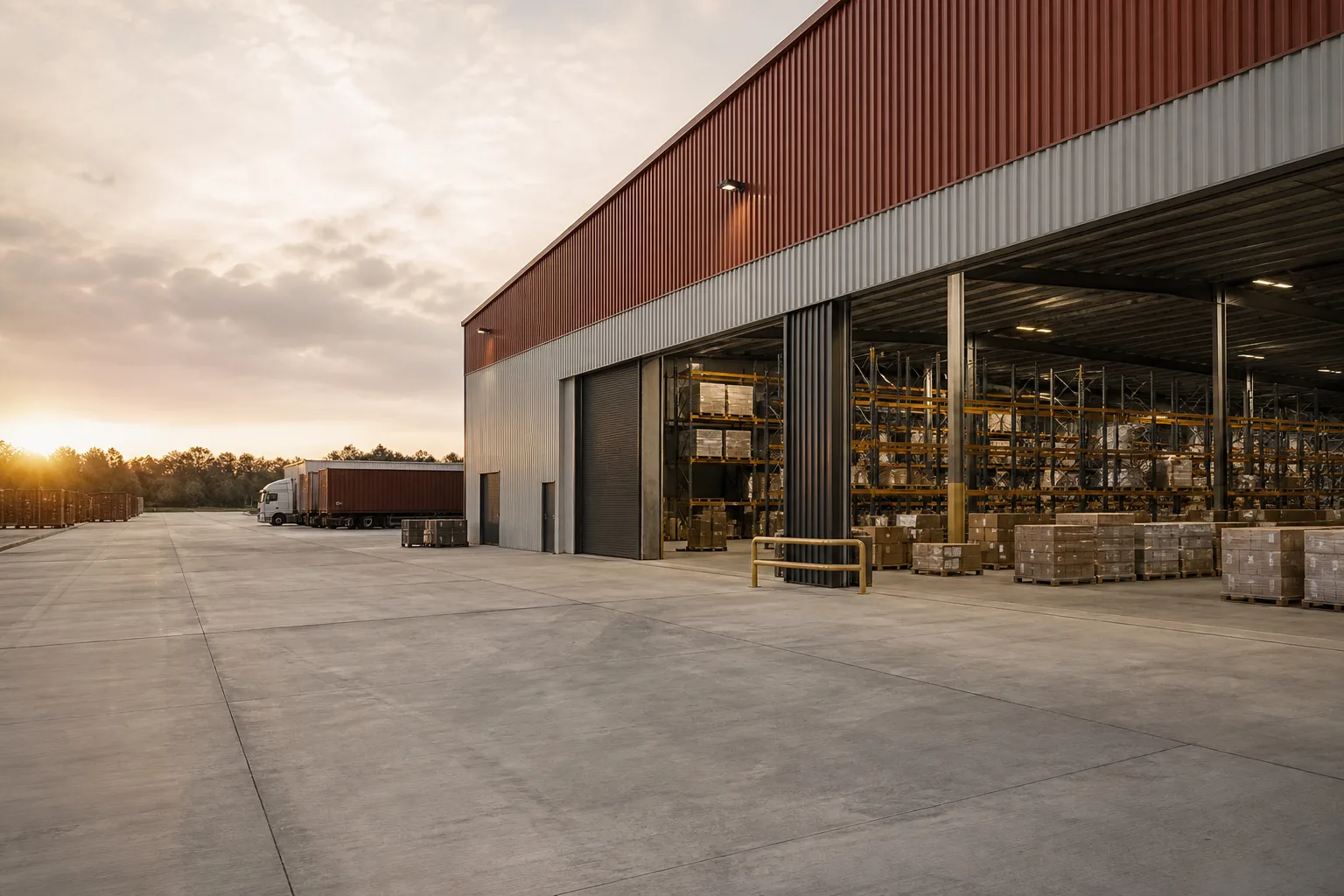
What is a distribution warehouse?
A distribution warehouse is a building whose job is to receive goods, sort them and send them out again as fast as possible, rather than to store them for long

Key takeaways
- A distribution warehouse is a building designed to move goods through quickly rather than store them, sorting and dispatching stock to shops, businesses or customers.
- It differs from a general warehouse, which holds inventory for longer; a distribution warehouse is built around throughput, with many loading doors, high eaves and large yards.
- UK distribution sheds run from regional big-box units of 100,000 sq ft and up to small last-mile depots, with big-box take-up reaching 25.6m sq ft in 2025 (CBRE, Q4 2025).
- As an asset they price keenly: prime UK distribution and logistics yields stood at 5.00 percent in January 2026 (Knight Frank, UK Logistics Market Dashboard).
- We arrange the finance behind these buildings as a broker and introducer, not a lender; nothing here is advice or an offer of finance.
A distribution warehouse is a building whose job is to receive goods, sort them and send them out again as fast as possible, rather than to store them for long periods. It is the physical hinge of the modern supply chain: stock arrives from factories, ports or suppliers, is broken down, consolidated and routed, and leaves for shops, other warehouses or the customer's door. The clue is in the name. A general warehouse is about holding goods; a distribution warehouse is about moving them, and almost everything about how it is built follows from that single difference.
This guide explains what a distribution warehouse is and what it does, how it differs from a general warehouse, the main types you find across the UK from regional big-box sheds down to last-mile depots, what makes the buildings work physically, what they cost and how they are valued, and how owner-occupiers and investors finance them. We arrange the debt behind logistics and distribution property as a broker and introducer; we are not a lender, and nothing here is financial, tax or legal advice.
What does a distribution warehouse do?
A distribution warehouse exists to keep goods flowing. Stock arrives in bulk at one side of the building through goods-in doors, is checked, recorded and put away or staged, then picked, packed, consolidated and dispatched through goods-out doors on the other side. The best distribution buildings barely store anything at all: stock turns over in days or hours, and the floor is dominated by sortation, conveyor lines, marshalling areas and dock doors rather than by deep static racking. The measure of a distribution warehouse is throughput, the volume of goods it can move per day, not the volume it can hold.
That operational purpose makes the distribution warehouse the node where a supply chain becomes a delivery network. A national retailer might run a single distribution warehouse that receives from hundreds of suppliers and replenishes a whole region of stores overnight; a parcel carrier runs distribution hubs that sort millions of items between trunk routes and local rounds. The building is, in effect, a machine for re-sorting goods between an inbound pattern and an outbound one, and its location, road access and door count matter more than almost any other feature.
What is the difference between a general warehouse and a distribution warehouse?
The cleanest way to separate the two is by what they optimise for. A general warehouse, sometimes called a storage warehouse, is designed to hold inventory securely and cheaply for weeks or months, so it maximises cubic storage with tall racking, deep aisles and a relatively modest number of loading doors. A distribution warehouse is designed for fast turnover, so it maximises the rate at which goods can enter and leave, with many dock-level doors, generous yards for trailers, cross-docking layouts and often automation. One is built around space; the other is built around speed.
Those priorities show up in the building specification. Distribution sheds carry higher eaves, a higher ratio of doors to floor area, larger service yards with deep trailer parking and HGV circulation, and stronger power supplies to run conveyors and chargers. A general warehouse can tolerate a tighter site and fewer doors because lorries call less often. The same steel-clad box can serve either purpose, but a building optimised for distribution and one optimised for storage are rarely identical, and the differences are exactly what a valuer and a lender look at.
| Feature | General (storage) warehouse | Distribution warehouse |
|---|---|---|
| Primary purpose | Hold inventory for longer periods | Move goods through quickly |
| Key metric | Cubic storage capacity | Throughput per day |
| Loading doors | Fewer | Many dock-level doors |
| Yard and trailer parking | Modest | Large, with HGV circulation |
| Typical fit-out | Deep static racking | Sortation, conveyors, cross-dock |
In practice the line blurs. Many buildings do both, storing some lines while distributing others, and a single occupier may run storage at the back and dispatch at the front. The label that matters for finance is the lawful planning use rather than the marketing description: storage and distribution both sit in planning use class B8 in England, which our guide to the industrial use classes explains, so the two uses are usually interchangeable in planning terms even when they are very different operations. We compare the two definitions in more depth in our distribution centre versus warehouse guide.
What are the main types of distribution warehouse in the UK?
UK distribution property runs across a clear size range, and the type matters because each end has a different occupier market, a different price and a different financing pattern. At the top sit big-box regional distribution centres, single large sheds from roughly 100,000 sq ft to well over a million, sited on motorway junctions and let to retailers, manufacturers and third-party logistics operators on long leases. In the middle sit mid-box and multi-let logistics units, typically 20,000 to 100,000 sq ft, serving regional distribution and a deep base of smaller occupiers, which our big-box versus multi-let comparison covers in detail.
At the smaller, denser end sit urban and last-mile facilities: distribution depots placed close to where people live so that the final leg of delivery is short and fast. These range from converted industrial units to purpose-built parcel hubs, and they trade on proximity to population rather than on cheap motorway land. Our guides to urban logistics and last-mile logistics property explain why this end of the market has grown so fast.
A separate category cuts across the size range: temperature-controlled or cold storage distribution, where the building holds and moves chilled or frozen goods. These are specialist, capital-intensive assets with their own financing pattern, covered in our cold storage finance guide. The common thread across every type is that a distribution warehouse is priced and financed primarily on its location, its building specification and the strength of the occupier, not on the bare square footage.
What makes a distribution warehouse work as a building?
Eaves height comes first. Modern distribution requires clear internal height, often 12 to 18 metres or more in big-box units, both to stack goods and to install mezzanines and automation; height is one of the features occupiers now pay rent for. Floor loading and flatness follow, because forklifts, racking and automated systems need a strong, level slab. Then come the doors: a distribution warehouse lives or dies on its dock-level loading doors and level-access doors, and the ratio of doors to floor area is a direct measure of how much throughput the building can handle.
Outside the walls, the yard is half the asset. Deep service yards let articulated lorries manoeuvre, reverse onto docks and park while waiting, and a shallow yard quietly caps how a building can be used however good the shed itself is. Power supply matters more every year as automation, electric vehicle charging and, increasingly, refrigeration all draw heavily on the grid connection. Finally, energy performance has become a building issue rather than a paperwork one: the current minimum to let commercial property in England is EPC band E, and the government has consulted on a higher trajectory, so a poor rating now affects both lettability and value.

What does a distribution warehouse cost to buy or build?
There is no single figure, because cost depends on size, location and specification, but sourced benchmarks give a starting point. On build cost, large distribution boxes come in comparatively cheaply per square foot precisely because a big rectangle of space spreads its expensive elements over a vast floor: typical UK construction for large sheds runs at roughly £540 to £660 per sq m, against £1,100 to £1,220 per sq m for smaller warehouses and stores (Costmodelling, April 2026), excluding land, fees and VAT. Our construction costs guide breaks the build down in full.
On rent, which drives both occupier cost and investment value, prime big-box rent stood at £11.90 per sq ft in the second half of 2025, up 5.2 percent, while prime mid-box and multi-let rent reached £15.55 per sq ft, up 4.0 percent (Colliers, H2 2025), with the UK average prime rent at £12.55 per sq ft (Savills, 2025). Regional spread is wide: South East big-box prime reached £27.50 per sq ft against £11.75 per sq ft in the North West at Warrington (CBRE, Q4 2025). The location, not the building type, drives most of that gap.
For a purchase, the price follows the rent through the yield. A distribution warehouse let at a market rent and bought at a market yield is valued by capitalising that rent, so the same building is worth far more in a supply-starved location with strong rental growth than in a weak one. Our guide to industrial property yields explains how rent and yield combine to set the price, which is the figure that then drives how much debt a purchase can support.
How do investors and occupiers finance a distribution warehouse?
Most distribution warehouses are bought with a commercial mortgage. A trading business buying its own depot uses an owner-occupier mortgage, sized against the affordability of the business; an investor buying a let shed uses an investment commercial mortgage, sized against the rent through an interest cover test. Either way the building is the security, and the lender looks hard at the planning use, the lease, the tenant covenant and the energy rating before agreeing terms. Our commercial mortgages page sets out how term debt on these assets is typically built.
Where the timing or the planning position is not yet settled, other tools come in. A buyer acquiring a vacant or part-let shed, or one needing works to reach a lettable energy rating, may use acquisition finance or a bridge before refinancing onto a term loan once the income is in place. A developer building a new distribution unit uses development finance, drawn in stages against construction. We cover the full route in our guide to financing a distribution warehouse.
Most lending against commercial distribution property is unregulated. Where a loan would be secured on a borrower's home, or otherwise falls within the FCA perimeter, different rules apply and the matter is referred to an authorised firm; we flag that at the outset. Our role is to model the numbers across a panel of lenders and arrange the right structure, not to lend.
What is a distribution warehouse?: common questions
What does a distribution warehouse do?
A distribution warehouse receives goods in bulk, sorts and consolidates them, and dispatches them onward to shops, businesses or customers as quickly as possible. Its purpose is to move goods through the supply chain rather than to store them for long periods, which is why it is built around loading doors, yards and throughput rather than around deep static storage. Many also hold some stock, but the dominant activity is the receive, sort and dispatch loop.
What is the difference between a general warehouse and a distribution warehouse?
A general warehouse is optimised to store inventory cheaply for longer periods, with tall racking and fewer loading doors. A distribution warehouse is optimised for fast turnover, with many dock-level doors, large trailer yards, cross-docking and often automation, so goods spend hours or days inside rather than weeks. Both usually sit in the same planning use class, B8 in England, but the buildings are specified differently because one is built around storage capacity and the other around throughput.
What are the three types of warehouses?
A common grouping is storage warehouses, which hold inventory; distribution warehouses, which move goods through quickly; and fulfilment or e-commerce warehouses, which pick and pack individual customer orders. In UK property terms the more useful split is by size and location: big-box regional distribution centres, mid-box and multi-let logistics units, and urban or last-mile depots close to population. Temperature-controlled cold storage sits across that range as a specialist category.
What are the four types of distribution?
In supply-chain terms, distribution is often described in four channels: intensive distribution, getting a product into as many outlets as possible; selective distribution, through a limited set of outlets; exclusive distribution, through a single outlet or region; and direct distribution, straight from producer to customer. A distribution warehouse can serve any of these models. The property question is separate: it is about the building that physically handles the goods, whichever distribution strategy the occupier runs.
Ready to talk about a real deal?
Send us the deal and we will come back with a view on fundability and likely terms within one working day.